Exemption Forms, Effective Dates, and Renewal Rules
Built from official state-agency sources · desk review 2026-08-26
Why filing a form is only one step: approval timing, expiration, revocation, and policy-cycle rules can all change the result.
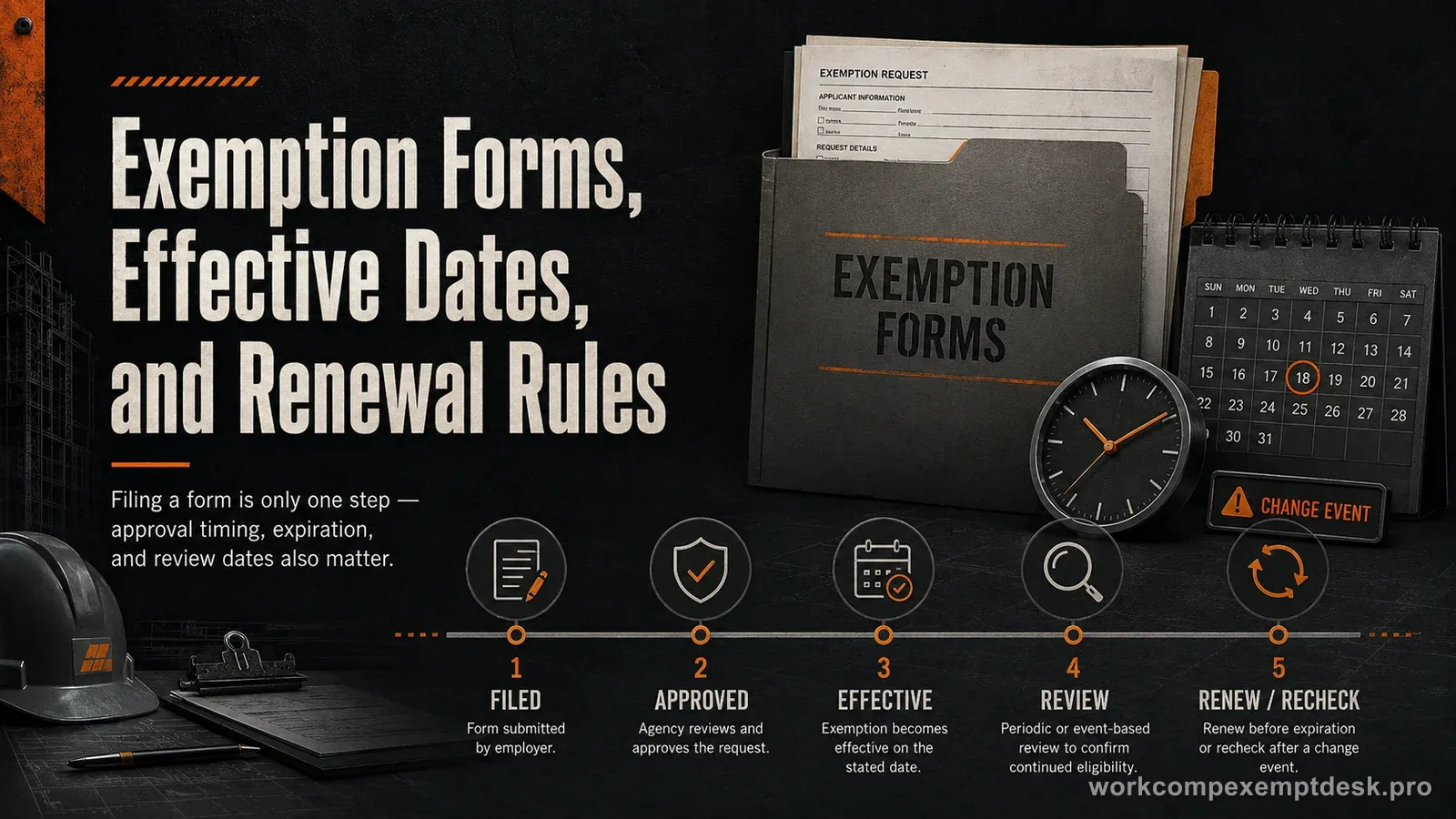
A form is not necessarily effective when it is signed, and an exemption is not necessarily permanent. The controlling rule may depend on agency approval, carrier receipt, a policy period, a fixed expiration date, or continued eligibility facts.
Facts to lock down before relying on an exemption
- Record who must receive the form: agency, carrier, licensing board, or employer
- Identify the event that makes the filing effective
- Record any fixed expiration or renewal window
- Check revocation, withdrawal, cancellation, and ownership-change rules
- Set reminders from the actual rule, not a generic annual calendar
Owners often focus on getting the right form and overlook the timing rule attached to it. That can create a dangerous gap: the form is signed, but the election is not effective yet; the certificate exists, but it expired; or the record has no fixed expiration, yet the owner no longer satisfies the eligibility conditions. A complete filing review tracks the document, the effective event, the duration, and the change events that terminate or require a new election.
Signing the form and becoming exempt can be two different dates
Some systems make an election effective only after a particular recipient receives it. Illinois says a qualifying corporate officer's withdrawal is effective when the carrier receives the written notice. Georgia's WC-10 procedure also ties effectiveness to filing with the insurer, or in a limited owner-only situation with the Board. Those details matter if an injury occurs during the gap between signature and receipt.
The practical control is simple: do not record only the signature date. Save evidence of submission and, where available, receipt, approval, or carrier endorsement. The effective-date field in the compliance file should be based on the official rule, not inferred from when the owner completed the paperwork.
Fixed-term certificates require a true expiration calendar
Florida construction exemptions are valid for two years unless revoked earlier. That creates a concrete renewal problem: a certificate can look current in a shared drive while its legal period has ended. The business needs the exact expiration date, not just the year of filing.
If multiple owners have separate exemptions, track each one separately. Different filing dates can produce different expiration dates. A single company-level reminder can therefore be insufficient when officers or members entered the exemption system at different times.
SOURCE CONTEXT: Florida construction exemptions use a two-year validity period.
Open-ended elections still need change-event monitoring
An election without a fixed annual expiration is not the same as a permanent exemption regardless of facts. Florida non-construction exemptions can remain valid until voluntary or agency revocation. California qualifying owner waivers under Labor Code section 3352 remain in effect until written withdrawal. But the owner still needs to satisfy the conditions that made the election available.
That means the compliance calendar must include ownership, role, and staffing events in addition to expiration dates. A waiver that has no printed expiry can become a poor basis for reliance if the person stops being the qualifying owner, the entity changes, or the business moves into a different regulatory setting.
Policy-cycle rules can restrict when a coverage choice changes
Some owner choices operate through the insurance policy rather than a standalone state certificate. Pennsylvania's SWIF guidance, for example, treats executive-officer elections within the policy framework and states that the officer coverage choice cannot be changed during the policy term. The timing question therefore becomes connected to renewal and underwriting, not just a state filing portal.
Carrier-controlled elections should be reviewed with the declaration page, endorsements, and renewal documents. An owner may believe an exclusion was requested while the issued policy still includes the owner. The policy record—not the owner's intent—controls what the insurer actually wrote.
Revocation and withdrawal deserve the same attention as initial filing
A business can outgrow an exemption, voluntarily restore owner coverage, or have a state revoke a record. The research file should therefore capture how the election ends. If the agency provides a revocation process or the carrier requires a written withdrawal, save that rule alongside the initial application instructions.
This is especially useful when an owner wants to re-enter coverage after taking on more operational work. The question is not merely whether the old exemption can be ignored. The business should document the formal step that restores coverage and the date on which the new status becomes effective.
Turn every exemption into a small lifecycle record
For each election, store the owner, entity, state, form name, submission recipient, signature date, submission date, effective date, expiration if any, renewal rule, withdrawal rule, and the eligibility facts that were true at filing. Add a source-check date and a link to the official agency page used to verify the rule.
That record is far more useful than a folder full of PDFs. It lets the business see which exemptions are approaching expiration, which rely on ownership percentages, which are carrier-controlled, and which must be revisited after a staffing or entity change. It also makes later audits much faster because the reasoning is preserved with the document.
Common questions
- Is filing the exemption form the last step?
- No. Approval timing, the effective date, an expiration or renewal cycle, revocation rules, and the policy period can each change the result after the form is submitted.
- Do workers' comp exemptions expire?
- It depends on the state. Some exemptions run for a fixed term and must be renewed; others continue until the owner revokes them or the underlying facts change.
- When does an owner election take effect?
- Many states tie the effective date to when the insurer or agency receives the notice, not the date the owner signs it. Check the specific rule before relying on the election.
Agency and statute pages behind this guide
The state-specific examples above draw on these links. Always confirm the current rule with the destination state before filing or changing coverage.