Sole Proprietor, Partner, LLC Member, or Corporate Officer?
Built from official state-agency sources · desk review 2026-08-26
The owner label changes the exemption question. Learn why entity type must be identified before looking for a form or certificate.
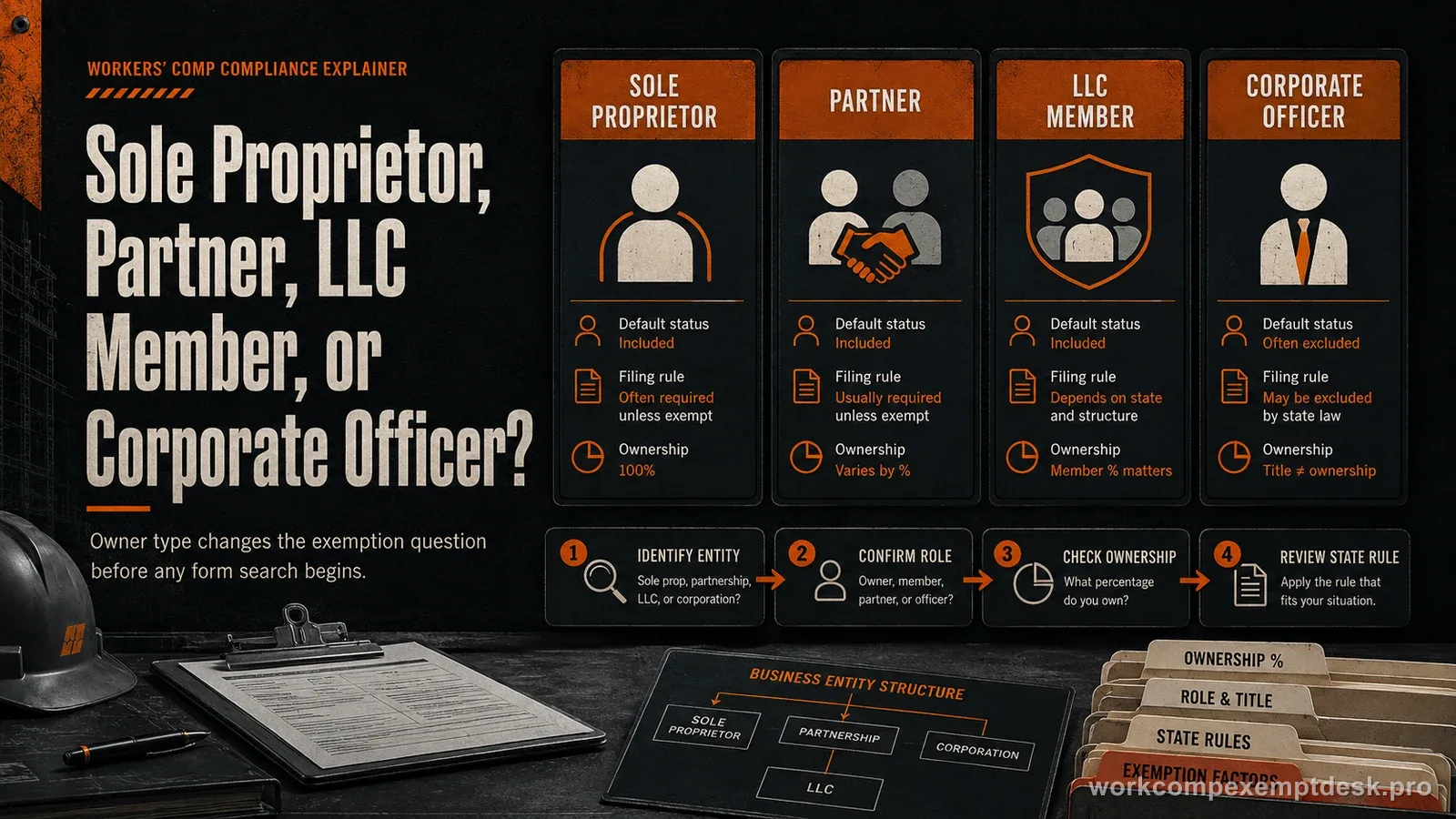
Do not research an owner exemption until you know whether the person is a sole proprietor, partner, LLC member or manager, corporate officer or director, and how much of the entity they own. States often assign different default coverage and opt-out rules to each category.
Facts to confirm before you rely on an exemption
- Write down the exact legal entity shown on formation records
- Identify each owner's role, title, ownership percentage, and whether the person performs services
- Check whether the state treats the category as an employee by default
- Look for category-specific ownership or management thresholds
- Re-run the analysis if ownership percentages, titles, or entity form change
The word “owner” is too broad for workers' compensation research. A sole proprietor is the business. A partner acts through a partnership. An LLC member may or may not be a managing member. A corporate officer can hold a title without owning enough stock to qualify for an exclusion. The state rule may turn on exactly those distinctions, which is why a form search based only on the word owner can send a business down the wrong path.
Sole proprietors often begin outside owner-employee treatment—but not always in every industry
A no-employee sole proprietor is commonly treated differently from an employee, but that observation is not a universal shortcut. Pennsylvania lists a sole proprietor with no other employees among excluded situations. California generally does not require a sole proprietor with no employees to buy a policy solely for the owner, yet contractor-license rules can create additional requirements for particular license classifications.
Florida shows why industry matters. In non-construction, sole proprietors are not treated as employees unless they elect coverage. Current Florida construction guidance, however, treats sole proprietors differently and reserves the owner-exemption application for qualifying corporate officers and LLC members. The entity label must therefore be paired with the industry before the result is reliable.
Partnership rules can differ from LLC rules even when the owners call each other partners
Business owners sometimes use “partner” conversationally for any co-owner. Workers' compensation law usually cares about the actual legal entity. A member of an LLC is not automatically analyzed as a partner merely because two people own the company together. California, for example, separately addresses general partners and managing LLC members in its owner-waiver statute.
Pennsylvania similarly distinguishes general partners from LLC members in its employer guidance. Both can have no-employee exclusion paths, but the legal categories are stated separately. The formation document and state registration record are therefore part of the workers' compensation research file, not just corporate paperwork kept elsewhere.
LLC member rules often turn on management role or ownership percentage
LLCs create some of the most state-specific owner questions. Florida construction and non-construction exemption rules require a qualifying LLC member to attest to at least 10% ownership, with different numerical limits on how many exemptions are permitted. California's waiver path refers to a managing member rather than every passive member.
Management role can matter as much as LLC ownership percentage
Arizona uses another model. A working LLC member owning less than 50% is treated as an employee, while a working member owning 50% or more may be covered through written carrier acceptance by endorsement. Texas has its own policy-manual treatment for members and managers. Those examples make clear that “LLC owners are exempt” is not a safe national statement.
Corporate title alone may not be enough
A president, treasurer, or director can be an employee for workers' compensation purposes unless a specific owner-officer rule applies. California's written-waiver provisions include ownership conditions. Pennsylvania's executive-officer exclusion path uses LIBC-509 and LIBC-513 and distinguishes categories such as qualifying S-corporation and C-corporation officers.
Georgia takes yet another approach: corporate officers count toward the three-person threshold, but up to five officers may reject their own personal coverage using WC-10. That rejection does not make the officer disappear from the threshold count. The rule depends on both the title and the statutory mechanism attached to that title.
Separate passive ownership from actually performing services
Some rules are written around a person who renders services, receives wages, or works for the entity. A passive investor can therefore present a different question from an owner who works on job sites every day. The business should record whether each owner performs services and how the person is paid, rather than assuming ownership percentage is the only relevant fact.
This distinction becomes especially important in family businesses where several relatives hold ownership interests but only some work for the company. It also matters when an investor becomes active or a working owner becomes passive. A change in day-to-day role can alter the factual basis for a prior exclusion even though the entity itself never changed.
Create an owner-status worksheet before touching the application
For each owner, capture legal entity, ownership percentage, formal title, management role, whether services are performed, whether wages or other compensation are paid, and the state in which the work occurs. Then compare that worksheet to the exact agency or statutory category. This is faster than repeatedly starting over with a vague “owner exemption” search.
Keep the worksheet with the exemption record. When ownership changes, the business can immediately see which facts must be rechecked. That is particularly useful for LLC membership transfers, stock issuances, officer changes, and entity conversions—the events most likely to make an old owner-election record look current even when its eligibility assumptions are no longer true.
Questions people ask
- Why does entity type change the workers' comp exemption question?
- States treat sole proprietors, partners, LLC members, and corporate officers differently. Some are outside employee status by default; others must file an election and may face ownership-percentage or head-count limits.
- Do I look for the form before or after identifying my owner type?
- After. Searching for a state's 'exemption form' before confirming whether you are a sole proprietor, partner, LLC member, or officer often leads the wrong owner to the wrong process.
- Does ownership percentage matter for an owner exemption?
- In many states, yes. Several require a minimum ownership share, or cap how many owners can be excluded per business, before an officer or LLC member can opt out.
Statutory and agency sources for this guide
These links support the state-specific examples in the article. Always recheck the destination state's current rule before filing or changing coverage.