LLC to Corporation? Recheck the Workers' Comp Exemption
Built from official state-agency sources · desk review 2026-08-26
An exemption tied to a member, partner, officer, policy, or business record may no longer fit after an entity conversion or ownership change.
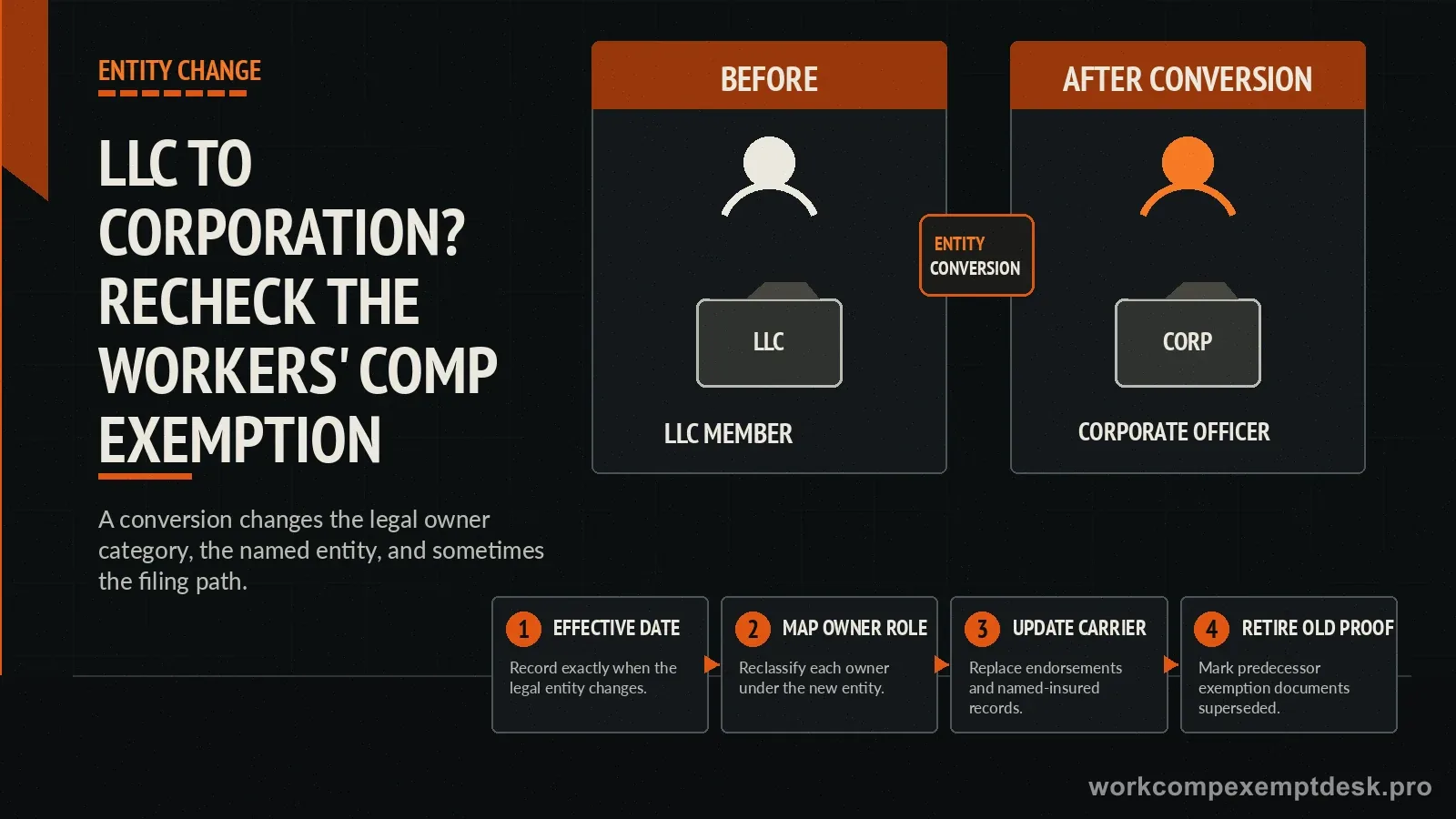
When a business converts from an LLC to a corporation, partnership to LLC, or otherwise changes ownership structure, assume the old owner-exemption analysis must be redone. The prior filing may have been tied to a different entity, owner category, ownership percentage, policy, or registration record.
Facts to confirm before you rely on an exemption
- Identify the exact effective date of the entity conversion
- Map every owner from the old legal category to the new one
- Recheck ownership-percentage and management-role requirements
- Update carrier, agency, licensing-board, and customer records
- Retire old exemption documents that name the predecessor entity
Entity conversion is usually handled as a corporate or tax project, but it can quietly break workers' compensation records. The person who was an LLC member yesterday may be a corporate officer today. A sole proprietor may become the shareholder of a new corporation. An old certificate can still be sitting in the vendor folder even though the named legal entity no longer performs the work. The fix is to treat conversion as a compliance event, not a paperwork rename.
The same person can move into a different legal owner category overnight
A sole proprietor who incorporates is no longer researching the sole-proprietor rule for new work performed by the corporation. The person may now be a shareholder and corporate officer. An LLC that elects corporate treatment for tax purposes may or may not have changed its state-law entity, so the business must distinguish a tax election from an actual legal conversion.
Workers' compensation analysis follows the legal facts that the state rule identifies. Record the new entity type, titles, ownership percentages, management roles, and whether each owner performs services. Then compare those facts to the destination state's current owner categories.
Ownership percentages can become newly important after conversion
Some states attach owner eligibility to a percentage. Florida construction exemptions require qualifying corporate officers and LLC members to meet ownership conditions. Arizona treats working LLC members and shareholders differently around the 50% ownership level. California's officer/director waiver provisions also contain ownership requirements.
A conversion that issues new shares or membership interests can therefore change exemption eligibility even when the same two people still “own the company” in ordinary conversation. The capitalization table belongs in the review file.
Carrier-based exclusions may need a new endorsement
Where the owner election operates through the workers' compensation policy, the new entity must be reflected in the insurance contract. California qualifying owner waivers are handled through the carrier. Illinois corporate-officer withdrawal becomes effective when the carrier receives written notice. Texas owner exclusions can also operate through policy endorsements.
Do not assume a carrier endorsement written for the old entity automatically attaches to the successor. Ask the carrier how the conversion affects named insureds, payroll treatment, owner inclusion or exclusion, and the effective date of any new endorsement.
State-issued certificates can be tied to the predecessor entity
A state certificate or exemption record normally identifies the business and the qualifying owner. If the contracting entity changes, forwarding the old certificate can create a mismatch even if the human owner is unchanged. Florida's exemption system, for example, ties the filing to qualifying officers or members of an active business entity.
Retain the predecessor document for historical records, but mark it as superseded for new work. The successor entity should complete the current filing or verification path required by the state rather than reusing a document that names a different company.
Move customer, licensing, and workers’ compensation records together after conversion
A vendor portal can continue showing an old workers' compensation exemption long after the legal conversion if nobody updates it. Contractor licenses, government permits, and certificates of insurance can have the same problem. The business should build workers' compensation into the entity-conversion closing checklist.
Update the legal name and entity number, workers' compensation policy, exemption or waiver record, contractor-license proof, W-9 or tax records, and customer vendor profiles together. That prevents the new entity from starting work under evidence that belongs to its predecessor.
After conversion, compare the first payroll report to the intended owner treatment. If an excluded owner is being included in payroll, or a newly covered officer is missing, resolve the mismatch with the carrier immediately. Then review the first new contract and confirm the entity name on the workers' compensation proof matches the entity signing the agreement.
This two-point audit catches most operational drift. It also creates a clear date at which the new workers' compensation status was verified, which is more reliable than assuming every system updated correctly on the conversion date.
Questions people ask
- Does converting my LLC to a corporation affect my workers' comp exemption?
- It can. An exemption tied to a member, partner, officer, policy, or business record may no longer fit after the entity type or ownership changes.
- Do I need to refile an owner exemption after an entity change?
- Often yes. The new entity may use a different owner category, form, or eligibility test, so the prior election may not carry over automatically.
- What else changes after an entity conversion?
- Ownership percentages, officer status, the policy, and the business's tax classification can all shift, and each can affect who is eligible for an owner exemption.
Statutory and agency sources for this guide
These links support the state-specific examples in the article. Always recheck the destination state's current rule before filing or changing coverage.