Your Workers' Comp Exemption Does Not Automatically Travel to Another State
Built from official state-agency sources · desk review 2026-08-26
Temporary work, remote employees, construction projects, and cross-border expansion can trigger a second state's coverage rules.
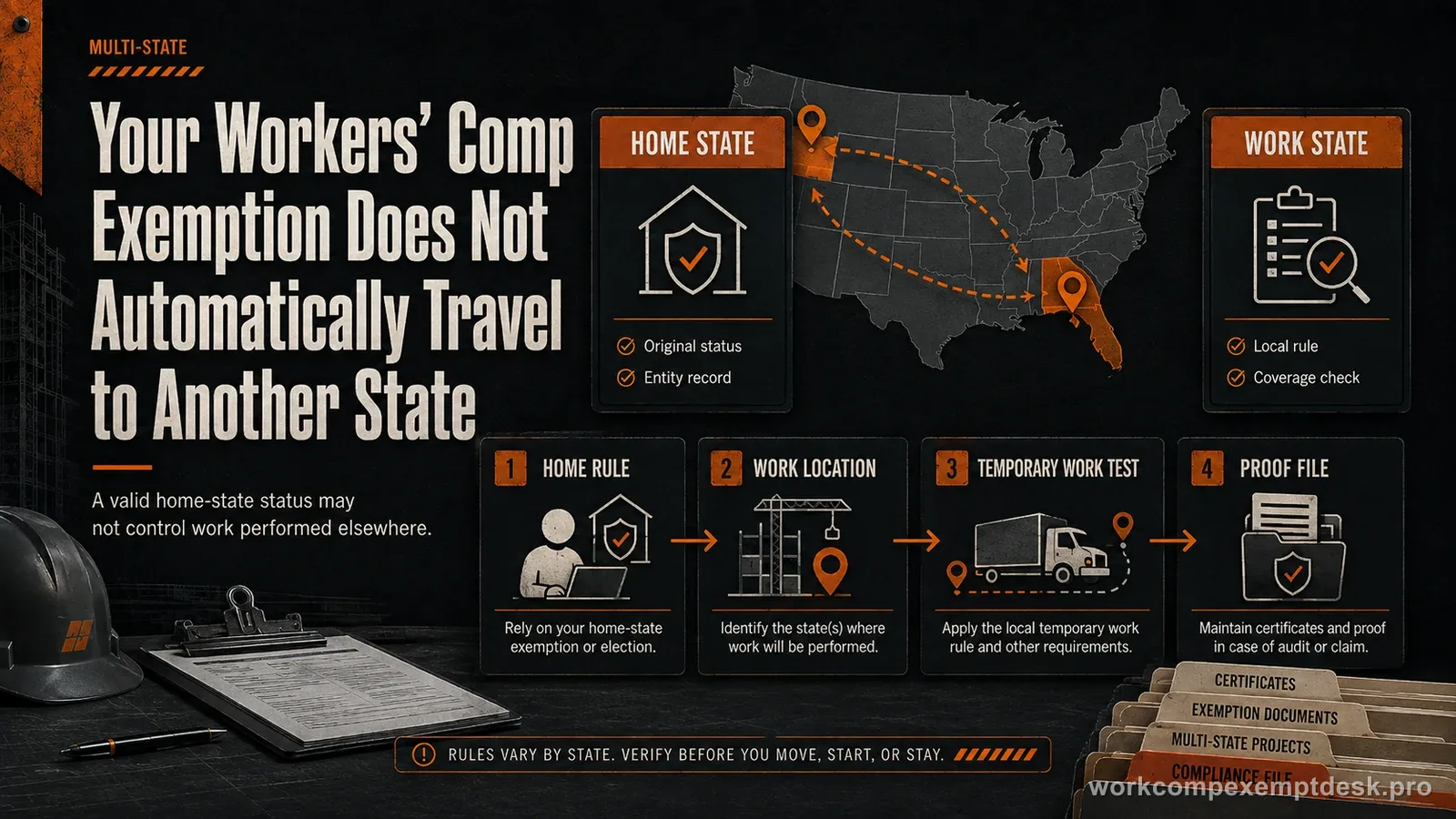
An owner exemption or no-employee status from one state does not automatically control work performed in another state. The second state can apply its own coverage, construction, licensing, and out-of-state-employer rules even for temporary work.
Facts to lock down before relying on an exemption
- List every state where employees or owners will physically perform work
- Check the destination state's out-of-state employer policy before work begins
- Review Item 3A/3C or equivalent policy-state listings with the carrier
- Check construction, permit, licensing, and public-contract rules in the destination state
- Document temporary-work reciprocity limits instead of assuming reciprocity exists
Small businesses become multi-state faster than they expect: a contractor takes a project across the border, a technician travels for an installation, a driver begins making deliveries, or a remote employee starts working from another state. Workers' compensation follows state jurisdiction rules, not just the address on the company's formation document. The home-state exemption is therefore one piece of evidence, not a passport.
Formation state and work state answer different questions
An LLC formed in Texas does not carry Texas workers' compensation rules with it everywhere. When people perform work in New York, California, Florida, or Illinois, those states can apply their own workers' compensation jurisdiction and coverage requirements. The business must identify where the work is actually performed and which state's law attaches to that employment relationship.
The work state can create obligations even when the company was formed elsewhere
The same is true for an owner exemption. A status valid under the home state's owner rules does not automatically satisfy a destination state's owner classification or proof requirements. The owner should check whether the destination state recognizes the same category and whether a new filing is required.
New York uses specific rules for out-of-state employers
New York states that out-of-state employers with employees working in the state may need full statutory New York workers' compensation coverage. Its current guidance lists circumstances that require New York in Item 3A, including certain construction work, permit or contract activity, a New York work location, and specified levels of physical work in the state.
The Board also explains when limited 3C treatment can be acceptable for infrequent meetings, seminars, conferences, conventions, or travel through the state without work such as pickups or deliveries. Those details show why “temporary” is not a universal exemption word; the destination state's policy defines what it accepts.
SOURCE CONTEXT: New York WCB publishes detailed 3A/3C rules for out-of-state employers.
Florida has its own temporary-work reciprocity framework
Florida requires out-of-state employers to evaluate Florida coverage and publishes an extraterritorial reciprocity rule for qualifying temporary work. The state describes temporary work using specific day limits and explains when a home-state policy can be used versus when Florida must be listed for coverage.
A contractor should therefore record the expected number of consecutive and total Florida work days before relying on reciprocity. If the job expands beyond the temporary limits, the insurance plan may need to change while the project is underway.
SOURCE CONTEXT: Florida DFS publishes reciprocity conditions and temporary-work limits for out-of-state employers.
California and Illinois can attach coverage to work performed in the state
California DWC warns that an out-of-state employer may need California workers' compensation if employees regularly work in California or if a contract of employment is entered into there. Illinois states that its law can cover injuries in Illinois, work principally localized in Illinois, and contracts of hire made in Illinois; its compliance guidance tells out-of-state companies doing work with employees in Illinois to carry coverage that includes Illinois.
Those examples make a simple point: the destination state can have several jurisdiction hooks. A company should not limit its research to the employee's residence or the employer's headquarters.
Construction and transportation create the fastest multi-state triggers
A short construction project can create full coverage obligations faster than an occasional business meeting. New York specifically lists contractors and subcontractors on construction projects among circumstances requiring full New York coverage. Florida also applies construction-specific out-of-state policy rules. Transportation companies face similar exposure because regular pickups and deliveries are actual work, not mere transit.
Before accepting an out-of-state job, compare the work type to the destination state's special rules. A certificate that satisfied a local private project may not satisfy a public project, contractor-license requirement, or transportation-specific employment rule across the border.
Use a state-entry checklist before the first person travels
Create a state-entry review for every new work state: employee and owner roles, expected days of work, project type, policy states, reciprocity rule, contractor or licensing requirements, and destination-state owner treatment. Ask the insurance carrier to confirm the policy response in writing when the state requires specific coverage listings or endorsements.
Keep the result with the project file and set a trigger when the expected duration changes. Multi-state mistakes often happen because a job that began as two days becomes six weeks. The compliance process should notice that change before the state or customer does.
Common questions
- Does my workers' comp exemption travel to another state?
- No. An exemption is granted under one state's law. Temporary work, a remote employee, a construction project, or expansion can trigger a second state's coverage rules.
- What can trigger a second state's workers' comp requirement?
- Hiring or sending an employee into that state, performing a project there, or basing operations there. Each state applies its own thresholds and owner rules.
- Do I need coverage in every state I do business?
- Not always, but you have to check each state where work is performed or where an employee is based rather than assuming home-state status carries over.
Agency and statute pages behind this guide
The state-specific examples above draw on these links. Always confirm the current rule with the destination state before filing or changing coverage.