GUIDE
LIBRARY
Use these general guides to frame the research question. Then move to the state directory for the controlling agency, threshold, form, and owner rules.
Understand the owner-exemption framework
Entity type, owner treatment, proof documents, and effective dates come before state-specific filing details.
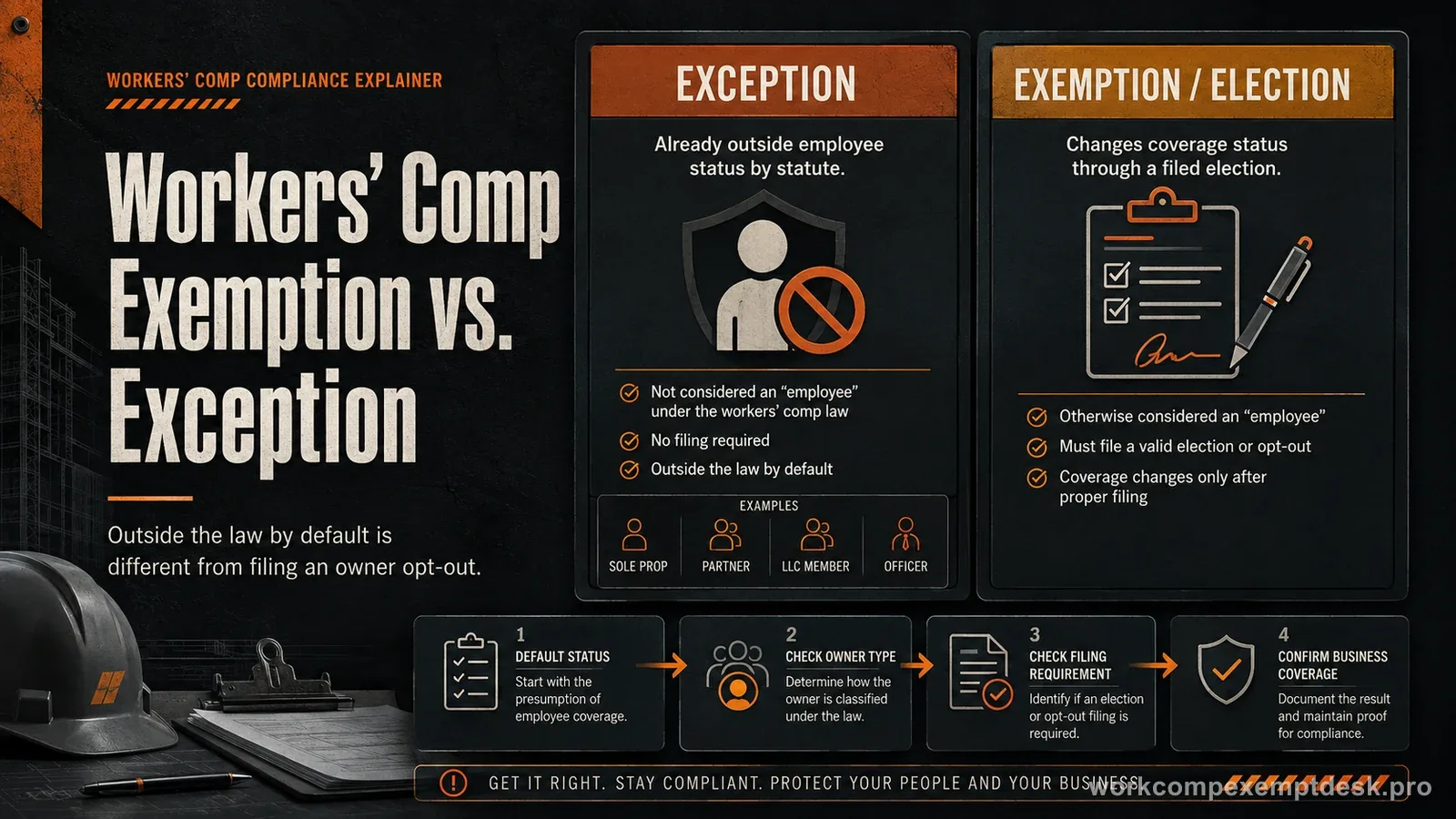
Workers' Comp Exemption vs. Exception
Why being outside a statute from the start is different from filing an election to remove an otherwise covered owner.
READ GUIDE 02DOCUMENTS · 5 min
What a Certificate of Election Actually Proves
What an exemption certificate can establish, what it cannot establish, and why contractors often ask for it before work starts.
READ GUIDE 03OWNER TYPE · 5 min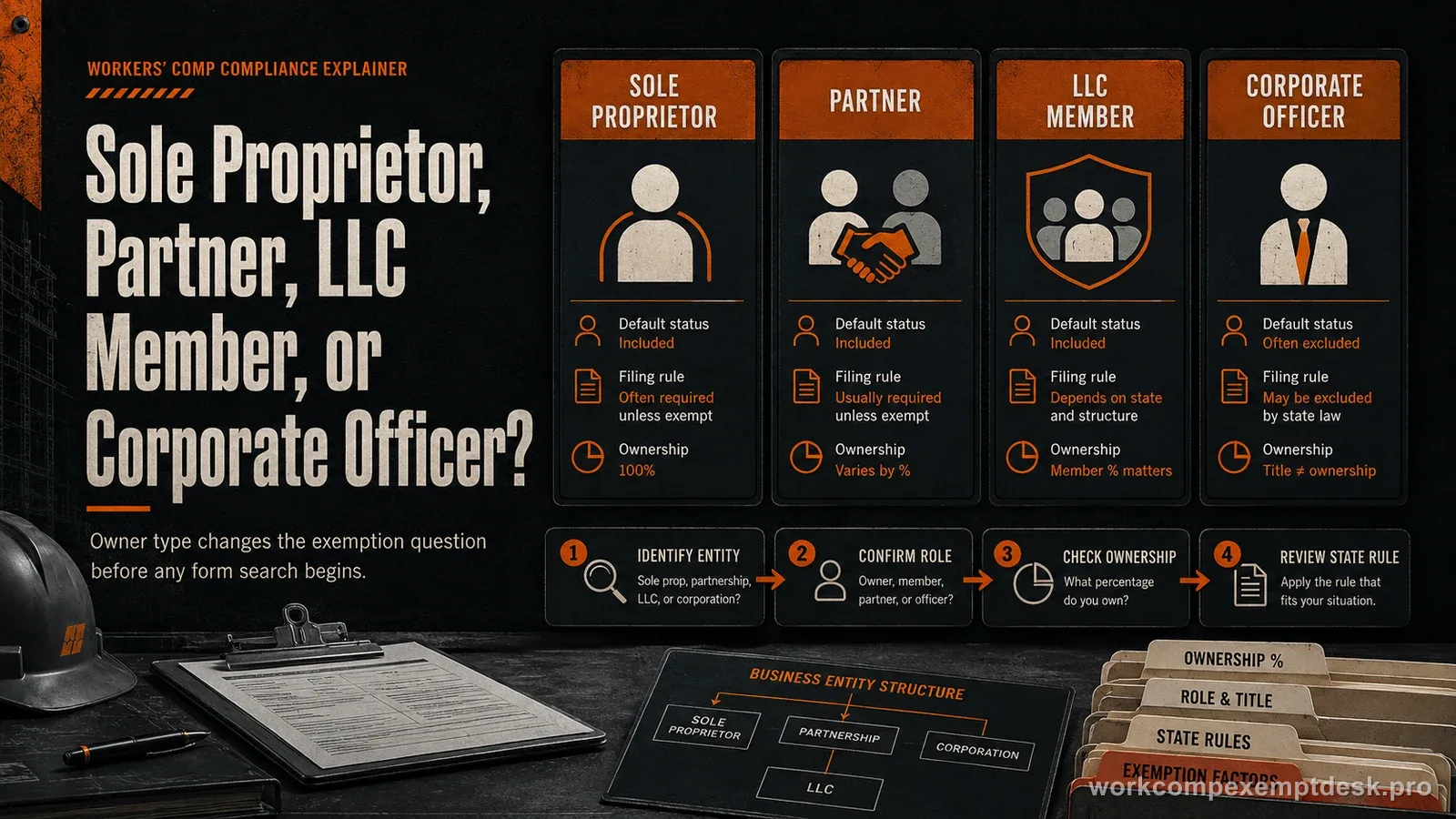
Sole Proprietor, Partner, LLC Member, or Corporate Officer?
The owner label changes the exemption question. Learn why entity type must be identified before looking for a form or certificate.
READ GUIDE 04FOUNDATION · 5 min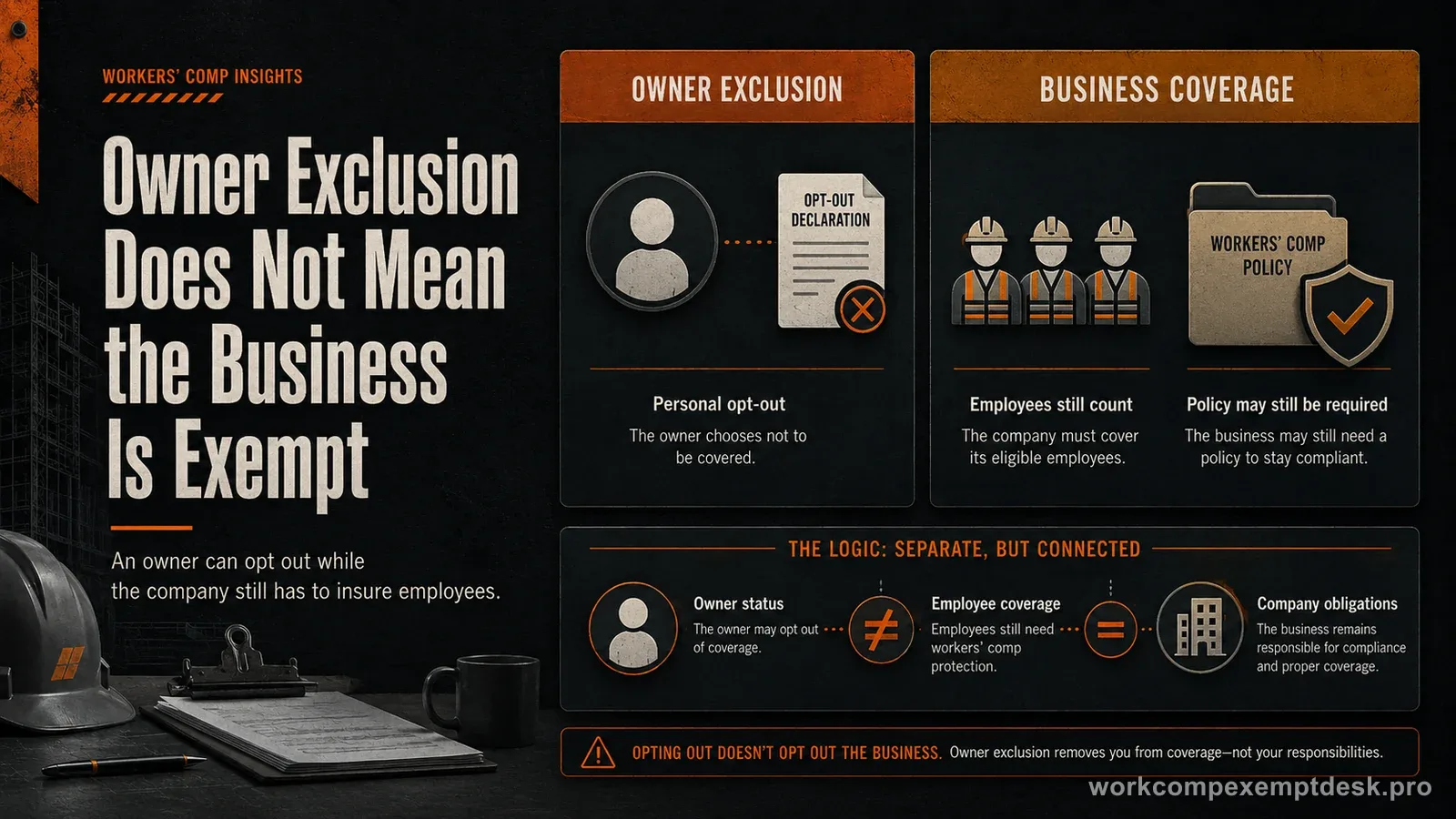
Owner Exclusion Does Not Mean the Business Is Exempt
A personal owner opt-out can coexist with a company obligation to insure employees. Keep those two questions separate.
READ GUIDE 05FILING LOGIC · 5 min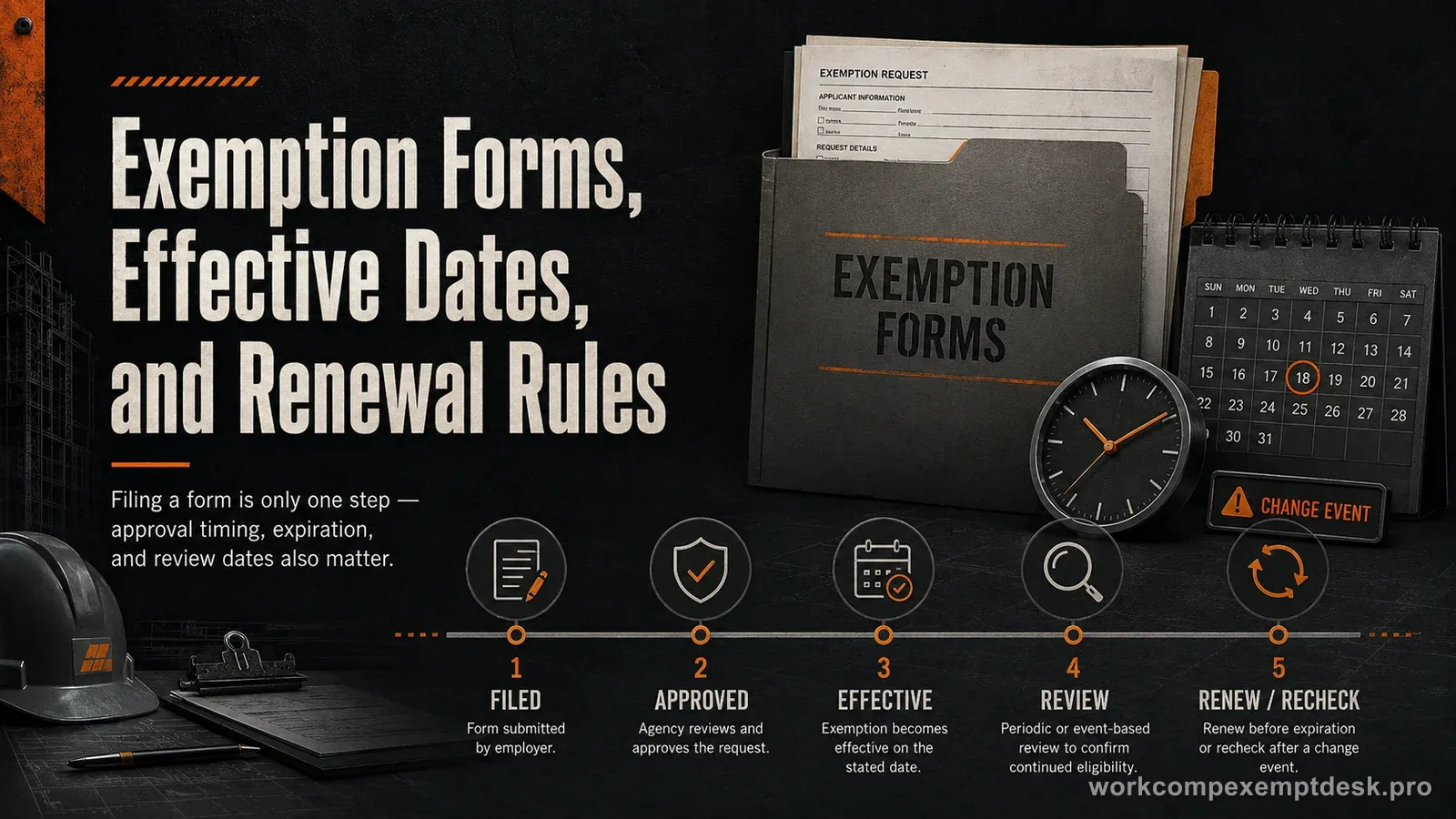
Exemption Forms, Effective Dates, and Renewal Rules
Why filing a form is only one step: approval timing, expiration, revocation, and policy-cycle rules can all change the result.
READ GUIDE 06STATE SYSTEM · 7 minOwner Exemptions in Monopolistic States: North Dakota, Ohio, Washington, Wyoming
In the four states with no private workers' comp market, the owner election runs through the state fund, not a carrier endorsement. Here is how each one works.
READ GUIDE 07LLC OWNER STATUS · 6 minSingle-member LLC owner exemptions: why the answer changes by state
A single-member LLC label does not create one national workers' comp rule. States differ on whether the member is outside coverage, included by default, or eligible for an election or rejection.
READ GUIDE 08OWNER TYPE · 6 minCorporate officer exclusion vs. LLC member exclusion
Corporate officers and LLC owners can fall under different statutory definitions, ownership tests, filing paths, and headcount rules even within the same state.
READ GUIDE 09EMPLOYEE THRESHOLD · 6 minDo owners count toward the employee threshold?
There is no national headcount rule. Some states count officers or LLC members even after they reject coverage, while others exclude specified owners from employee status.
READ GUIDE 10FAMILY PAYROLL · 7 minFamily members on the payroll and workers' comp
Family relationship does not create a universal workers’ comp exclusion. Several states expressly require family employees to be covered, while narrow owner or household exceptions remain state-specific.
READ GUIDEWhat each document proves — and what it does not
Certificates of insurance, exemption certificates, ghost policies, and revocation filings answer different questions. Match the document to the actual legal status before you rely on it.
A general contractor is asking for proof of coverage or exemption
Why a GC may ask for a workers' comp certificate, what an exemption document proves, and why contract requirements can be stricter than the statutory minimum.
READ GUIDE 02PROOF & POLICY · 6 minGhost policies: what the term means and what the policy may not cover
The informal term usually refers to a minimum-premium workers' comp policy with little or no covered payroll at inception. The policy can satisfy a proof request without necessarily covering the owner personally.
READ GUIDE 03PROOF DOCUMENTS · 6 minCertificate of insurance vs. certificate of exemption
A certificate of insurance reports policy information; an exemption certificate or election document supports a different legal status. Neither document has a single nationwide meaning.
READ GUIDE 04INVALID EXEMPTION · 7 minWhat happens if you file an exemption you weren't eligible for?
An exemption record does not erase the underlying coverage rule. If eligibility was missing, the business can still face coverage, penalty, audit, contract, or licensing consequences under state law.
READ GUIDE 05RESTORE COVERAGE · 7 minRestoring coverage on yourself after an exemption
Owner non-coverage can often be reversed, but the path and effective date are state-specific. Revocation, elective coverage, carrier action, and agency approval are separate steps.
READ GUIDEIndustries where the general rule is not enough
Construction, transportation, and agriculture can layer special thresholds, classification rules, and proof requirements onto the state baseline.
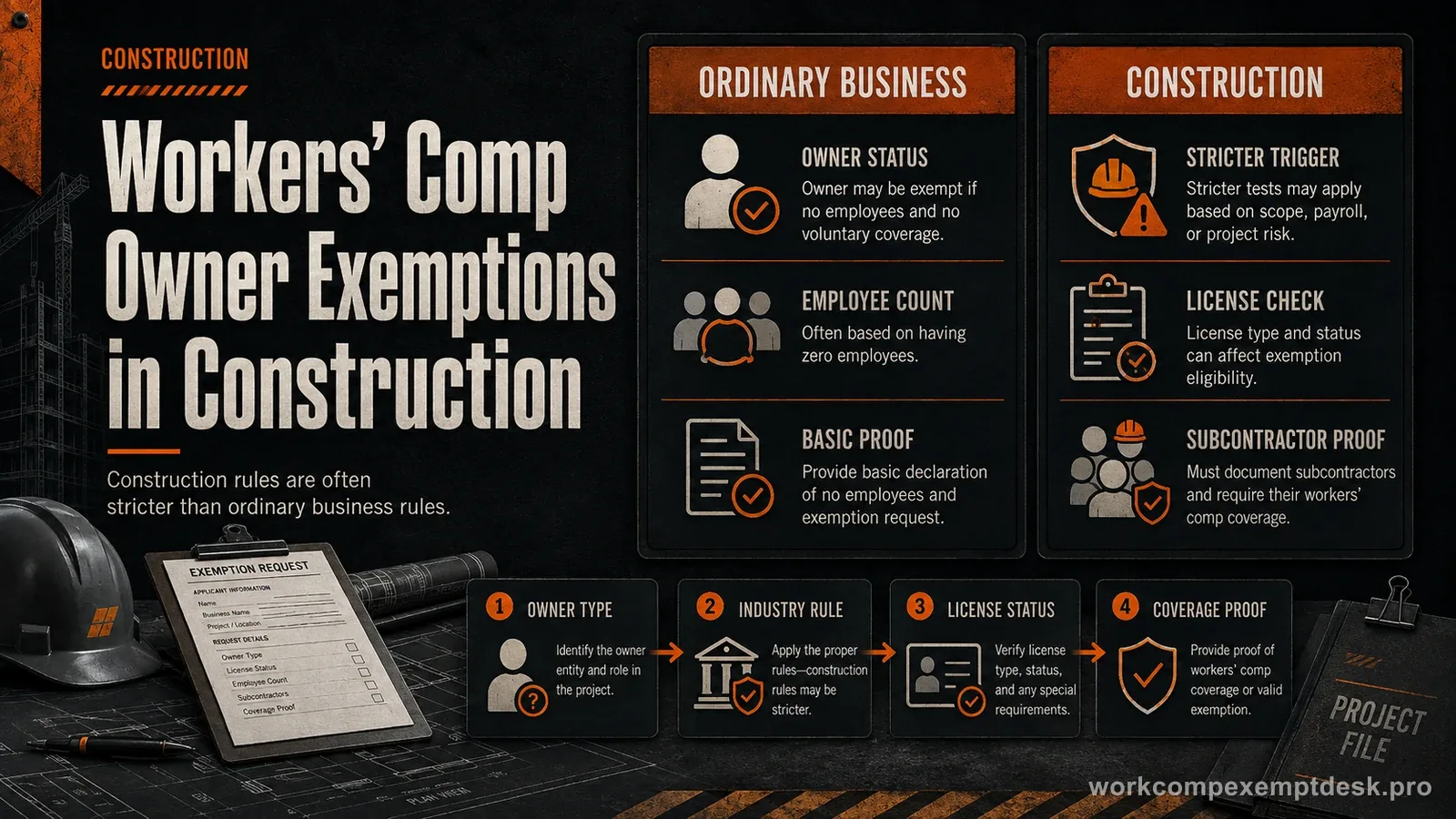
Workers' Comp Owner Exemptions in Construction
Construction often has stricter coverage triggers, tighter owner rules, and heavier proof requirements than ordinary businesses.
READ GUIDE 02TRANSPORTATION · 5 min
Workers' Comp Exemption Issues for Trucking and Transportation
Owner-operators, leased drivers, motor carriers, and multi-state routes create classification and jurisdiction questions that a simple 1099 does not solve.
READ GUIDE 03AGRICULTURE · 5 min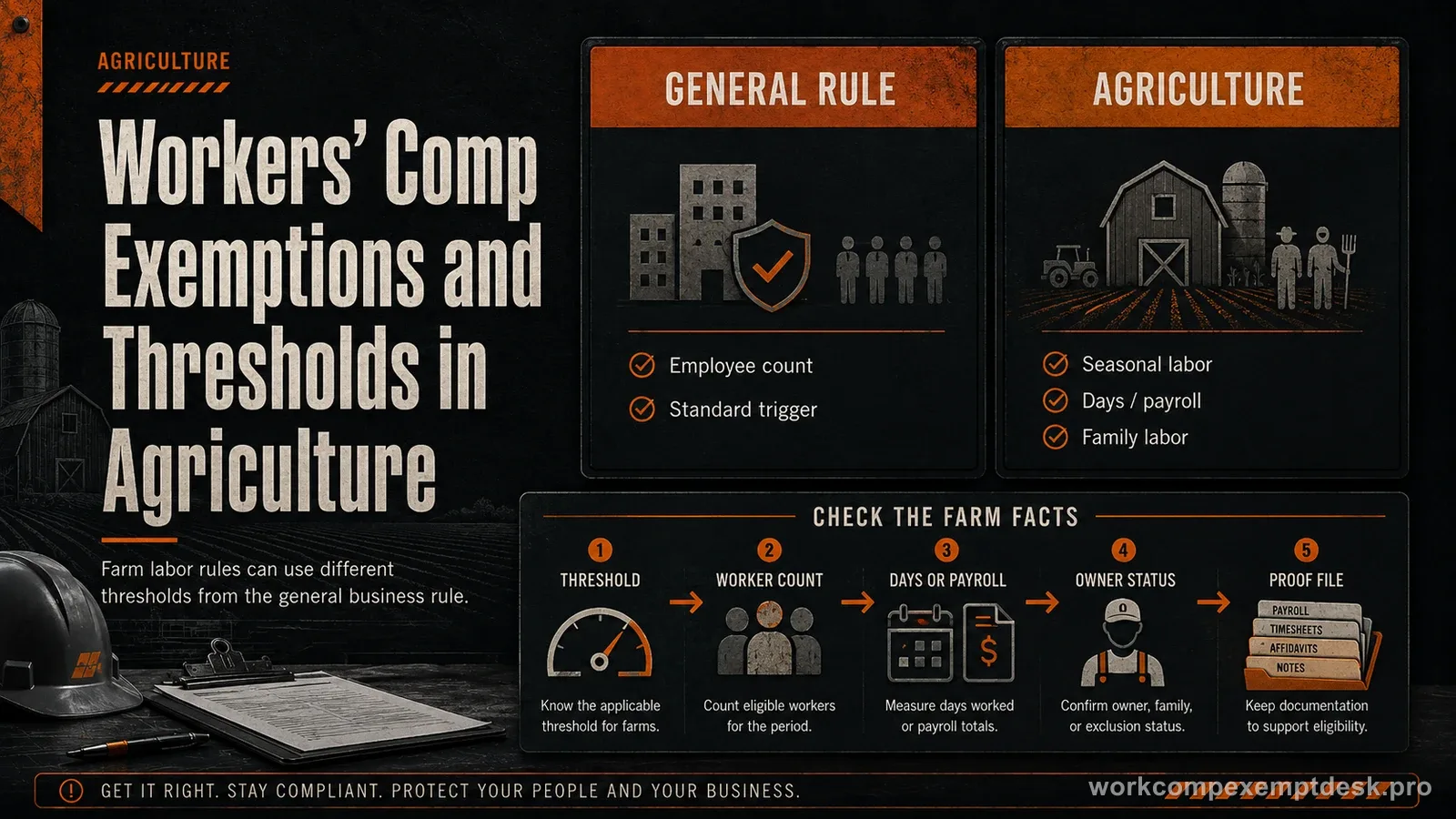
Workers' Comp Exemptions and Thresholds in Agriculture
Farm and seasonal-labor rules can use different thresholds and definitions from the general business rule in the same state.
READ GUIDE 04SUBCONTRACTOR STATUS · 7 minSubcontractor with no employees: what a prime contractor can require
No employees does not automatically end the workers' comp inquiry. State contractor-liability rules, worker classification, and contract terms can still affect the proof a prime contractor requests.
READ GUIDE 05HIGH-RISK TRADES · 7 minRoofing, concrete, HVAC and other trades with stricter owner-exemption limits
Construction is not one rule. Some states and licensing systems impose coverage or tighter exemption conditions on specified trades even when the business has no ordinary employees.
READ GUIDE 06OWNER-OPERATORS · 7 minTrucking owner-operators: workers' comp status vs. occupational-accident coverage
Owner-operator status is governed by state workers’ comp rules and transportation-specific agreements. A non-workers’ comp accident policy does not automatically satisfy a workers’ comp obligation.
READ GUIDE 07COMMISSION & BOOTH RENT · 7 minReal estate agents, stylists and other commission or booth-rent workers
Commission pay, a 1099, or chair rent does not create one national workers’ comp result. Real estate and salon workers are treated very differently across states.
READ GUIDEEvents that force a fresh workers' comp review
Hiring, crossing state lines, and changing entity structure can make a previously correct exemption analysis obsolete.
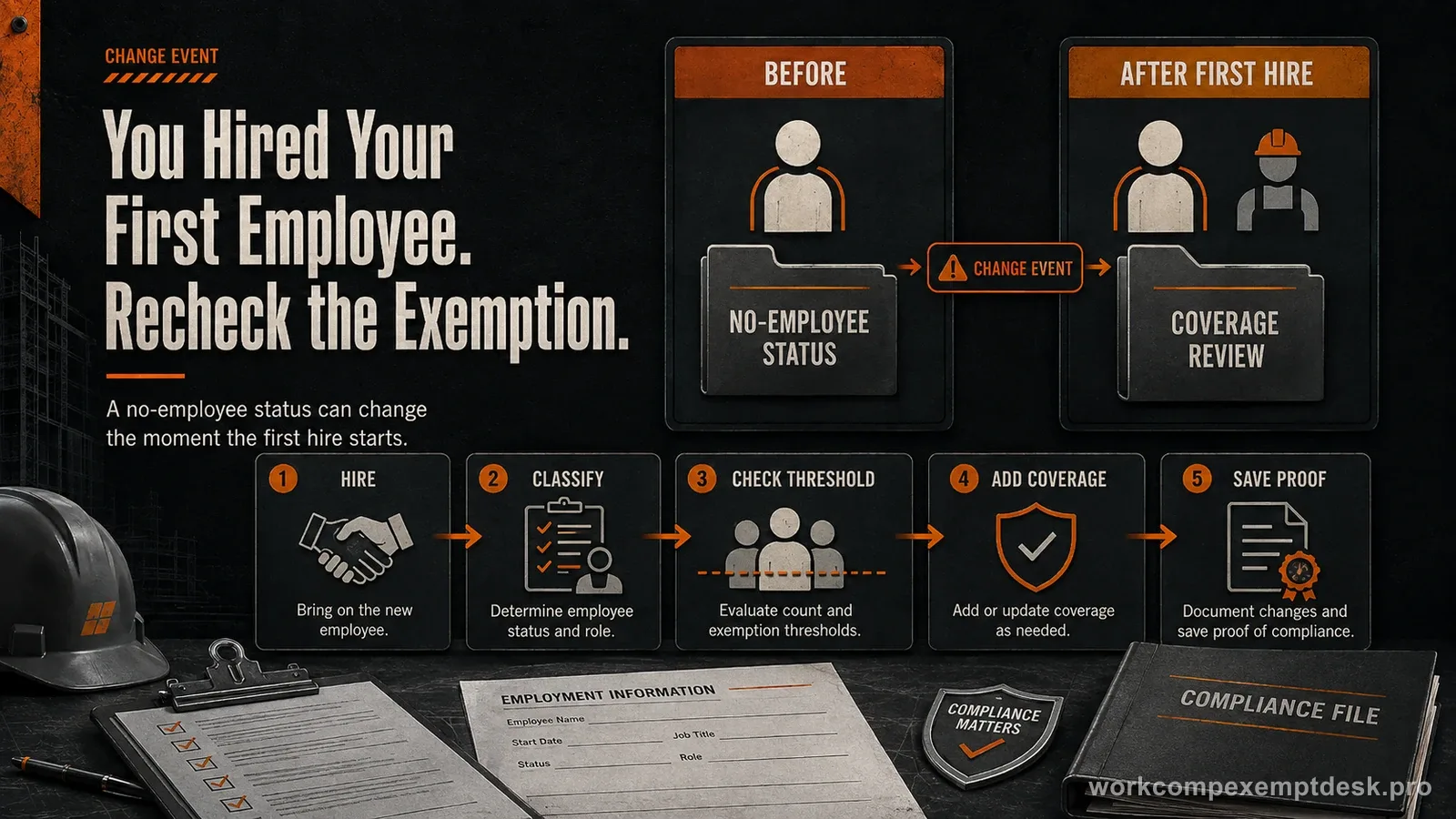
You Hired Your First Employee. Recheck the Exemption.
A practical research checklist for owners whose staffing changed after an exemption or owner exclusion was obtained.
READ GUIDE 02MULTI-STATE · 5 min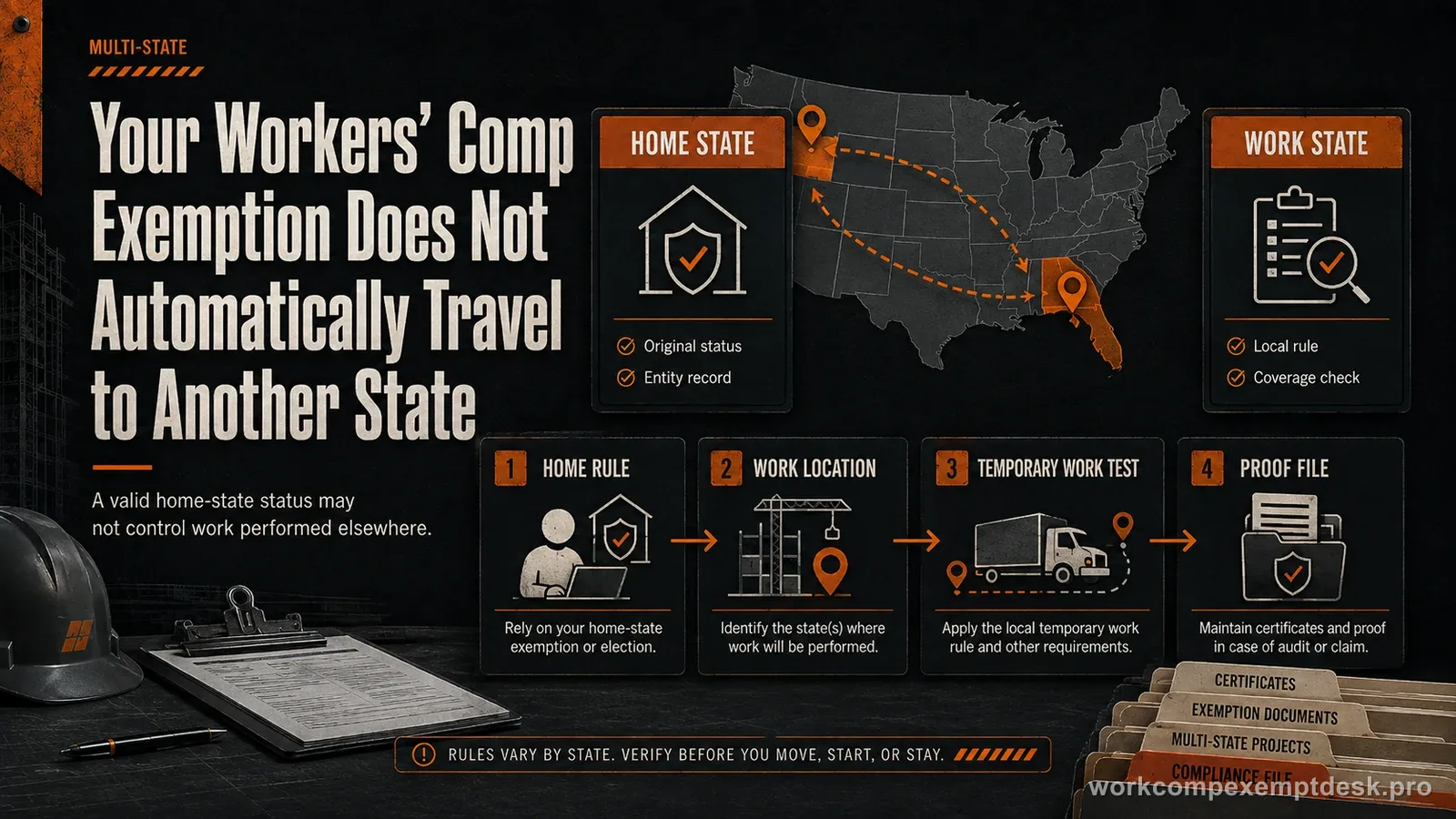
Your Workers' Comp Exemption Does Not Automatically Travel to Another State
Temporary work, remote employees, construction projects, and cross-border expansion can trigger a second state's coverage rules.
READ GUIDE 03ENTITY CHANGE · 4 min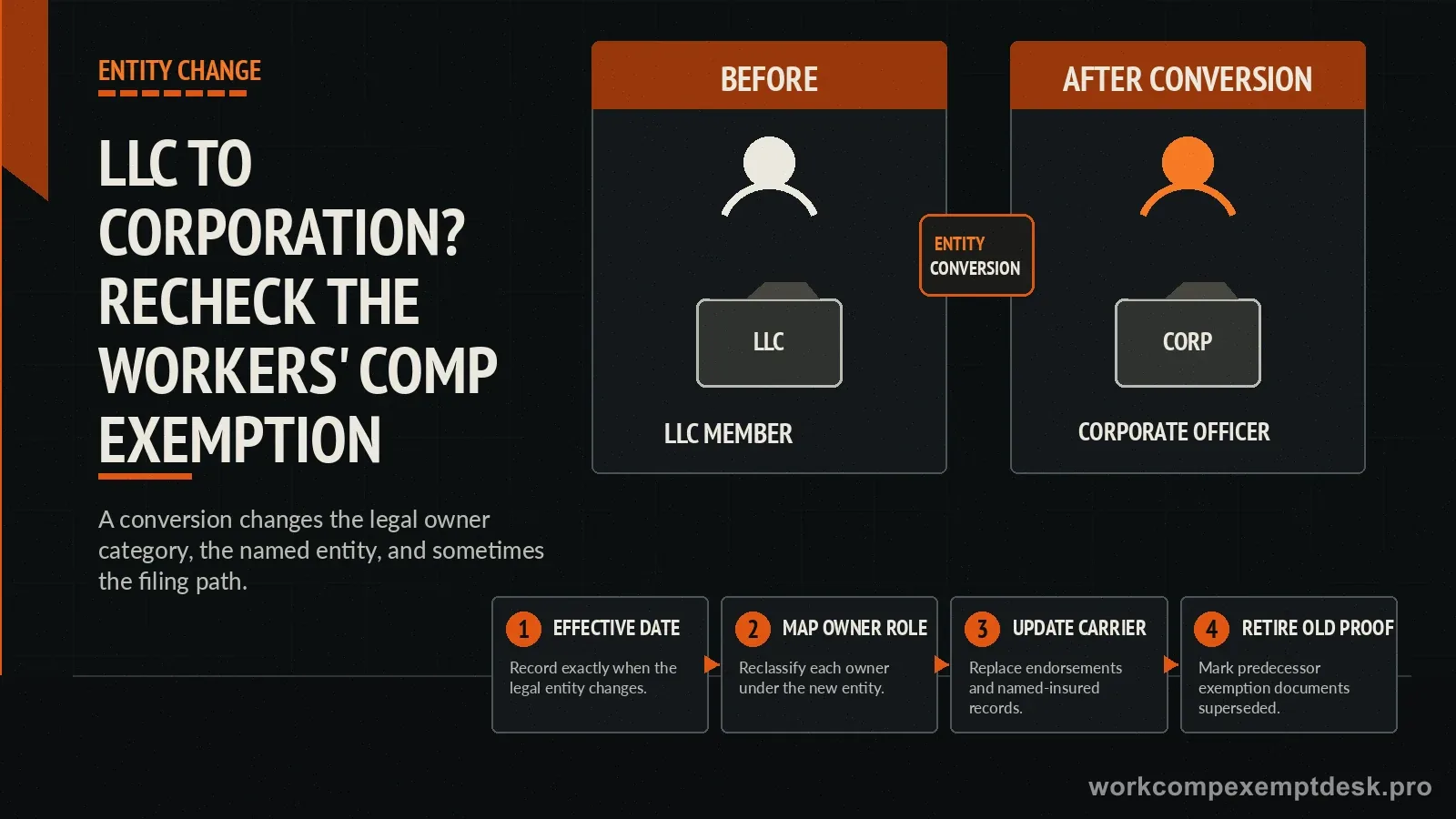
LLC to Corporation? Recheck the Workers' Comp Exemption
An exemption tied to a member, partner, officer, policy, or business record may no longer fit after an entity conversion or ownership change.
READ GUIDE 04FIRST HIRE · 6 minI just hired my first employee — what changes?
A first non-owner worker can change the business's workers' compensation obligation even when an owner exclusion or exemption remains valid for the owner.
READ GUIDE 05ENTITY CHANGE · 7 minBuying or dissolving a business: what happens to an owner exemption?
Owner exemptions are tied to specific legal facts such as entity, ownership, office, policy, and agency record. A sale, dissolution, or ownership change can make an old record inapplicable.
READ GUIDE