Workers' Comp Exemption vs. Exception
Built from official state-agency sources · desk review 2026-08-26
Why being outside a statute from the start is different from filing an election to remove an otherwise covered owner.
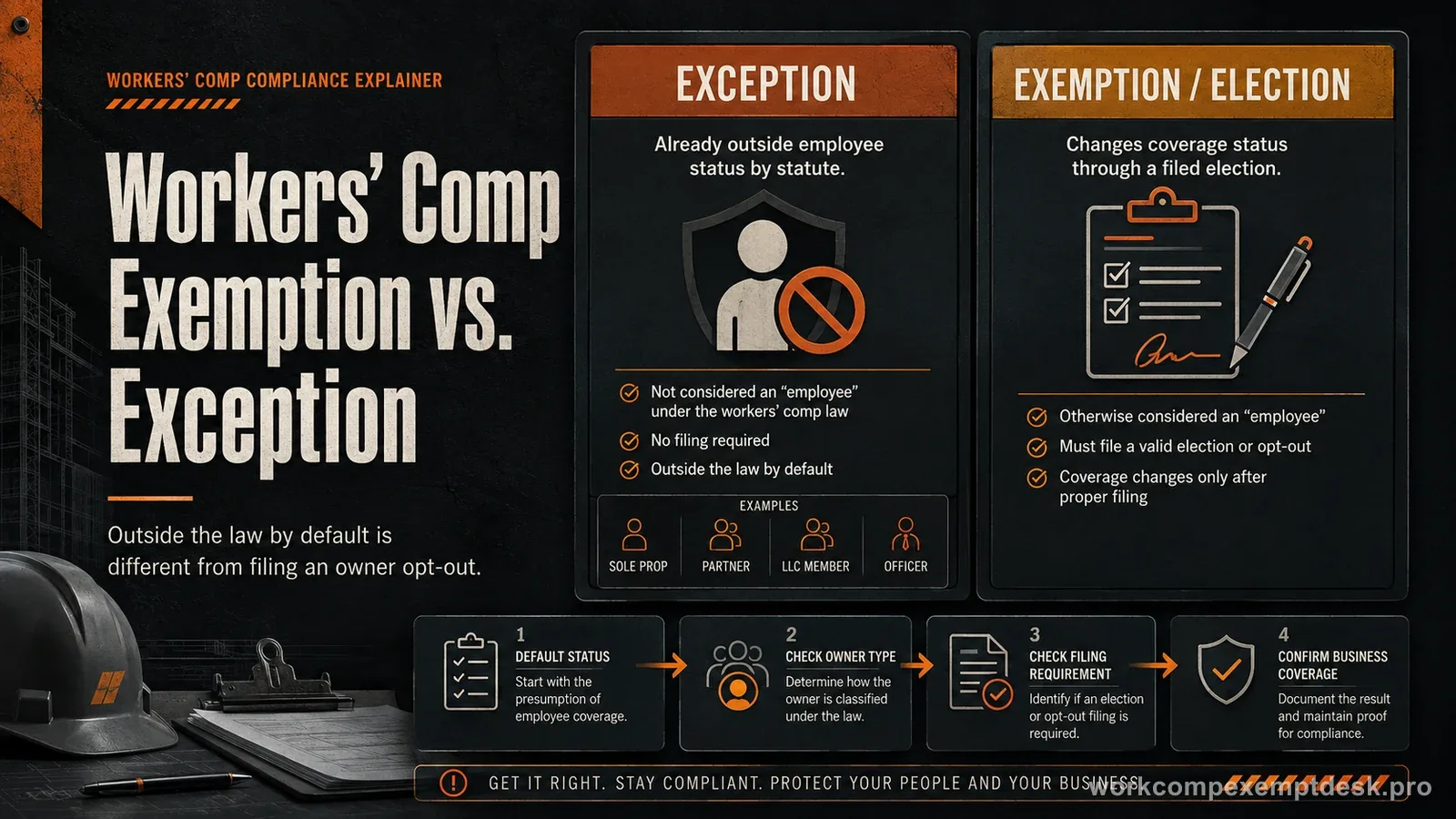
An exception or exclusion can mean the law does not treat a person as an employee in the first place. An exemption or election usually means a person who could otherwise be covered uses a state-defined process to opt out. The words vary by state, so the legal effect matters more than the label.
Facts to confirm before you rely on an exemption
- Identify the exact owner and entity type before searching for a form
- Check whether the owner is outside employee status by statute or must affirmatively opt out
- Separate the owner's personal status from the company's duty to insure employees
- Confirm whether the state, carrier, licensing board, or another agency controls the filing
- Recheck the result after hiring, ownership changes, or work in another state
Small-business owners often search for a single thing called a workers' compensation exemption. State systems are not built that way. One state may automatically leave a sole proprietor outside employee status, another may require a corporate officer to file an election, and another may use a carrier endorsement rather than a state certificate. Understanding the starting point prevents the most common research mistake: looking for a form before knowing whether a form is legally necessary.
Start with the legal default, not the document name
The first research question is not “Which exemption form do I file?” It is “How does this state classify this owner before any filing occurs?” That distinction can completely change the workflow. Pennsylvania, for example, lists a sole proprietor or general partners with no other employees among categories outside the mandatory coverage requirement. In that situation, the owner is not starting from the same place as a corporate executive officer who seeks a formal exclusion.
SOURCE CONTEXT: State examples: Pennsylvania DLI employer guidance and Florida DFS exemption guidance.
Then ask whether the owner must file an election
Florida illustrates the opposite problem. Its non-construction rules treat sole proprietors and partners differently from corporate officers and LLC members, while construction has a stricter framework. A generic search for “Florida exemption form” can therefore lead the wrong owner to the wrong process. The legal default is entity-specific and sometimes industry-specific before the filing question even begins.
SOURCE CONTEXT: State examples: Pennsylvania DLI employer guidance and Florida DFS exemption guidance.
An owner exclusion and a business exemption are not the same thing
A personal election can remove one owner from coverage without removing the employer's obligation to cover workers. Georgia is a useful example: corporate officers and LLC members count toward the three-person threshold even though up to five may reject their own personal coverage using Form WC-10. The rejection affects the individual's coverage; it does not erase the head-count rule or the company's obligations toward other employees.
That is why the phrase “my company is exempt” should trigger a second look. The evidence may actually show that a particular officer is excluded, that the business has no employees, or that a statutory category does not count as an employee. Those are different legal facts, and they change differently when the business hires, adds an owner, or changes entity form.
SOURCE CONTEXT: Georgia SBWC distinguishes owner rejection from the three-person coverage threshold.
The same state can use several different legal mechanisms
California does not reduce every owner question to one certificate. Labor Code section 3352 provides written-waiver paths for certain qualifying officers, directors, general partners, and managing LLC members. Separately, the Contractors State License Board has a no-employee workers' compensation exemption process for eligible licensees. Those systems answer different questions and have different eligibility conditions.
New York also separates concepts. A partnership, LLC, or LLP with no employees generally does not need workers' compensation coverage for members or partners, while CE-200 is an electronic certificate used by a business that is not required to carry workers' compensation and/or disability coverage when applying for a government permit, license, or contract. Calling both situations “the exemption” hides an important operational difference.
SOURCE CONTEXT: California uses carrier waivers and CSLB records; New York uses separate no-employee rules and CE-200 for government transactions.
Why contractors and customers make the terminology even messier
A prime contractor may ask for a certificate, policy, owner-election record, or other proof before allowing a subcontractor on site. That request can be stricter than the minimum statutory requirement. The contractor is managing contractual and downstream workers' compensation risk, not merely repeating the state statute word for word.
This is especially important in construction, where uninsured subcontractor exposure can move upstream. A business can therefore be legally outside a particular owner-coverage rule yet still face a contractual requirement to produce specified evidence. The right response is to identify what the document proves and whether it matches the actual state status, rather than treating any paper labeled “exemption” as interchangeable.
Use a two-column research test: default status and affirmative filing
A reliable research file records two answers separately. Column one states the default: Is this sole proprietor, partner, LLC member, or officer treated as an employee for workers' compensation purposes? Column two states the action: Is there a filing, waiver, endorsement, election, or certificate that changes that default? This simple split prevents circular reasoning.
Add a third line for company coverage. Even if the owner can be excluded, determine whether the business must still carry a policy for employees. Add a fourth for proof: what will the state, carrier, licensing agency, customer, or prime contractor accept as evidence? Only after those four items are known should the owner decide which document belongs in the compliance file.
A status that was correct last year can become wrong without any form changing
Exemption analysis depends on facts. Hiring the first employee, crossing a state threshold, adding an LLC member, changing ownership percentages, converting an LLC to a corporation, or taking work into another state can all change the answer. A certificate that remains physically unexpired does not guarantee that the business still satisfies the conditions behind it.
For that reason, the most useful compliance habit is not simply saving the certificate. Save the agency source, the entity facts that made the owner eligible, the filing date, effective or expiration rule, and the change events that require a new review. That creates a defensible trail and reduces the chance that an old document is used after the underlying facts have changed.
Questions people ask
- Is a workers' comp exemption the same as an exception?
- Not necessarily. An exception or exclusion can mean the law never treated the person as an employee. An exemption or election usually means someone who could be covered uses a state process to opt out. The words differ by state, so the legal effect matters more than the label.
- Does an owner exemption mean my business is exempt from workers' comp?
- No. A personal owner election removes one person from coverage. It does not remove the company's duty to insure employees, and it does not change a head-count threshold.
- How do I know whether I need to file a form at all?
- Identify the entity type and state first, then check whether that owner is already outside employee status by statute or must file an election, waiver, endorsement, or certificate to change the default.
Statutory and agency sources for this guide
These links support the state-specific examples in the article. Always recheck the destination state's current rule before filing or changing coverage.