California
Workers' Comp Exemption
Verified against California Department of Industrial Relations, Division of Workers' Compensation on 2026-08-25
A California employer with one or more employees must satisfy the workers’ compensation requirement. Qualifying officers, directors, general partners, and managing LLC members may be excluded under Labor Code section 3352 through a written waiver accepted by the carrier. Separately, an eligible CSLB contractor with no employees may file a no-employee exemption—but several license classifications cannot use that exemption even with zero employees.
Entity types covered
- Sole proprietor
- LLC member
- Partner
- Corporate officer
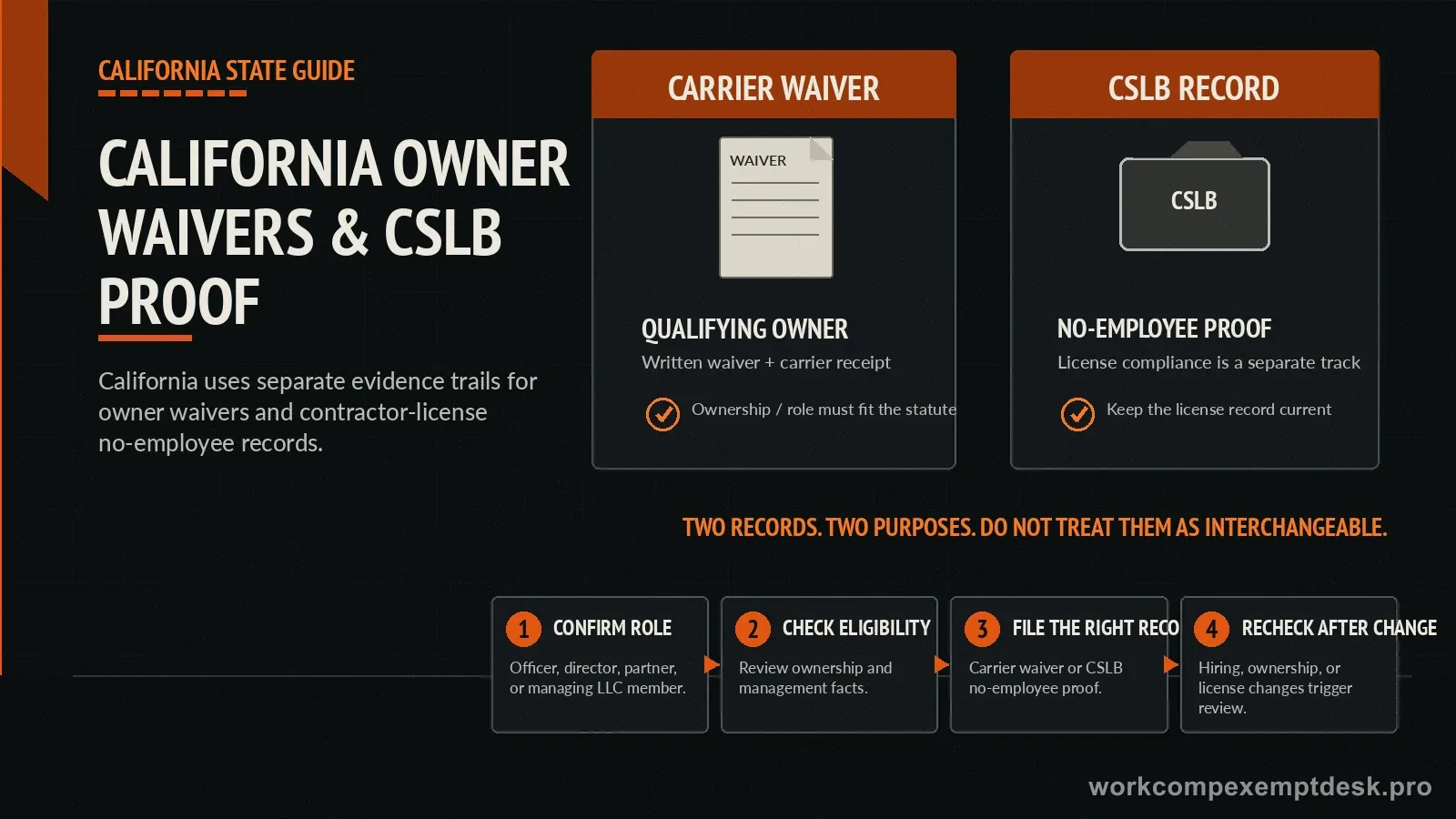
California has two exemption concepts that are easy to confuse. The first is an owner or officer waiver inside a workers’ compensation policy under Labor Code section 3352. The second is the Contractors State License Board’s no-employee exemption from filing proof of insurance. They answer different questions and should not be used interchangeably.
A California employer with one or more employees must satisfy the workers’ compensation requirement. Qualifying officers, directors, general partners, and managing LLC members may be excluded under Labor Code section 3352 through a written waiver accepted by the carrier. Separately, an eligible CSLB contractor with no employees may file a no-employee exemption—but several license classifications cannot use that exemption even with zero employees.
How owners are treated, at a glance
Sole proprietorA sole proprietor is not required to buy workers' compensation solely for themself when there are no employees, although owner coverage may be added by policy endorsement. Eligible CSLB contractors with no employees may file the CSLB workers' compensation exemption, except for classifications and situations that the Board lists as ineligible.
LLC memberA working LLC member receiving wages is included in the employee definition. A managing member may execute a written waiver under Labor Code §3352(a)(17); the waiver is effective when received and accepted by the LLC's carrier and remains in effect until withdrawn in writing.
PartnerA working partner receiving wages is included in the employee definition. A general partner may execute a written waiver under Labor Code §3352(a)(17); the waiver is effective when received and accepted by the partnership's carrier and remains in effect until withdrawn in writing.
Corporate officerCorporate officers and directors rendering service for pay are employees. A qualifying officer or director may execute a written waiver under Labor Code §3352(a)(16), including the ownership conditions stated there. A sole shareholder officer/director is excluded by statute unless coverage is elected.
One employee is enough to trigger the general California rule
California’s Division of Workers’ Compensation states the general rule plainly: employers must provide workers’ compensation benefits when they have one or more employees. The rule is not keyed to a four- or five-person threshold. Once a business employs someone who is an employee for California workers’ compensation purposes, coverage is required unless a specific statutory treatment changes that person’s status.
A sole proprietor with no employees is different. The DWC employer FAQ explains that a sole proprietor does not have to buy a policy solely to cover the owner, although the owner can be included by endorsement if coverage is desired. That no-employee situation should not be confused with a company that has employees but wants to exclude one qualifying owner from an otherwise required policy.
The practical starting point is therefore head count plus legal status: identify every person performing services, then determine whether the owner is already outside the employee definition or needs a statutory waiver.
A section 3352 waiver and a CSLB exemption are not the same document
Labor Code section 3352 addresses whether certain owners, officers, directors, general partners, and managing LLC members are excluded from the workers’ compensation employee definition. For the categories that require a waiver, the written waiver is delivered to the corporation’s, partnership’s, or LLC’s workers’ compensation carrier and becomes effective when the carrier receives and accepts it.
The CSLB exemption serves a different purpose. Active contractor licensees ordinarily must keep proof of workers’ compensation insurance or self-insurance on file with the Board. An eligible contractor with no employees can instead certify that no employee coverage is presently required. That filing is about the contractor license record, not about removing a particular officer from an existing policy.
A business can therefore encounter both concepts during its life. For example, a corporation with employees may maintain a workers’ compensation policy and use a qualifying officer waiver with the carrier. A no-employee contractor may instead use the CSLB exemption only while the facts supporting that no-employee status remain true.
For an eligible CSLB licensee, the online exemption flow records the submission in the license database immediately; it is not just a blank PDF download. If the licensee uses the printable 13L-50 route, the contractor must complete and sign the form and submit it to CSLB. Out-of-state licensees with employees covered under another state's laws must submit the signed exemption with their home-state certificate by email or mail, because that case cannot be completed as an online database submission.
California’s owner rules depend on the entity and the owner’s role
Corporate officers and directors who render service for pay are generally employees, but section 3352 provides exclusion paths. A qualifying officer or director who owns at least 10 percent of the corporation’s issued and outstanding stock may execute the written waiver described in the statute. The statute also has a family-ownership alternative for an officer or director with at least 1 percent ownership when a close family member owns at least 10 percent and the officer or director has qualifying health coverage. A sole shareholder officer or director of a private corporation is treated separately by the statute unless coverage has been elected.
For partnerships and LLCs, the relevant owner category is narrower than “any owner.” Section 3352 provides a written waiver path for a general partner and for a managing member of an LLC. The waiver remains effective until the owner withdraws it in writing, so ownership titles and management status matter when deciding whether a particular person fits the exclusion.
This is one reason a generic certificate saying “business owner exempt” is not enough in California. The legal entity, ownership percentage, officer/director title, and management role determine whether the statute’s specific exclusion fits.
Some contractor classifications must carry coverage even with no employees
The CSLB no-employee exemption has important classification limits. Current CSLB guidance says active C-8 Concrete, C-20 Warm-Air Heating, Ventilating and Air-Conditioning, C-22 Asbestos Abatement, C-39 Roofing, and C-61/D-49 Tree Service contractors must maintain workers’ compensation insurance or valid self-insurance even when they have no employees.
A contractor also cannot use the ordinary no-employee exemption when the license is qualified by a Responsible Managing Employee. And if the licensee does employ anyone in a manner subject to California workers’ compensation law, the exemption is no longer valid.
This construction-license rule is separate from the general DWC rule that an employer with one or more employees needs workers’ compensation. It is stricter because it can require proof of coverage for specified contractor classifications before there is any employee to count.
Hiring the first employee can invalidate the contractor exemption immediately
CSLB states that a no-employee exemption on file becomes invalid once the licensee employs anyone in a manner subject to California workers’ compensation law. The Board then requires proof of workers’ compensation coverage, and its current guidance says that proof must reach CSLB headquarters within 90 days of the hire.
That 90-day filing window should not be read as permission to leave the employee uninsured for 90 days. California DWC’s general rule requires the employer to satisfy workers’ compensation requirements when the employee exists; the CSLB period is about getting proof of that coverage into the contractor-license record.
For an owner-managed contractor, the operational control is simple: make workers’ compensation review part of the first-hire checklist before payroll starts, then separately update the CSLB record.
Keep the carrier waiver record and the CSLB license record as two separate evidence trails
For a qualifying officer, director, general partner, or managing LLC member, the important insurance record is the section 3352 waiver and the carrier’s receipt and acceptance. The statute makes timing matter: a waiver is not merely an internal company resolution. Keep the signed waiver, proof of carrier acceptance, the ownership or management facts that made the person eligible, and any later written withdrawal with the workers’ compensation policy records.
For a contractor relying on a no-employee CSLB exemption, the important license record is different. Keep the exemption filing and confirm that the license classification, qualifier arrangement, and workforce still satisfy CSLB’s current requirements. The contractor should not use the carrier waiver as a substitute for a CSLB filing, or use the CSLB exemption as proof that a working owner was excluded from an insured policy.
Set change triggers for both files. A first employee, a new RME, a change into a classification that must carry coverage, a transfer of stock, or a change in who manages an LLC can move the business out of the fact pattern that supported the old document. The practical compliance task is therefore not 'renew the exemption' on a fixed schedule; it is to preserve the right evidence and re-test eligibility whenever the underlying facts change.
What failing to secure coverage actually costs in California
California treats an uninsured period as its own violation, separate from any individual injury claim, and the penalties escalate the longer the gap and the more employees are on payroll during it.
Under Labor Code §3722, once the Director of Industrial Relations finds an employer was uninsured for more than one week in the prior year, it issues a penalty assessment order for the greater of twice the premium the employer would have paid for that period, or $1,500 per employee employed during it. A stop order — which bars using employee labor until coverage is in place — adds a further $1,500 per employee employed when the order is served.
Working through a stop order is a separate misdemeanor, punishable by up to 60 days in county jail, a fine of up to $10,000, or both. If a claim is filed while the employer is found uninsured, the Workers' Compensation Appeals Board can add $2,000 per employee for a non-compensable case or $10,000 per employee for a compensable one.
- Penalty assessment order: greater of 2× the unpaid premium or $1,500 per employee for the uninsured period
- Stop order: additional $1,500 per employee employed when the order is served
- Working through a stop order: misdemeanor, up to 60 days jail and/or a $10,000 fine
- WCAB finding of uninsured status at claim time: $2,000/employee (non-compensable) or $10,000/employee (compensable)
California owner checklist
- Count employees first; California’s general employer rule starts at one employee.
- Separate a carrier-based owner waiver under Labor Code §3352 from a CSLB no-employee exemption.
- For officers/directors, verify the ownership conditions before treating the waiver as available.
- For partnerships and LLCs, confirm that the person is a general partner or managing member covered by the statute’s waiver language.
- If licensed by CSLB, check whether the classification is one of the categories that must carry coverage even with no employees.
- Maintain separate carrier-waiver and CSLB-license records, and re-test eligibility after staffing, ownership, management, qualifier, or classification changes.
Form, fee, and timing, at a glance
Cross-checked against California Contractors State License Board and verified 2026-09-10. This restates the state forms reference; the state agency remains the authority.
Coverage ruleCalifornia employers must provide workers' compensation coverage when they have one or more employees. A sole proprietor with no employees generally does not need a policy solely to cover the owner, subject to special contractor-license rules.
Construction ruleConstruction employers with one or more employees must carry coverage. For CSLB licensees, a no-employee exemption can be filed only when the licensee remains eligible. Active C-8 Concrete, C-20 HVAC, C-22 Asbestos Abatement, C-39 Roofing, and C-61/D-49 Tree Service contractors must carry workers' compensation or valid self-insurance even with no employees; a license qualified by an RME also cannot use the CSLB no-employee exemption.
Document13L-50 (CSLB "Order Form #32") — Exemption from Workers’ Compensation (CSLB license record)
Issuing bodyCalifornia Contractors State License Board
Filing methodUse the CSLB online exemption service, or file the printable Form 13L-50 (identified as "Order Form #32" on the CSLB requirements page) with the license/application record.
FeeNo separate filing fee verified
NoteThis is the contractor-license no-employee exemption — the licensee certifies under penalty of perjury that it employs no one subject to California workers' comp law. It is separate from the Labor Code §3352 carrier waiver for qualifying corporate/LLC owners, and some contractor classifications (C-8, C-20, C-22, C-39, C-61/D-49) cannot use the ordinary no-employee CSLB exemption.
EffectiveWhen CSLB accepts and records the exemption for the license/application.
RenewalNo fixed annual renewal interval; the exemption ceases to fit when the licensee hires employees or no longer meets CSLB eligibility.
Watch out forCSLB Form 32 is separate from Labor Code §3352 carrier waivers, and some contractor classifications cannot use the ordinary no-employee exemption.
Full 13L-50 (CSLB "Order Form #32") filing guide Open the official source Open the state filing form Compare renewal rules across states Run the eligibility screener
Which agency handles this
California Department of Industrial Relations, Division of Workers' Compensation
Official sources for this page
These are the state-agency, statutory, or state-board materials used for this guide. The page was last source-checked on 2026-08-25.
California workers' comp exemption FAQ
- Does a sole proprietor need workers' comp coverage in California?
- A sole proprietor is not required to buy workers' compensation solely for themself when there are no employees, although owner coverage may be added by policy endorsement. Eligible CSLB contractors with no employees may file the CSLB workers' compensation exemption, except for classifications and situations that the Board lists as ineligible.
- Can an LLC member get a workers' comp exemption in California?
- A working LLC member receiving wages is included in the employee definition. A managing member may execute a written waiver under Labor Code §3352(a)(17); the waiver is effective when received and accepted by the LLC's carrier and remains in effect until withdrawn in writing.
- How does a corporate officer opt out of workers' comp in California?
- Corporate officers and directors rendering service for pay are employees. A qualifying officer or director may execute a written waiver under Labor Code §3352(a)(16), including the ownership conditions stated there. A sole shareholder officer/director is excluded by statute unless coverage is elected.
- Are partners covered by workers' comp in California?
- A working partner receiving wages is included in the employee definition. A general partner may execute a written waiver under Labor Code §3352(a)(17); the waiver is effective when received and accepted by the partnership's carrier and remains in effect until withdrawn in writing.
- What form is used for a California workers' comp owner exemption?
- Written owner/officer waiver to the workers' compensation carrier under Labor Code §3352(a)(16)/(17); eligible no-employee contractors use the CSLB Workers' Compensation Exemption form. The owner/officer waiver described in Labor Code §3352 remains in effect until the qualifying owner submits a written withdrawal to the carrier. A CSLB no-employee exemption becomes invalid once the licensee employs anyone in a manner subject to California workers' compensation law; CSLB says proof of coverage must then be submitted within 90 days.
Answers restate the sourced fields above. Open the official source library for the underlying agency and statute pages.