You Hired Your First Employee. Recheck the Exemption.
Built from official state-agency sources · desk review 2026-08-26
A practical research checklist for owners whose staffing changed after an exemption or owner exclusion was obtained.
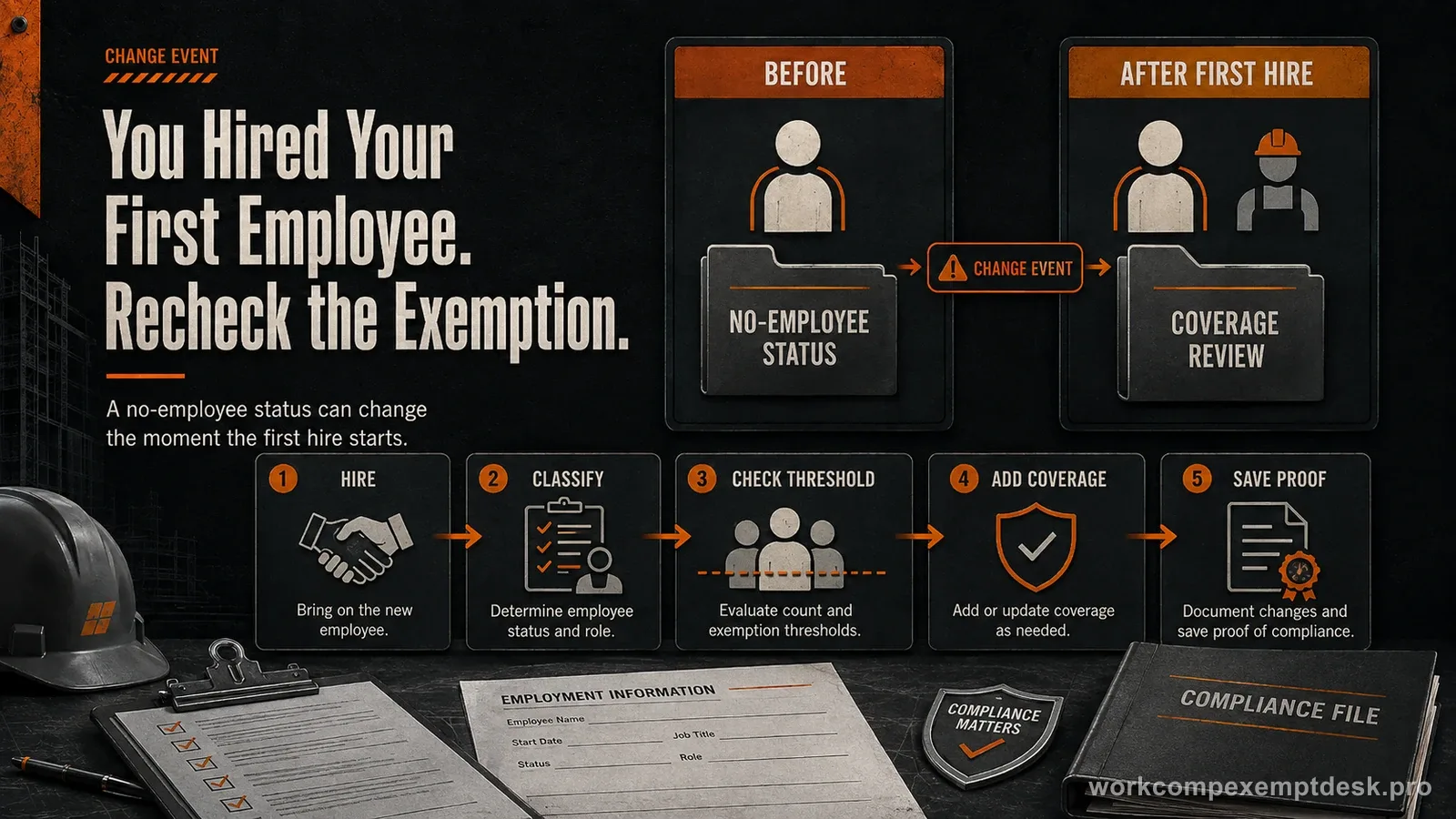
Hiring the first employee should trigger a fresh company-level workers' compensation review. The owner may remain personally excluded while the business becomes required to carry coverage for the employee—or the state threshold may still not be reached. The answer depends on the state and industry.
What to verify before relying on an exemption
- Identify the employee's first day of actual work
- Apply the correct state and industry employee threshold
- Check whether excluded owners count toward that threshold
- Secure required coverage before the statutory trigger date
- Replace or update no-employee and contractor proof documents
A no-employee business can operate for years with an owner election, no-employee certificate, or no policy requirement. The first hire changes the factual foundation of that setup. The mistake is to ask only whether the owner's exemption remains valid. The business also has to determine whether the new worker triggers coverage, whether the owner still counts toward a threshold, and whether existing proof documents now overstate the company's status.
Treat the first hire as a new legal fact, not an HR detail
Workers' compensation requirements are often triggered by facts about the workforce. The date an employee begins work can therefore matter more than the date payroll software is configured or the first paycheck is issued. The business should identify the actual start date and complete the coverage analysis before the employee begins covered work.
The owner's prior exemption may still be relevant, but it no longer answers the whole question. The company now has a worker whose status must be analyzed independently.
One employee is enough in some states and industries
California generally requires employers to provide workers' compensation when they have one or more employees. Florida construction employers with one or more employees must secure coverage. Pennsylvania generally requires coverage when an employer has at least one employee unless all workers fit an exclusion.
Those examples show why a business cannot rely on a national rule such as “workers' comp starts at three employees.” The first employee may be the trigger immediately depending on the state and the work being performed.
Other states use a higher threshold—but owners may affect the count
Florida non-construction employers generally use a four-employee threshold. Georgia generally uses three persons and counts corporate officers and LLC members toward that threshold even when they reject personal coverage. A business with two working owner-officers that hires one employee can therefore present a different Georgia result from what the phrase “first employee” suggests.
Do the state-specific count from scratch. List every person the statute or agency says must be counted, then apply any exclusions. Do not begin by subtracting owners simply because they have personal exemption paperwork.
No-employee certificates may need to be replaced or withdrawn
A document based on having no employees can become inaccurate the moment the workforce changes. California's CSLB no-employee exemption, for example, is tied to the licensee continuing to meet the no-employee conditions; CSLB directs contractors to submit proof of coverage after employees are hired. New York's CE-200 is likewise based on the business not being required to carry coverage for the transaction at issue.
The compliance step is not merely buying a policy. Update the proof package so customers, prime contractors, licensing boards, and government agencies are not shown a no-employee document after the underlying fact has changed.
Classify the first worker and run the coverage checklist before onboarding
A common response to the first-hire issue is to pay the person as a contractor. That does not automatically solve workers' compensation. California expressly says that a 1099 or independent-contractor agreement does not determine status. New York has industry-specific presumptions in construction and commercial goods transportation.
If the worker performs the core work of the business under company direction, treat classification as a real legal question. A misclassified worker can create both coverage and penalty exposure even while the owner holds a valid personal exemption.
Add a workers' compensation gate to the hiring process: state, work location, industry, worker classification, employee count, owner count treatment, required policy effective date, and any certificate or licensing updates. Assign responsibility to one person so the review happens before the start date rather than after a customer asks for proof.
Then repeat the same check when the second or third worker is hired if the state uses a higher numerical threshold. The first employee is the most obvious trigger, but every head-count change matters until the business is clearly above the state's coverage threshold.
Frequently asked questions
- Do I need to recheck my exemption after hiring my first employee?
- Yes. A staffing change can cross a coverage threshold, change how owners are counted, or trigger a company policy requirement even if the owner's personal exemption is unchanged.
- Does my owner exemption still work once I have employees?
- The owner election usually still removes the owner personally, but the business may now have to carry coverage for the new employee. Those are separate results.
- What should I check first after hiring?
- The state's coverage threshold, whether the new worker is an employee or contractor under that state's test, and the filing or notice duties that a first hire can create.
Agency and statutory pages used for this guide
These links back the state-specific examples above. Recheck the destination state's current rule before filing or changing coverage.