Florida
Workers' Comp Exemption
Verified against Florida Department of Financial Services, Division of Workers' Compensation on 2026-08-25
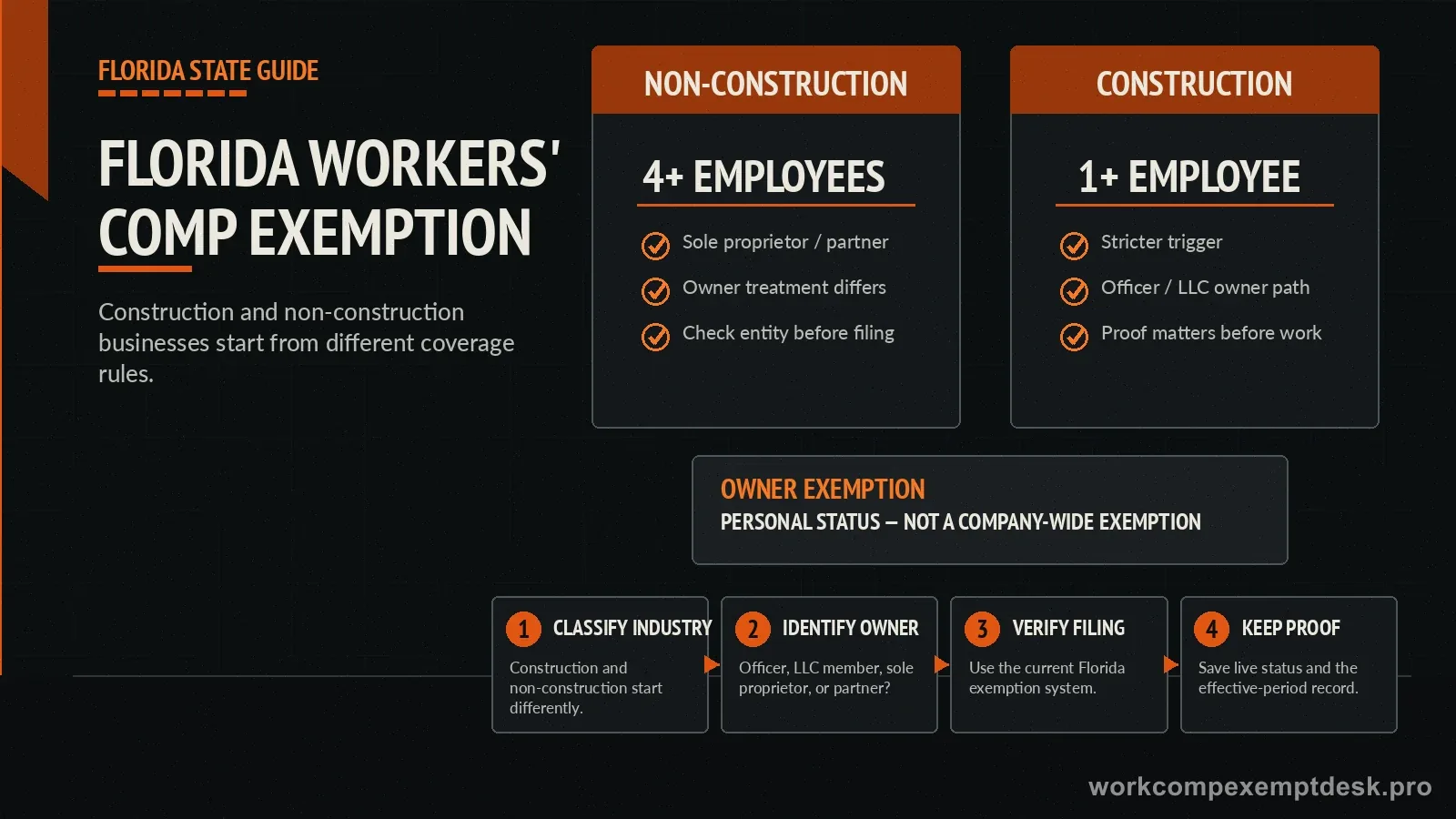
Construction and non-construction businesses start from different coverage thresholds. A qualifying corporate officer or LLC member can obtain an individual exemption, but the certificate belongs to that owner—not to the company—and an exempt owner gives up workers’ compensation benefits for their own work injury while the exemption is in force.
Entity types covered
- Sole proprietor
- LLC member
- Partner
- Corporate officer
Florida is one of the states where the word “exemption” has a precise workers’ compensation meaning. The first question is not simply whether you own the business; it is whether the business is in construction or non-construction, what legal entity you operate through, and whether the owner is being removed from employee status or is already outside that status under the statute.
Construction and non-construction businesses start from different coverage thresholds. A qualifying corporate officer or LLC member can obtain an individual exemption, but the certificate belongs to that owner—not to the company—and an exempt owner gives up workers’ compensation benefits for their own work injury while the exemption is in force.
Owner treatment, at a glance
Sole proprietorNon-construction: not treated as an employee unless the owner elects coverage on DWC-251. Construction: current Division contractor guidance treats sole proprietors as employees; the current owner-exemption application is for corporate officers and LLC members.
LLC memberAn LLC member may apply to exclude themself from employee status. In construction, the member must attest to at least 10% ownership; no more than three exemptions are permitted per business or affiliated group, and the application fee is $50. In non-construction, an LLC member must attest to at least 10% ownership and no more than 10 members may elect exemption.
PartnerNon-construction: partners are not treated as employees unless they elect coverage on DWC-251. Construction: current Division contractor guidance treats partners as employees; the current owner-exemption application is for corporate officers and LLC members.
Corporate officerA qualifying corporate officer may file a Notice of Election to be Exempt. Construction officers must be listed with the Division of Corporations, attest to at least 10% ownership, and are subject to the three-exemption limit and $50 fee. Non-construction officers must be listed as officers of an active corporation; the Division's current non-construction page does not impose the construction fee or three-officer limit.
Florida has two different starting lines
For non-construction employers, the Division of Workers’ Compensation says coverage is generally required once the business has four or more employees. The count includes non-exempt corporate officers and LLC members. Non-construction sole proprietors and partners are treated differently: they are not employees for this purpose unless they elect to be covered.
Construction is much stricter. A construction employer with one or more employees must secure coverage, and the Division counts a non-exempt owner who is a corporate officer or LLC member as an employee. That means a small construction company can reach the coverage requirement immediately even when the only person doing the work is an owner who has not obtained a valid exemption.
This split is why a Florida owner should identify the industry classification before looking for a form. A rule that is correct for a four-person non-construction shop can be wrong for a one-person construction operation.
The exemption belongs to the person, not the business
Florida’s exemption system is designed for an officer of a corporation or a member of an LLC to exclude that individual from the statutory definition of employee. The Division expressly says exemptions are issued to the officer or member, not to the business entity itself.
That distinction matters when a company has several owners. One member’s certificate does not make the other members exempt, and it does not remove the company’s duty to cover ordinary employees. It also matters after an injury: the Division states that an exempt officer or member may not recover workers’ compensation benefits while that exemption applies.
A certificate therefore changes the owner’s personal treatment under the workers’ compensation law. It is not a blanket certificate saying that the company never needs a policy.
Construction owners face ownership, filing, and head-count limits
For a construction corporation, the company must be active with the Florida Division of Corporations, the applicant must be listed as an officer, and the applicant must attest to at least 10 percent ownership. The construction page also limits exemptions to three officers across a corporation or affiliated group and requires a $50 application fee for each application.
The LLC path is similar but keyed to membership rather than officer status. The LLC must be active, the member must attest to at least 10 percent ownership, and the same three-exemption limit and $50 fee apply. The Division also states that an applicant cannot be affiliated with an active Stop Work Order or Working in Violation status, and a valid state driver’s license is required to obtain or renew the certificate.
Construction exemptions are not permanent. Current Florida employer materials state that they are valid for two years unless voluntarily revoked or revoked by the Division. A construction owner who relies on an old certificate should therefore verify the expiration rather than assuming an exemption continues indefinitely.
Non-construction owners do not all use the same path
A non-construction sole proprietor or partner is already outside employee status unless that person elects coverage. In other words, that owner does not need a DWC-250 owner-exemption certificate to accomplish what the statute already does. Florida instead provides an election-of-coverage process for a sole proprietor or partner who wants to come into the system.
Corporate officers in non-construction may elect exemption if the corporation is active and the applicant is listed as an officer. The current non-construction eligibility page does not impose the construction industry’s 10 percent ownership rule, three-officer cap, or $50 fee on corporate officers.
LLC members have a different non-construction rule: the member must attest to at least 10 percent ownership, and no more than 10 LLC members may elect exemption. This is a useful example of why “owner” is not a single workers’ compensation category in Florida—the entity form changes the filing analysis.
A valid owner exemption does not solve the subcontractor problem
Florida puts a separate compliance burden on contractors. Before subcontracted work begins, the contractor is expected to confirm that the subcontractor has the required workers’ compensation coverage or valid owner exemption documentation. The Division warns that if a subcontractor does not have coverage for its employees, those workers can become the contractor’s responsibility for workers’ compensation purposes.
Construction also has an unusually strict classification problem: Florida’s employer FAQ says the workers’ compensation law does not recognize independent contractors in the construction industry in the ordinary way. A worker is either a business owner or an employee of a business for this purpose. Calling a worker a 1099 contractor does not itself remove the coverage issue.
For a small general contractor, this means the owner’s exemption is only one piece of the file. The business still needs a reliable way to verify the status of every person and subcontractor on the project.
After approval, verify the certificate and manage the events that can make it stale
The useful compliance record does not end with the approval screen. Florida maintains an exemption search that contractors and other parties can use to confirm whether an individual exemption is active. Keep the issued certificate with the company’s workers’ compensation records, but also keep the information needed to re-check the owner in the Division’s system when a general contractor, customer, or auditor asks for current proof.
For construction exemptions, the two-year term creates a real calendar event. A certificate that was valid when a subcontract began can expire during a later project. Non-construction exemptions do not use that same two-year cycle, but they still depend on the facts that supported the election. A change in entity type, officer/member status, ownership, or the nature of the business can make an old compliance file unreliable even if a PDF is still sitting in the folder.
The same file should separate owner proof from workforce proof. Keep the owner’s exemption record, the company’s policy information if employees remain covered, and the coverage or exemption evidence collected from subcontractors as distinct items. That makes it much easier to answer the practical question a contractor is usually asked: who is exempt personally, who is insured, and what proof was current on the date the work started.
What failing to secure coverage actually costs in Florida
Florida treats a coverage gap as an immediate public-safety matter, not a paperwork lapse — the statute itself calls it a serious danger sufficient to justify shutting the business down on the spot.
An employer that fails to secure required coverage, or fails to produce requested business records within 21 days of the department's written request, can be issued a stop-work order within 72 hours, halting all business operations. On top of the stop-work order, the department assesses a penalty equal to 2 times the premium the employer would have paid using approved manual rates for the period it went without coverage, or $1,000, whichever is greater.
Operating in violation of an active stop-work order draws a separate penalty of $1,000 for each day of the violation. A first-time violator can get the assessed penalty reduced 25% for promptly producing business records, and a further 15% reduction for completing the state's coverage and compliance tutorial with at least 80% correct answers.
- Stop-work order: issued within 72 hours, immediate cessation of all business operations
- Base penalty: 2× the premium the employer would have paid for the uninsured period, or $1,000, whichever is greater
- Operating through a stop-work order: separate penalty of $1,000 per day of violation
- First-time violators: up to 25% reduction for prompt records, plus 15% for completing a compliance tutorial
Florida owner checklist
- Classify the business as construction or non-construction before counting employees.
- Identify the owner’s legal role: sole proprietor, partner, LLC member, or corporate officer.
- For construction, verify active entity status, at least 10% ownership, and the three-exemption affiliated-group limit.
- Treat the exemption as personal to the named owner; do not use one certificate as proof that the entire company is exempt.
- Verify subcontractor coverage or owner exemptions before work starts.
- Verify the owner in the Division exemption system, calendar any construction expiration, and re-check after ownership, entity, workforce, or business-activity changes.
Form, fee, and timing, at a glance
Cross-checked against Florida Department of Financial Services, Division of Workers’ Compensation and verified 2026-09-10. This restates the state forms reference; the state agency remains the authority.
Coverage ruleNon-construction employers generally must secure workers' compensation coverage when they have four or more employees, counting non-exempt corporate officers and LLC members. Sole proprietors and partners in non-construction are not treated as employees unless they elect coverage.
Construction ruleConstruction employers with one or more employees must have coverage. Corporate officers and LLC members may qualify for an owner exemption; construction sole proprietors and partners are treated as employees under the Division's current contractor guidance and are not listed as eligible applicants in the current exemption system.
DocumentDWC-250 — Notice of Election to Be Exempt
Issuing bodyFlorida Department of Financial Services, Division of Workers’ Compensation
Filing methodOnline DWC Notice of Election to Be Exempt system.
Fee$50 plus $1 convenience fee (construction); $0 (non-construction)
NoteThe $50 construction exemption is limited to active officers/members with at least 10% ownership, with a three-person cap across affiliated entities. Non-construction corporations have no ownership-percentage rule or fee; non-construction LLC members need at least 10% ownership and are capped at 10. The online service handles application, renewal, status lookup, and certificate printing.
EffectiveWhen issued by the Division or 30 days after receipt, whichever occurs first, subject to the statute’s special early-policy rule.
Renewal2 years; renewal application is required. Florida sends an expiration notice at least 60 days before expiration.
Watch out forConstruction and non-construction have different eligibility and fee rules; the exemption is issued to the individual, not the business.
Full DWC-250 filing guide Open the official source Compare renewal rules across states Run the eligibility screener
Agency in charge
Florida Department of Financial Services, Division of Workers' Compensation
Official source library
These are the state-agency, statutory, or state-board materials used for this guide. The page was last source-checked on 2026-08-25.
- Florida DFS — Coverage Requirements
- Florida DFS — Workers' Compensation Exemptions
- Florida DFS — Construction Exemption Eligibility
- Florida DFS — Non-Construction Exemption Eligibility
- Florida DFS — Workers' Compensation Forms (DWC-250 / DWC-251)
- Florida DFS — Employer Frequently Asked Questions
- Florida DFS — Election of Coverage for Sole Proprietors / Partners
Florida workers' comp exemption FAQ
- Does a sole proprietor need workers' comp coverage in Florida?
- Non-construction: not treated as an employee unless the owner elects coverage on DWC-251. Construction: current Division contractor guidance treats sole proprietors as employees; the current owner-exemption application is for corporate officers and LLC members.
- Can an LLC member get a workers' comp exemption in Florida?
- An LLC member may apply to exclude themself from employee status. In construction, the member must attest to at least 10% ownership; no more than three exemptions are permitted per business or affiliated group, and the application fee is $50. In non-construction, an LLC member must attest to at least 10% ownership and no more than 10 members may elect exemption.
- How does a corporate officer opt out of workers' comp in Florida?
- A qualifying corporate officer may file a Notice of Election to be Exempt. Construction officers must be listed with the Division of Corporations, attest to at least 10% ownership, and are subject to the three-exemption limit and $50 fee. Non-construction officers must be listed as officers of an active corporation; the Division's current non-construction page does not impose the construction fee or three-officer limit.
- Are partners covered by workers' comp in Florida?
- Non-construction: partners are not treated as employees unless they elect coverage on DWC-251. Construction: current Division contractor guidance treats partners as employees; the current owner-exemption application is for corporate officers and LLC members.
- What form is used for a Florida workers' comp owner exemption?
- DWC-250 — Notice of Election to be Exempt (submitted through the Division's online exemption system). Construction exemptions are valid for two years and must be renewed to continue. Non-construction exemptions remain valid until voluntarily revoked or revoked by the Division.
Answers restate the sourced fields above. Open the official source library for the underlying agency and statute pages.