Workers' Comp Owner Exemptions in Construction
Built from official state-agency sources · desk review 2026-08-26
Construction often has stricter coverage triggers, tighter owner rules, and heavier proof requirements than ordinary businesses.
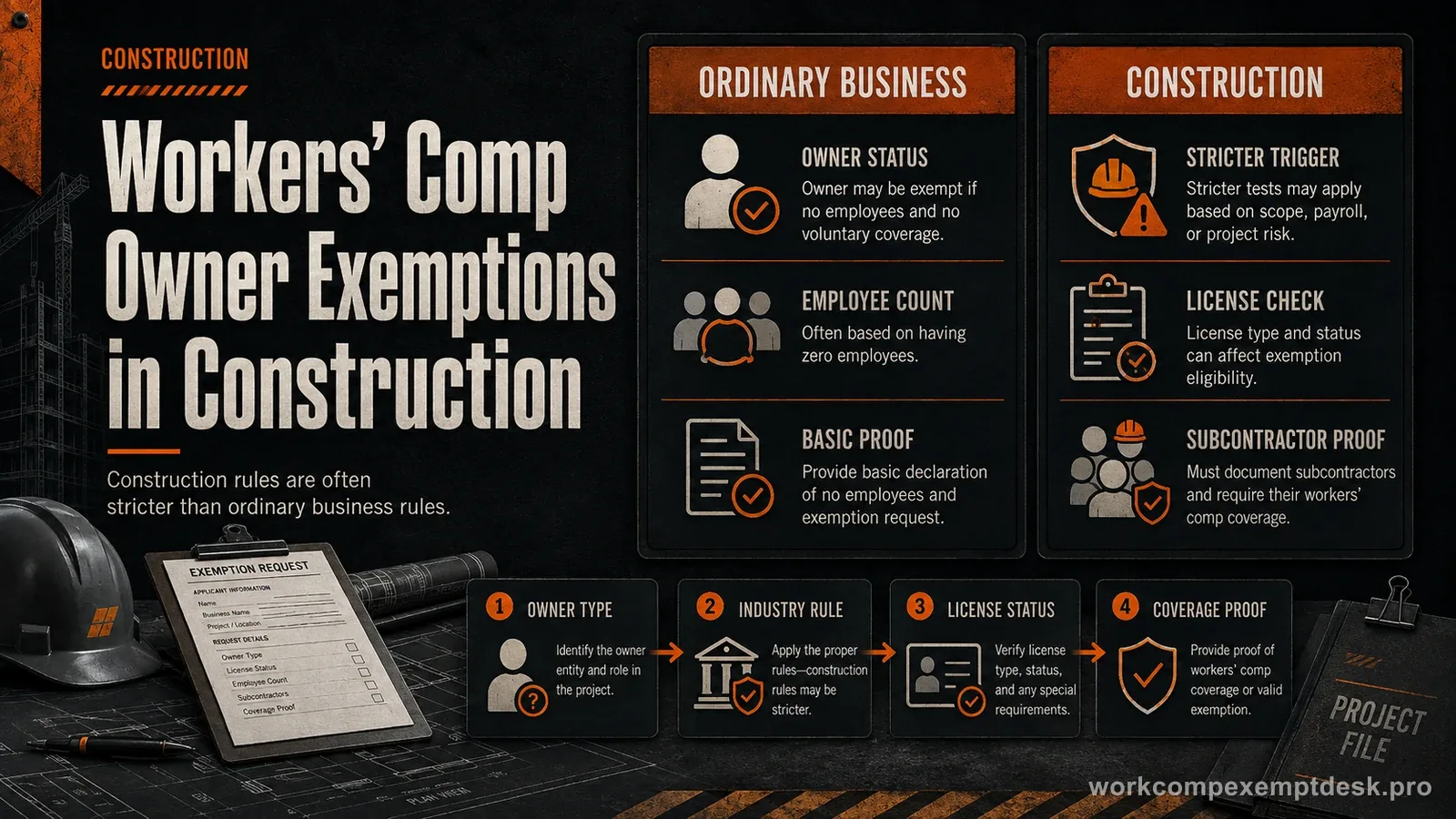
Construction is one of the worst places to assume a general owner-exemption rule applies unchanged. States may use lower coverage thresholds, narrower owner eligibility, contractor-licensing requirements, subcontractor liability, and job-specific proof rules.
Facts to lock down before relying on an exemption
- Confirm whether the state has a construction-specific employee threshold
- Check whether sole proprietors, partners, LLC members, and officers are treated differently in construction
- Verify contractor-license workers' compensation requirements
- Collect proof from subcontractors and verify worker classification
- Recheck coverage before crossing state lines or starting a public project
A small contractor can have no office staff, one working owner, and a few subcontractors yet face more workers' compensation scrutiny than a larger non-construction business. The reason is not one national construction rule. It is the combination of state coverage thresholds, worker-classification laws, licensing systems, and prime-contractor risk. Construction research therefore starts with the state and the exact trade before the owner exemption is evaluated.
Construction can have a lower coverage trigger than ordinary business
Florida provides a direct example. Non-construction employers generally reach the workers' compensation requirement at four or more employees, while construction employers with one or more employees must secure coverage. Agricultural employers have another rule again. An owner who reads only the general non-construction threshold can therefore reach the wrong conclusion before the project even begins.
This is why industry classification belongs at the top of the research worksheet. The business should confirm whether its actual trade falls within the state's construction definition and whether the rule counts non-exempt owners when determining the trigger.
SOURCE CONTEXT: Florida publishes separate construction and non-construction coverage requirements.
Owner eligibility can narrow inside the construction industry
Florida also shows how the owner rule itself can change. The current construction exemption process is aimed at qualifying corporate officers and LLC members, with ownership, numerical-limit, and fee requirements. Sole proprietors and partners do not simply carry over the non-construction treatment into the construction exemption system.
That is a critical distinction for a one-person trade business. The legal entity selected at formation can change the available workers' compensation owner path once the company performs construction work. The answer should come from the construction-specific agency page, not a generic owner FAQ.
Licensing boards can create a second compliance layer
California contractors have to account for CSLB requirements in addition to the general workers' compensation rules. The Board allows a no-employee exemption only for eligible licensees and identifies classifications and situations where a contractor must carry workers' compensation even with no employees. California DWC also specifically notes that roofers must carry coverage even with no employees.
The practical lesson is that a general owner waiver and a contractor-license workers' compensation record are not automatically the same thing. A contractor should verify both the employment-law status and the license-maintenance requirement before deciding that no policy is needed.
SOURCE CONTEXT: California DWC and CSLB maintain construction-specific compliance rules for licensed contractors.
Subcontractors can create exposure even when the owner is excluded
Construction projects often move risk up the contracting chain. A prime contractor may require certificates of insurance or other proof from every subcontractor because an uninsured subcontractor can create workers' compensation exposure for the contractor under state law. The owner's personal election does not resolve whether the subcontractor's labor force is properly insured.
Lower-tier workers can create exposure even when the principal owner is excluded
A useful subcontractor file includes the legal entity, workers' compensation policy or valid state-specific exemption evidence, coverage dates, and verification of who will actually perform the work. If the subcontractor arrives with additional helpers not reflected in the original proof, the file should be rechecked before work continues.
Worker classification is a separate construction risk
Calling a laborer or crew member an independent contractor does not necessarily remove the worker from workers' compensation. Pennsylvania applies the Construction Workplace Misclassification Act to construction, and California uses statutory employment tests that cannot be defeated simply by issuing a 1099. Illinois also flags construction and construction-site trucking for classification scrutiny.
For a small contractor, that means the owner-exemption analysis should never be used as a substitute for classifying everyone else. The owner can have a valid opt-out while the business still misclassifies workers and fails to secure required coverage for them.
Public projects and cross-border jobs need a fresh review
Texas generally allows most private employers to choose whether to carry workers' compensation, but building or construction work for governmental entities has a major statutory exception: contractors and subcontractors must provide coverage for employees working on the public project. New York also imposes full statutory New York coverage on out-of-state contractors working on construction projects in the state.
The safe workflow is project-specific. Before mobilization, check the project's state, public or private status, licensing rules, employee and subcontractor roster, and required proof language in the contract. A certificate that worked for a private job at home may not satisfy a public project or another state's law.
SOURCE CONTEXT: Texas public construction and New York out-of-state construction rules illustrate project-specific coverage obligations.
Common questions
- Are construction workers' comp rules stricter for owners?
- Frequently. Construction often has lower or one-employee coverage triggers, tighter owner-eligibility conditions, and heavier proof requirements than an ordinary business in the same state.
- Does calling a construction worker a 1099 contractor remove the coverage issue?
- Not on its own. Some states do not recognize independent-contractor status in construction the ordinary way, and misclassification statutes can apply.
- Can a general contractor be liable for an uninsured subcontractor's injured worker?
- In many states, yes. That is why contractors verify each subcontractor's coverage or valid owner exemption before work begins.
Agency and statute pages behind this guide
The state-specific examples above draw on these links. Always confirm the current rule with the destination state before filing or changing coverage.