Michigan
Workers' Comp Exemption
Verified against Michigan Department of Labor and Economic Opportunity, Workers' Disability Compensation Agency on 2026-08-25
Michigan generally requires coverage when a private employer has one person working at least 35 hours a week for 13 weeks in the prior 52 weeks, or three employees at one time. Owner-only partnerships, small corporations, and qualifying LLCs can sometimes use WC-337 instead of buying a policy, but WC-337 is valid only when every employee is excludable and the business uses no subcontractors. A sole proprietor with no employees does not use WC-337 just to prove independent-contractor status.
Entity types analyzed
- Sole proprietor
- LLC member
- Partner
- Corporate officer
Michigan is easy to misread because the state combines a staffing threshold with entity-specific owner rules. A sole proprietor is never the employee of the sole proprietorship, while partners, corporate officers, and qualifying LLC member-managers can start from employee status and then use a statutory exclusion path. The result depends on both head count and who the workers actually are.
Michigan generally requires coverage when a private employer has one person working at least 35 hours a week for 13 weeks in the prior 52 weeks, or three employees at one time. Owner-only partnerships, small corporations, and qualifying LLCs can sometimes use WC-337 instead of buying a policy, but WC-337 is valid only when every employee is excludable and the business uses no subcontractors. A sole proprietor with no employees does not use WC-337 just to prove independent-contractor status.
How owners are treated, at a glance
Sole proprietorThe sole proprietor is self-employed and is not an employee of the sole proprietorship. The business generally needs a policy when it has one full-time employee or three part-time employees; a no-employee sole proprietor does not use WC-337 simply to prove independent-contractor status.
LLC memberA member who is also a manager is treated as an employee. An LLC with no more than 10 members may exclude a member-manager who owns at least 10% and meets the statutory consent requirements. If all employees are qualifying member-managers, the LLC may use WC-337; otherwise the exclusion is handled through the insurer while the business maintains employee coverage.
PartnerA partner is treated as an employee of the partnership. A named partner may be excluded by policy endorsement, and a partnership whose only employees are partners may use WC-337. The exclusion does not remove the business's obligation to insure non-excluded employees.
Corporate officerA corporate officer is treated as an employee. In a corporation with no more than 10 stockholders, an officer-stockholder owning at least 10% may elect individual exclusion with the corporation's consent. If every employee is a qualifying officer-owner, WC-337 can serve as the Agency-filed exclusion record.
Michigan has two general private-employer triggers, not one simple head count
The Workers’ Disability Compensation Agency lists two alternative triggers for ordinary private employers. Coverage is required when an employer regularly has at least one employee working 35 hours or more per week for 13 weeks or longer during the preceding 52 weeks. Coverage is also required when the employer regularly has three or more employees at one time, including part-time employees. A business can therefore cross the line with one sustained full-time worker or with a larger part-time crew even if no one works 35 hours.
Agriculture has its own version of the rule: three or more employees working 35 hours or more per week for 13 or more consecutive weeks. That separate agricultural trigger is one reason a Michigan owner should not copy the general threshold into a farm or seasonal-labor analysis without checking the business category.
The threshold question comes before the owner-exclusion question, but the two interact because Michigan treats some owners as employees. The Agency says a partner is an employee of the partnership, a corporate officer is an employee of the corporation, and an LLC member who is also a manager is an employee of the LLC. Those owner-workers can affect the entity’s starting position even when no outside employee has been hired.
A sole proprietor starts outside personal coverage; partnerships, corporations, and LLCs do not
Michigan’s sole-proprietor rule is unusually clear. The individual owner is self-employed and is not an employee of the sole proprietorship. The owner therefore does not buy a workers’ compensation policy merely to cover themself under the business. The business’s obligation changes when employees are added: the Agency’s 2026 employer publication summarizes the sole-proprietor trigger as one full-time or three part-time employees.
A partnership, corporation, or LLC requires a different analysis because the law can treat owner-workers as employees. The recent Agency publication says those entities must either maintain a workers’ compensation policy or have a valid WC-337 exclusion on file when the owner-only structure fits the exclusion rules. It is not enough to say that everyone on the payroll is an owner.
For LLCs, role and ownership matter together. Section 161 allows an employee of an LLC with no more than 10 members to elect individual exclusion when the person is both a member and manager, owns at least 10 percent, and satisfies the statutory consent rules. A passive member, a manager who is not a member, or an owner whose structure does not meet the statutory conditions should not be assumed to qualify.
WC-337 is an owner-only compliance route with strict boundaries
The most important limit on WC-337 is easy to miss: the Agency says an employer may use the form only if all employees can be excluded under the Act and no subcontractors are used in the business. The form is therefore not a general-purpose waiver that a company can file while continuing to employ ordinary non-owner workers. If even one worker is not excludable, the business needs a policy and any qualifying owner exclusion is handled within that insured structure.
The Agency’s 2026 publication gives the owner-only categories. A partnership can use the route when all employees are partners. A stock corporation can use it when all employees are corporate officers who each own at least 10 percent. An LLC can use it when all employees are members who are also managers and each owns at least 10 percent. A sole proprietorship can use the exclusion form only in the narrow family-employee setting described by the Agency—not when the sole proprietor is simply working alone.
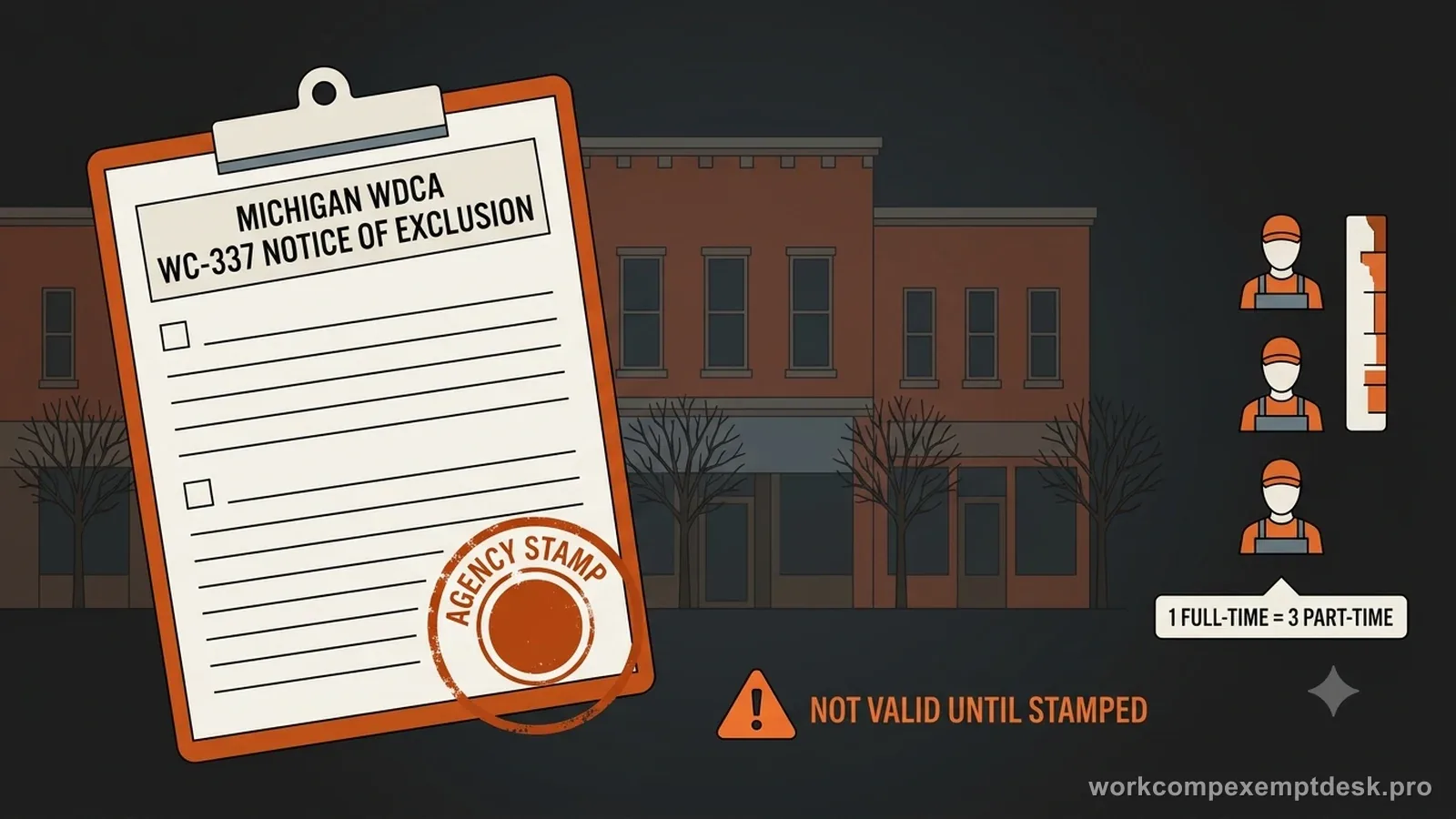
WC-337 is also not valid merely because someone filled out a copy. The Agency says the form is not available online and is not valid unless stamped by the Workers’ Disability Compensation Agency showing that it is on file. A contractor asking for proof should therefore receive the actual Agency-filed record when WC-337 is the relevant document, not a homemade owner affidavit.
When employees remain, qualifying owners are excluded through the policy instead of replacing it
Michigan separates the owner-only WC-337 route from exclusions inside a policy. If a partnership or corporation has other employees, the Agency FAQ directs the business to arrange qualifying partner or officer exclusions with its insurance company rather than treating WC-337 as a substitute for employee coverage. Section 161 likewise provides individual exclusion rules for certain named owners.
For a small corporation, an officer-stockholder in a corporation with no more than 10 stockholders may elect individual exclusion when the officer owns at least 10 percent of the stock and the corporation gives the required consent. For an LLC with no more than 10 members, the comparable rule requires a member-manager with at least a 10 percent interest and the applicable member/manager consent. A named partner can also be excluded through the statutory policy mechanism.
These personal exclusions save premium on the owner’s exposure; they do not turn employees into uninsured workers. Keep the current policy declarations, carrier endorsement or exclusion confirmation, ownership records, and corporate/LLC role documents together. That file is more useful than a generic certificate because it shows why the named owner is outside personal coverage while the rest of the company remains insured.
Subcontractors can destroy the WC-337 path even when there are no outside employees
Michigan’s latest employer publication says corporations, LLCs, and partnerships must have a workers’ compensation policy if they use subcontractors. The same publication says the WC-337 exclusion route is available only when no subcontractors are used. That makes a project-based business especially vulnerable to stale owner-only paperwork: a company can start as a two-owner entity and later hire a subcontractor without realizing the compliance structure has changed.
The issue is distinct from whether a particular subcontractor ultimately proves to be an independent contractor. WC-337 does not establish contractor status, and the Agency expressly says the exclusion form does not establish the relationship between the business and a contractor. A general contractor, trade business, or field-service company should therefore maintain contractor classification evidence separately from its owner-exclusion record.
If the company’s business model changes from owner-only work to subcontracted work, re-run the coverage analysis before the first project begins. Waiting until a premium audit or injury occurs means the owner-only document may be accurate historically but irrelevant to the current operation.
Treat hiring, subcontracting, ownership changes, and exclusion revocation as four separate reset events
The first reset is hiring. A sole proprietor who crosses the one-full-time or three-part-time trigger needs employee coverage; an owner-only partnership, corporation, or LLC using WC-337 no longer fits that route when a non-excludable employee is added. The second reset is subcontracting, because the Agency’s current owner-only exclusion guidance disallows WC-337 when subcontractors are used.
The third reset is an ownership or management change. A corporate officer can fall below the 10 percent stock requirement, an LLC member-manager can lose manager status, or a new owner can expand the number and composition of the entity. The fourth reset is a voluntary return to coverage. Michigan lists WC-338 as the Notice to Terminate Exclusion, and the statute also contemplates written revocation of individual exclusions.
A reliable Michigan file therefore keeps the staffing calendar, current entity documents, ownership percentages, any Agency-stamped WC-337, carrier endorsements, and any WC-338 or written revocation. Those records answer different questions; one old 'exemption certificate' should never be expected to prove all of them.
What failing to carry insurance actually costs in Michigan
Michigan treats every day without required coverage as a fresh violation, which is what lets criminal fines stack up quickly on top of a separate civil penalty tied to unpaid premiums.
An employer that fails to obtain required workers' compensation coverage is guilty of a misdemeanor, punishable by a fine of up to $1,000, up to 6 months in jail, or both — and each day of continued failure is treated as a separate offense.
On the civil side, the Workers' Disability Compensation Agency can assess a penalty of twice the premium the employer should have paid for the uninsured period, and can bar the business from having any employees at all until it obtains coverage.
- Misdemeanor: fine up to $1,000 and/or up to 6 months in jail — each day is a separate offense
- Civil penalty: 2× the premium that should have been paid for the uninsured period
- Agency can prohibit the business from having any employees until coverage is in place
Michigan owner checklist
- Apply both Michigan staffing triggers; do not use only a three-person head count.
- Identify whether each owner is a sole proprietor, partner, corporate officer, or LLC member-manager before counting employees.
- Use WC-337 only when every employee is legally excludable and no subcontractors are used.
- Confirm that any WC-337 relied on is Agency-stamped and on file.
- When ordinary employees remain, preserve the policy plus any owner-specific carrier exclusion rather than replacing the policy with WC-337.
- Re-check immediately after the first non-excludable hire, first subcontractor, ownership/manager change, or exclusion revocation.
Form, fee, and timing at a glance
Cross-checked against Michigan Workers’ Disability Compensation Agency and verified 2026-09-10. This restates the state forms reference; the state agency remains the authority.
Coverage ruleMichigan generally requires coverage when a private employer regularly employs at least one person 35 hours or more per week for 13 weeks in the preceding 52 weeks, or regularly employs three or more people at one time. Agricultural employers use a separate three-employee / 35-hour / 13-consecutive-week trigger.
Construction ruleThe cited Michigan materials do not publish a separate construction head-count trigger. For corporations, LLCs, and partnerships, the Agency's 2026 employer publication says a workers' compensation policy is required if the business has any employees or uses subcontractors; the WC-337 owner-only exclusion path is available only when all employees can be excluded and no subcontractors are used.
DocumentWC-337 — Notice of Exclusion
Issuing bodyMichigan Workers’ Disability Compensation Agency
Filing methodFile the current WC-337 with the Agency under its owner-only exclusion process.
FeeNo separate filing fee verified
NoteWC-337 is not a generic owner certificate. Mich. Admin. Code R 408.41b makes the exclusion effective upon Agency receipt, but the Agency form also states it is not valid unless stamped as on file — so keep the stamped copy. Businesses with employees generally handle qualifying owner exclusions through the policy instead.
EffectiveUpon receipt by the Michigan Workers’ Disability Compensation Agency (Mich. Admin. Code R 408.41b); the filed, stamped form is the proof.
RenewalNo fixed interval stated on the current WC-337 landing page; refile when the exclusion facts or Agency requirements change.
Watch out forWC-337 is an owner-only exclusion route and is not valid unless stamped on file by the Agency.
Full WC-337 filing guide Open the official source Compare renewal rules across states Run the eligibility screener
Which agency handles this
Michigan Department of Labor and Economic Opportunity, Workers' Disability Compensation Agency
Official sources for this page
These are the state-agency, statutory, or state-board materials used for this guide. The page was last source-checked on 2026-08-25.
Michigan workers' comp exemption FAQ
- Does a sole proprietor need workers' comp coverage in Michigan?
- The sole proprietor is self-employed and is not an employee of the sole proprietorship. The business generally needs a policy when it has one full-time employee or three part-time employees; a no-employee sole proprietor does not use WC-337 simply to prove independent-contractor status.
- Can an LLC member get a workers' comp exemption in Michigan?
- A member who is also a manager is treated as an employee. An LLC with no more than 10 members may exclude a member-manager who owns at least 10% and meets the statutory consent requirements. If all employees are qualifying member-managers, the LLC may use WC-337; otherwise the exclusion is handled through the insurer while the business maintains employee coverage.
- How does a corporate officer opt out of workers' comp in Michigan?
- A corporate officer is treated as an employee. In a corporation with no more than 10 stockholders, an officer-stockholder owning at least 10% may elect individual exclusion with the corporation's consent. If every employee is a qualifying officer-owner, WC-337 can serve as the Agency-filed exclusion record.
- Are partners covered by workers' comp in Michigan?
- A partner is treated as an employee of the partnership. A named partner may be excluded by policy endorsement, and a partnership whose only employees are partners may use WC-337. The exclusion does not remove the business's obligation to insure non-excluded employees.
- What form is used for a Michigan workers' comp owner exemption?
- WC-337 — Notice of Exclusion; WC-338 — Notice to Terminate Exclusion. The Agency does not publish a fixed annual renewal date for WC-337. A filed WC-337 remains the exclusion record until the underlying exclusion is revoked or the business no longer fits the exclusion conditions; WC-338 is the Agency form for terminating an exclusion.
Answers restate the sourced fields above. Open the official source library for the underlying agency and statute pages.