What a Certificate of Election Actually Proves
Built from official state-agency sources · desk review 2026-08-26
What an exemption certificate can establish, what it cannot establish, and why contractors often ask for it before work starts.
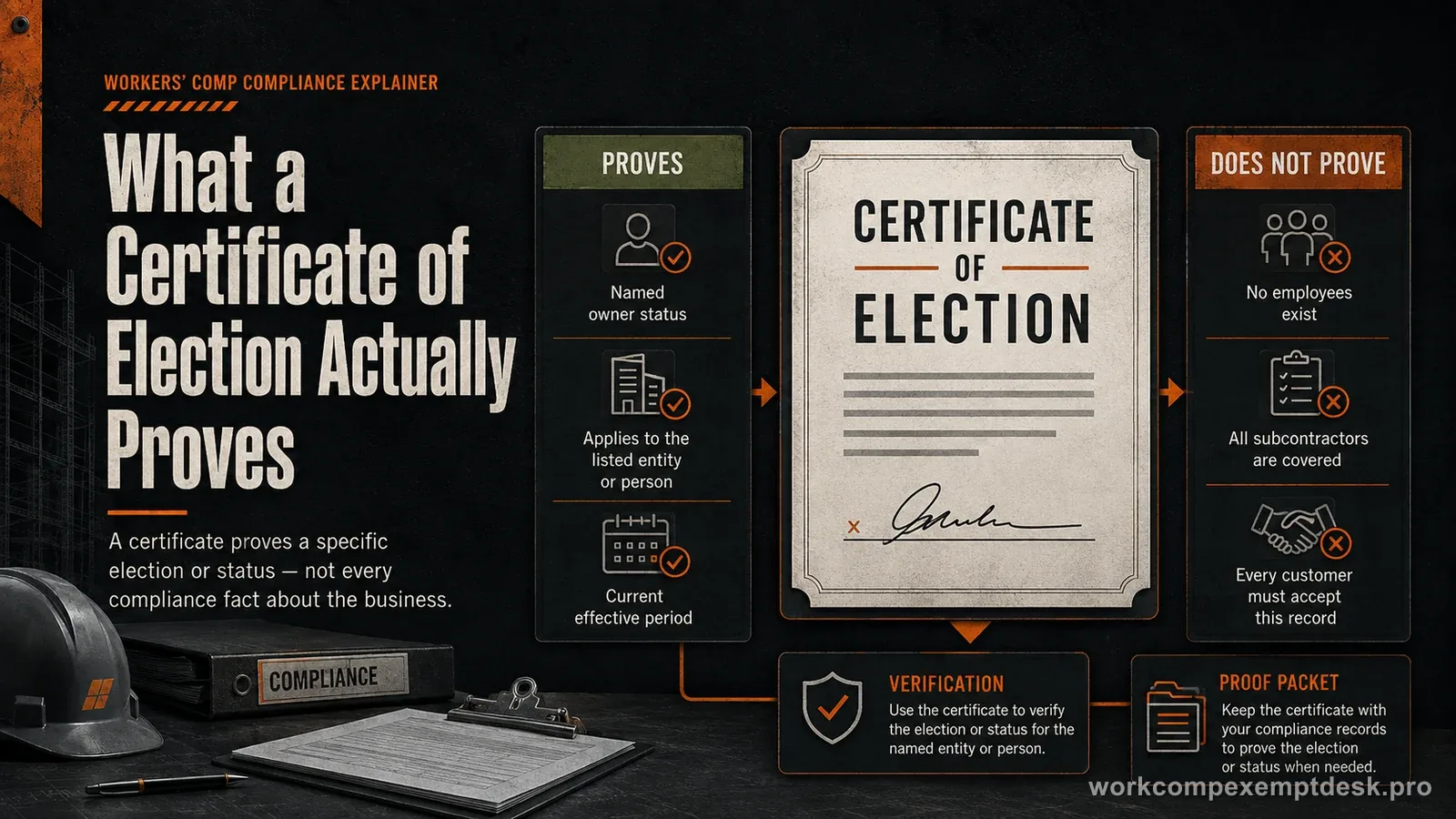
A certificate or election record proves only the status created by the issuing system. It does not automatically prove that the company has no employees, that every subcontractor is compliant, or that a customer must accept the document instead of insurance.
What to verify before relying on an exemption
- Match the certificate or form to the named individual and legal entity
- Confirm whether it is an owner election, no-employee certificate, carrier endorsement, or proof-of-coverage document
- Record the effective date, expiration, revocation, or withdrawal rule
- Check whether a project owner or licensing agency asks for a different document
- Verify the record again after a change in staffing, ownership, or business form
The phrase “certificate of exemption” sounds more universal than it is. Some states issue or recognize owner-exemption records, some use carrier endorsements, and some reserve a certificate for a specific transaction such as a government permit. Before relying on any document, identify who issued it, whose status it changes, how long it remains valid, and what facts can make it obsolete.
First identify what the document legally changes
A useful certificate has a defined legal job. Florida's owner-exemption system is designed for qualifying corporate officers and LLC members who elect to be exempt from workers' compensation coverage. The document is about the named owner's status. It should not be read as a blanket statement that the company has no workers or no workers' compensation obligations.
New York's CE-200 demonstrates why the document name alone can mislead. CE-200 is used when a business that is not required to carry workers' compensation and/or disability benefits coverage needs evidence for a government permit, license, or contract. It is not a general-purpose private-market owner exemption that automatically substitutes for every certificate of insurance request.
SOURCE CONTEXT: Compare Florida's owner-election system with New York's government-transaction CE-200 certificate.
A certificate can be person-specific, entity-specific, or transaction-specific
The safest reading starts with the names on the record. An owner election may apply to one officer or member, not every owner. A no-employee certificate may belong to one legal entity, not a commonly owned affiliate. A government permit certificate may apply to the named permit or transaction rather than every future job.
This becomes critical when a business has several DBAs, related LLCs, or a holding-company structure. Contractors often focus on the entity actually signing the contract. If the certificate is tied to a different entity, the fact that the same person owns both companies does not by itself establish the required status for the contracting company.
Check the effective-period rule instead of assuming annual renewal
There is no national one-year renewal convention. Florida construction exemptions are valid for two years unless revoked earlier, while its non-construction exemptions can remain valid until voluntary or agency revocation. California owner waivers under Labor Code section 3352 operate through the carrier and remain in effect until withdrawn in writing, assuming the statutory conditions remain satisfied.
That difference matters operationally. A recurring annual calendar reminder may be too late for a two-year certificate that expires midyear, and unnecessary for a waiver that continues until withdrawal. The compliance calendar should be built from the actual agency or carrier rule, not from a generic “renew every year” habit.
SOURCE CONTEXT: Florida and California show two different effective-period models.
Contractual proof can be stricter than the state filing
A general contractor may require a certificate of insurance even when an individual owner has validly excluded themself. The purpose is often to verify protection for the subcontractor's employees and reduce upstream exposure. A valid owner election answers only the owner's personal coverage question unless the state specifically gives the certificate a broader function.
The same issue appears with licensing boards and public agencies. California's CSLB uses workers' compensation records as part of contractor-license compliance, while New York government entities have their own proof requirements. The right document is determined by the transaction as well as the underlying legal status.
Verify the live record and build a proof packet that matches the request
A saved PDF is evidence of what existed when it was issued. It may not reveal a later revocation, ownership change, policy cancellation, or loss of eligibility. When the state provides an online lookup or when a carrier controls the endorsement, verification should include the live record or current carrier confirmation.
Preserve the verification date. That date is useful when bidding, renewing a vendor file, or responding to a customer's audit. It shows that the business checked current status rather than merely forwarding an old attachment whose legal effect was never reexamined.
A strong proof packet usually contains the current certificate or election record, the official source describing eligibility, the policy or carrier evidence for employees if coverage is required, and a note identifying the legal entity and owner to which the record applies. If a customer requests a different document, resolve that request directly instead of renaming one form to sound equivalent.
Avoid statements such as “the company is fully exempt” unless the official rule actually supports that conclusion. More precise language—such as “this officer has a current owner exclusion” or “this no-employee entity is using CE-200 for this government application”—reduces misunderstandings and makes later change-event reviews much easier.
Frequently asked questions
- What does a workers' comp exemption certificate actually prove?
- Only the status created by the system that issued it. It does not automatically prove the company has no employees, that every subcontractor is compliant, or that a customer must accept it instead of an insurance policy.
- Why do contractors ask for an exemption certificate before work starts?
- A prime contractor is managing its own downstream risk, especially in construction where an uninsured subcontractor's exposure can move upstream. That request can be stricter than the minimum the statute requires.
- Can an exemption certificate expire or become invalid?
- Yes. Some states set a fixed term; in every state the certificate depends on the facts behind it, so hiring, ownership changes, or an entity conversion can make an unexpired certificate unreliable.
Agency and statutory pages used for this guide
These links back the state-specific examples above. Recheck the destination state's current rule before filing or changing coverage.