North Carolina
Workers' Comp Exemption
Verified against North Carolina Industrial Commission on 2026-08-25
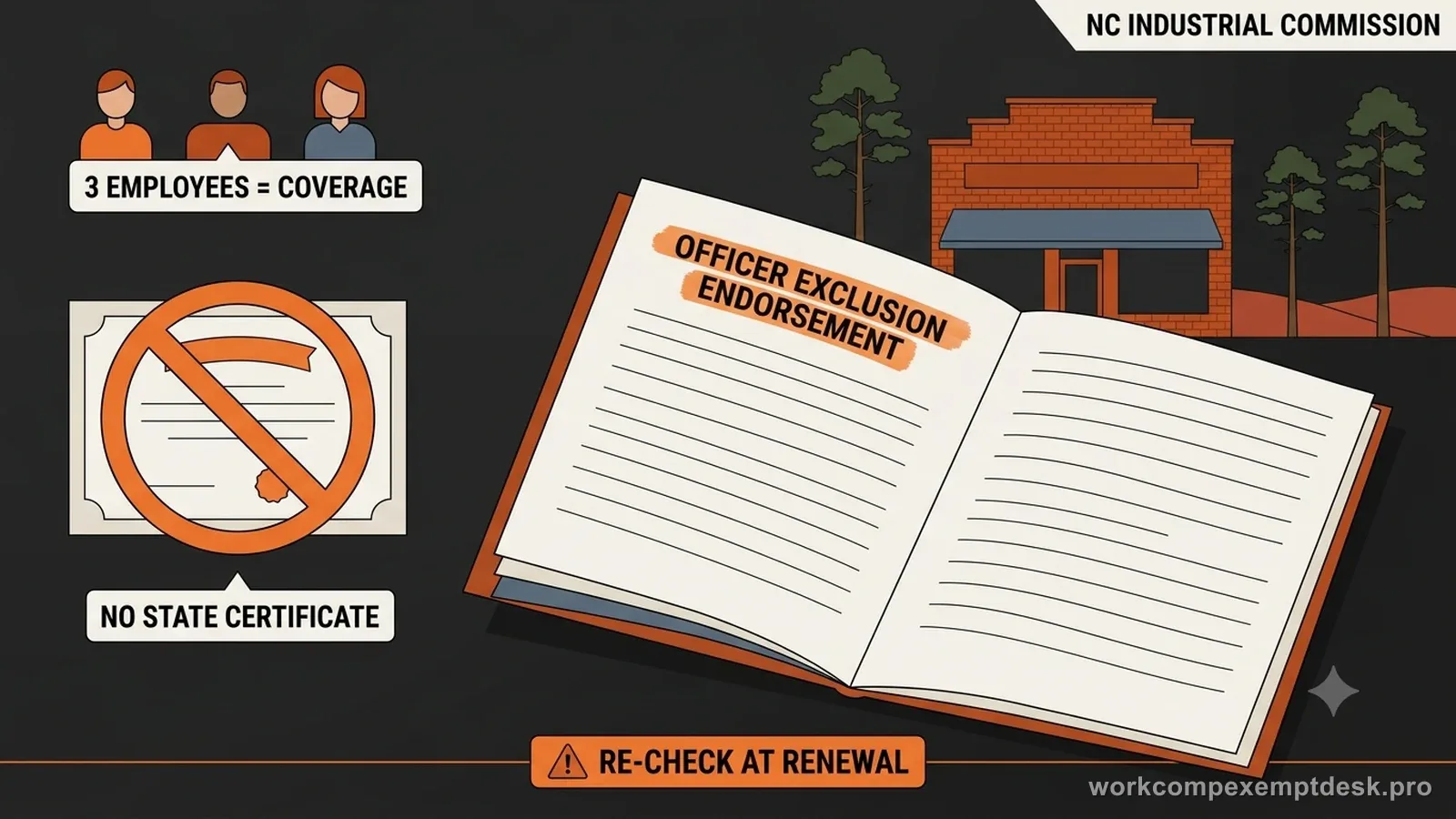
Most North Carolina businesses with three or more regular employees must carry workers’ compensation. Corporate executive officers count toward that threshold but may be specifically excluded from the policy for the policy period. Sole proprietors, partners, and LLC members are not automatically counted as employees; they may elect coverage by notifying the insurer. North Carolina does not use a general state-issued owner exemption certificate for these elections.
Ownership types reviewed
- Sole proprietor
- LLC member
- Partner
- Corporate officer
North Carolina’s three-employee rule is easy to misread when owners are part of the workforce. Corporate officers count toward the threshold even though an officer may be specifically excluded from personal coverage under the corporation’s policy. Sole proprietors, partners, and LLC members are different: they are not automatically counted as employees and can elect to be included if they are actively engaged in the business and the insurer is notified.
Most North Carolina businesses with three or more regular employees must carry workers’ compensation. Corporate executive officers count toward that threshold but may be specifically excluded from the policy for the policy period. Sole proprietors, partners, and LLC members are not automatically counted as employees; they may elect coverage by notifying the insurer. North Carolina does not use a general state-issued owner exemption certificate for these elections.
How owners are treated, at a glance
Sole proprietorNot automatically counted as an employee. An actively engaged sole proprietor may elect to be included in the business's coverage by notifying the insurer.
LLC memberNot automatically counted as an employee. An actively engaged LLC member may elect to be included in the business's coverage by notifying the insurer.
PartnerNot automatically counted as an employee. An actively engaged partner may elect to be included in the business's coverage by notifying the insurer.
Corporate officerGenerally counted as an employee for the three-person threshold. A corporation may specifically exclude an executive officer from the insurance contract; the exclusion continues for the period that contract is in effect.
North Carolina’s general trigger is three regular employees
The North Carolina Industrial Commission states that, in general, a business with three or more employees regularly employed in the same business must carry workers’ compensation insurance or qualify as self-insured. The statute has special categories and exceptions, but three is the ordinary small-business starting point.
For an owner-operated company, the difficult part is deciding who enters that count. The answer depends on entity type. A corporation can reach three with two executive officers and one other employee because the Commission treats executive officers as employees for the threshold analysis.
That makes the employee count a legal classification exercise rather than a simple payroll report. Count the owner roles the statute includes before deciding whether any of those owners will be excluded from personal policy benefits.
A corporate officer can be excluded from coverage and still have counted toward the three-person trigger
North Carolina’s statute says an executive officer elected or appointed and empowered under the corporation’s charter and bylaws is generally considered an employee. It then allows the corporation to specifically exclude that officer from the insurance contract. The exclusion continues for the period that insurance contract is in effect.
The Industrial Commission emphasizes the counting consequence: corporate officers are counted in determining whether a corporation has three or more employees even when they are excluded from personal coverage. In other words, the coverage election changes the officer’s benefits under the policy; it does not retroactively erase the officer from the threshold calculation that required the policy.
Keep the policy endorsement or exclusion wording with the policy period. At renewal, confirm whether the exclusion continues under the new contract rather than assuming last year’s treatment automatically controls a new policy term.
Sole proprietors, partners, and LLC members start outside the automatic employee count
North Carolina takes a different approach to sole proprietors, partners, and LLC members. The Commission says they are not automatically counted as employees. The statute allows an actively engaged owner in one of those categories to elect to be included under the business’s workers’ compensation coverage if the insurer is notified.
That is an election into coverage, not an exemption application. A one-member LLC with no employees should not search for a state owner-exemption certificate merely to prove that the member was never automatically counted. If that member wants workers’ compensation benefits, the file should instead show the election and insurer notice.
The distinction matters as soon as non-owner labor is added. The owner may remain outside personal coverage while the employee count grows toward the three-person trigger. Keep the owner election and the workforce count as separate fields in the business’s compliance record.
The operative North Carolina record is the policy—not a Commission exemption certificate
The Industrial Commission’s employer forms list does not provide a general owner-exemption certificate for the common corporate-officer or sole-proprietor/LLC election. The statutory mechanics run through the insurance contract and insurer notification.
For a corporate officer, retain the policy language specifically excluding the officer and the policy dates. For a sole proprietor, partner, or LLC member who elects in, keep the insurer notification and carrier confirmation. If the owner does not elect in, document the entity role and current workforce facts that explain why the person was not automatically included.
This approach also produces better proof for customers. If a customer wants evidence that the company itself is insured, provide policy or certificate information; an owner’s personal exclusion is not a substitute for proof that the business has coverage for employees.
Principal contractors need subcontractor coverage proof as a separate control
North Carolina warns principal contractors to obtain a certificate of coverage from subcontractors in order to avoid liability for injuries to a subcontractor’s employees. Commission rules explain that a certificate of insurance or approved self-insurance certificate can satisfy that proof function under G.S. 97-19.
The requirement is operationally different from an owner election. A subcontractor’s sole proprietor or LLC member may not be personally included, but that says nothing about whether the subcontractor has employees who must be covered. The principal contractor needs proof addressing the subcontractor’s company-level coverage.
For construction and other subcontracted work, store the certificate with the project record and track its effective dates. If the subcontractor reports a lapse, cancellation, or nonrenewal, the project file should be updated rather than relying on a certificate that was valid only at the start.
The third employee, a policy renewal, and a new subcontractor are the main reset points
The third regularly employed person is an obvious threshold event, but an owner-operated corporation can reach that point sooner than expected because executive officers count. Review the head count when hiring, appointing officers, or reorganizing rather than waiting for an insurance audit.
Policy renewal is a second reset because the statute ties a corporate officer’s exclusion to the period the insurance contract is in effect. Confirm the new policy treatment each term. A new subcontractor is the third reset: collect current coverage proof before relying on that firm’s labor.
A North Carolina file that records the head count, owner category, policy treatment, and subcontractor proof will answer the questions the statute actually asks. A generic 'owner exempt' label cannot show whether the company crossed three employees or whether a contractor obtained the certificate it needed from a subcontractor.
What failing to secure coverage actually costs in North Carolina
North Carolina scales its base penalty by headcount and lets an employer who fixes the problem convert it into a smaller, policy-based fine — but a willful failure is charged as a felony regardless.
An employer that refuses or neglects to secure required coverage is subject to a penalty of $1 per employee per day of the violation, with a floor of $20 and a ceiling of $100 per day. If the employer then produces proof of coverage, the Industrial Commission can rescind that penalty and reassess it based on the per-employee cost of the policy actually obtained.
A willful failure to secure coverage is a Class H felony; a merely negligent failure is a Class 1 misdemeanor. Throughout the period of refusal or neglect, the employer also remains directly liable to any injured employee for compensation under the Act or under ordinary law, at the employee's election.
- Base penalty: $1/employee/day, minimum $20 and maximum $100 per day
- Can be rescinded and reassessed on a per-employee policy-cost basis once coverage is obtained
- Willful failure: Class H felony; negligent failure: Class 1 misdemeanor
North Carolina owner checklist
- Count regular employees using North Carolina’s entity rules; corporate officers count toward the general three-person threshold.
- Do not treat an excluded corporate officer as erased from the threshold calculation.
- For a sole proprietor, partner, or LLC member, document whether the owner elected into coverage rather than searching for a state exemption certificate.
- Tie a corporate-officer exclusion to the current insurance contract and re-check it at renewal.
- Principal contractors should collect current workers’ compensation proof from subcontractors.
- Re-run the analysis when the third person is added, officers change, the policy renews, or a new subcontractor starts.
Form, fee, and timing summary
Cross-checked against North Carolina Industrial Commission / workers’ compensation insurer and verified 2026-09-02. This restates the state forms reference; the state agency remains the authority.
Coverage ruleIn general, businesses with three or more regular employees must carry workers' compensation or qualify as self-insured. Corporate officers count toward the threshold; sole proprietors, partners, and LLC members are not automatically counted.
Construction ruleNo general stricter construction head-count threshold is stated in the cited Commission guidance. Principal contractors should obtain workers' compensation certificates from subcontractors to avoid liability for injuries to subcontractor employees; special rules also exist for trucking and radiation work.
DocumentNo universal owner-exemption filing; the rule is statutory or policy-based
Issuing bodyNorth Carolina Industrial Commission / workers’ compensation insurer
Filing methodNo state owner-exemption certificate. Corporate-officer exclusion is written into the insurance contract; sole proprietors, partners, and LLC members may elect personal coverage through insurer notice.
FeeNo separate filing fee verified
NoteCorporate officers still count toward the general employee threshold even when personally excluded.
EffectivePolicy endorsement/insurer notice controls the personal election.
RenewalCorporate-officer exclusion lasts for the insurance contract period; other owner elections are tied to insurer/policy records.
Watch out forExcluded corporate officers still count toward the three-employee threshold; sole proprietors/partners/LLC members use different treatment.
Open the official source Compare renewal rules across states Run the eligibility screener
Which agency handles this
North Carolina Industrial Commission
Official sources for this page
These are the state-agency, statutory, or state-board materials used for this guide. The page was last source-checked on 2026-08-25.
North Carolina workers' comp exemption FAQ
- Does a sole proprietor need workers' comp coverage in North Carolina?
- Not automatically counted as an employee. An actively engaged sole proprietor may elect to be included in the business's coverage by notifying the insurer.
- Can an LLC member get a workers' comp exemption in North Carolina?
- Not automatically counted as an employee. An actively engaged LLC member may elect to be included in the business's coverage by notifying the insurer.
- How does a corporate officer opt out of workers' comp in North Carolina?
- Generally counted as an employee for the three-person threshold. A corporation may specifically exclude an executive officer from the insurance contract; the exclusion continues for the period that contract is in effect.
- Are partners covered by workers' comp in North Carolina?
- Not automatically counted as an employee. An actively engaged partner may elect to be included in the business's coverage by notifying the insurer.
- What form is used for a North Carolina workers' comp owner exemption?
- No general NCIC owner-exemption certificate; corporate-officer exclusion is written into the insurance contract, while sole proprietor/partner/LLC inclusion is elected through insurer notification. A corporate-officer exclusion continues for the period the insurance contract is in effect, so it should be re-checked at renewal. Sole proprietor/partner/LLC elections should be kept aligned with current insurer records.
Answers restate the sourced fields above. Open the official source library for the underlying agency and statute pages.