Owner Exclusion Does Not Mean the Business Is Exempt
Built from official state-agency sources · desk review 2026-08-26
A personal owner opt-out can coexist with a company obligation to insure employees. Keep those two questions separate.
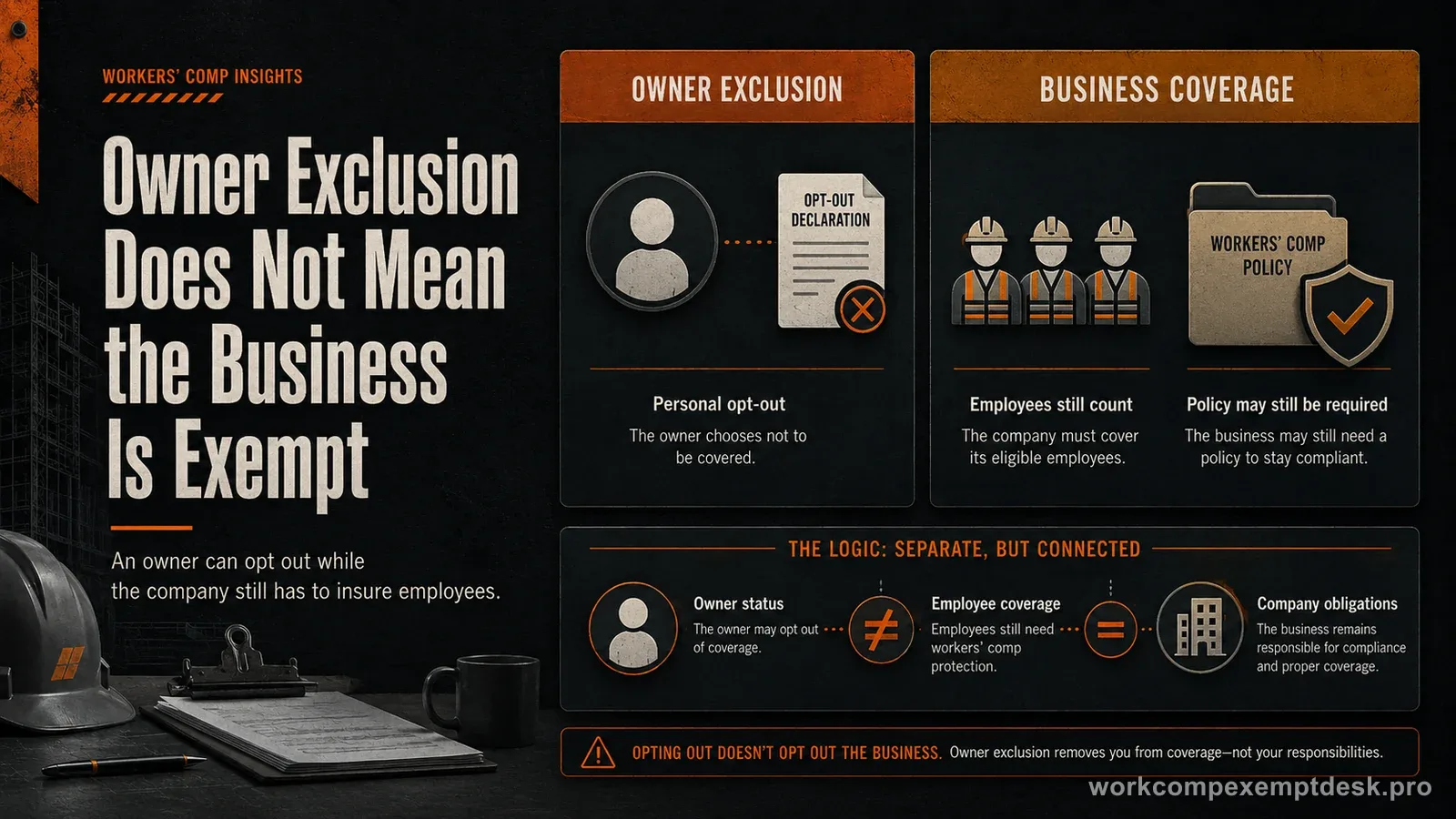
An owner's personal exclusion answers whether that owner is covered as an employee. The company's insurance obligation answers whether the employer must cover everyone else. A valid owner opt-out does not automatically remove the company's duty to carry workers' compensation for employees.
Facts to lock down before relying on an exemption
- Count workers using the state's rule before subtracting anyone
- Determine whether excluded owners still count toward the coverage threshold
- Identify employees, part-time workers, leased workers, and potentially misclassified contractors
- Confirm whether construction or another industry has a different trigger
- Keep owner-election evidence separate from the policy evidence for employees
Many compliance mistakes begin with one sentence: “I have an exemption, so the business does not need workers' comp.” That conclusion may be right for a truly no-employee entity in a particular state, but it does not follow from an owner's personal exclusion alone. The owner question and the employer question must be tested independently, then reconciled with the current workforce.
Personal coverage and employer coverage are two different layers
A corporate officer can be excluded from personal coverage while the corporation remains an employer that must insure its workforce. An LLC member can opt out while technicians, laborers, or office staff remain covered. The policy can therefore be required even though one or more owners are not included in the insured payroll basis.
This two-layer model is more useful than asking whether the “business is exempt.” First determine the owner's treatment. Then determine whether the entity has workers who trigger coverage. Finally determine how the state counts excluded owners when applying any employee threshold. Each answer can be different.
Georgia shows why threshold counting must be checked separately
Georgia generally requires coverage when a business regularly employs three or more persons. Corporate officers and LLC members are included in that count. Up to five officers or members may reject their own coverage on Form WC-10, but the state guidance does not let the employer erase those people from the three-person threshold merely because they rejected personal benefits.
That means a three-owner corporation can present a different coverage question from a sole proprietor with no employees. Treating both as simply “owner-only businesses” would miss the counting rule that determines whether the policy requirement is triggered.
SOURCE CONTEXT: Georgia SBWC is a clear example of an owner rejection that does not remove the owner from the threshold count.
Florida shows why industry can change the company-level trigger
Florida generally uses a four-employee threshold for non-construction employers, while construction employers with one or more employees must secure coverage. Agricultural employers use a separate threshold. A valid owner exemption therefore has to be read against the correct industry rule before the company-level obligation is known.
This becomes practical when a small contractor adds a helper. The owner may still hold a valid personal construction exemption, but the presence of a non-exempt employee can trigger a policy obligation for the company. The owner certificate is not a substitute for employee coverage.
SOURCE CONTEXT: Florida publishes separate construction, non-construction, and agricultural coverage triggers.
Subcontractors and 1099 workers can change the analysis
A business cannot safely assume that everyone paid on a 1099 is outside workers' compensation. Classification rules vary by state and industry. California expressly warns that a contract label or Form 1099 does not determine whether a worker is an independent contractor, and its ABC test applies to workers' compensation unless a specific exception changes the test.
Construction can add an upstream-liability problem. State laws may make a contractor responsible for workers of an uninsured subcontractor in certain circumstances. Even when an owner personally opts out, the company still needs to examine who is actually doing the work and whether the subcontractor relationship is legally recognized.
SOURCE CONTEXT: California DIR emphasizes that labels and 1099 treatment do not control employment status.
Keep separate owner and employer records, then recheck them after change events
The owner file should contain the election, waiver, endorsement, or official status record and the eligibility facts supporting it. The employer file should contain the workers' compensation policy, coverage verification, certificates of insurance, and records for subcontractors where applicable. Keeping these together but distinct makes audits and contract reviews much clearer.
When a customer asks “Are you exempt?”, the business can then answer precisely. It may be that the owner is excluded but the company has active coverage for employees. Or the entity may truly have no employees and be outside the coverage requirement. Precision is better than a blanket yes or no.
A first employee, a part-time hire, a new owner who also works, a temporary labor arrangement, or a move into construction can change the employer side of the equation. The owner certificate may not change at all, which makes it easy to miss the new policy requirement if the business only monitors certificate expiration dates.
Build a trigger list into the compliance process. Each trigger should cause a fresh employee count, classification review, and industry check before work starts. That turns the owner exclusion from a static piece of paper into one component of a living workers' compensation compliance system.
Common questions
- If I exclude myself, does my company still need a workers' comp policy?
- Often yes. A personal owner opt-out and a company obligation to insure employees are separate questions. If the business has any non-excluded employee, the coverage duty can still apply.
- Does excluding an owner reduce the employee count that triggers coverage?
- Usually not. Several states count corporate officers and LLC members toward the threshold even when those owners reject personal coverage.
- What should I keep in the compliance file?
- The owner election record plus the separate proof of the company's employee coverage, the agency source, the facts that made the owner eligible, and the events that require a fresh review.
Agency and statute pages behind this guide
The state-specific examples above draw on these links. Always confirm the current rule with the destination state before filing or changing coverage.