Georgia
Workers' Comp Exemption
Verified against Georgia State Board of Workers' Compensation on 2026-08-25
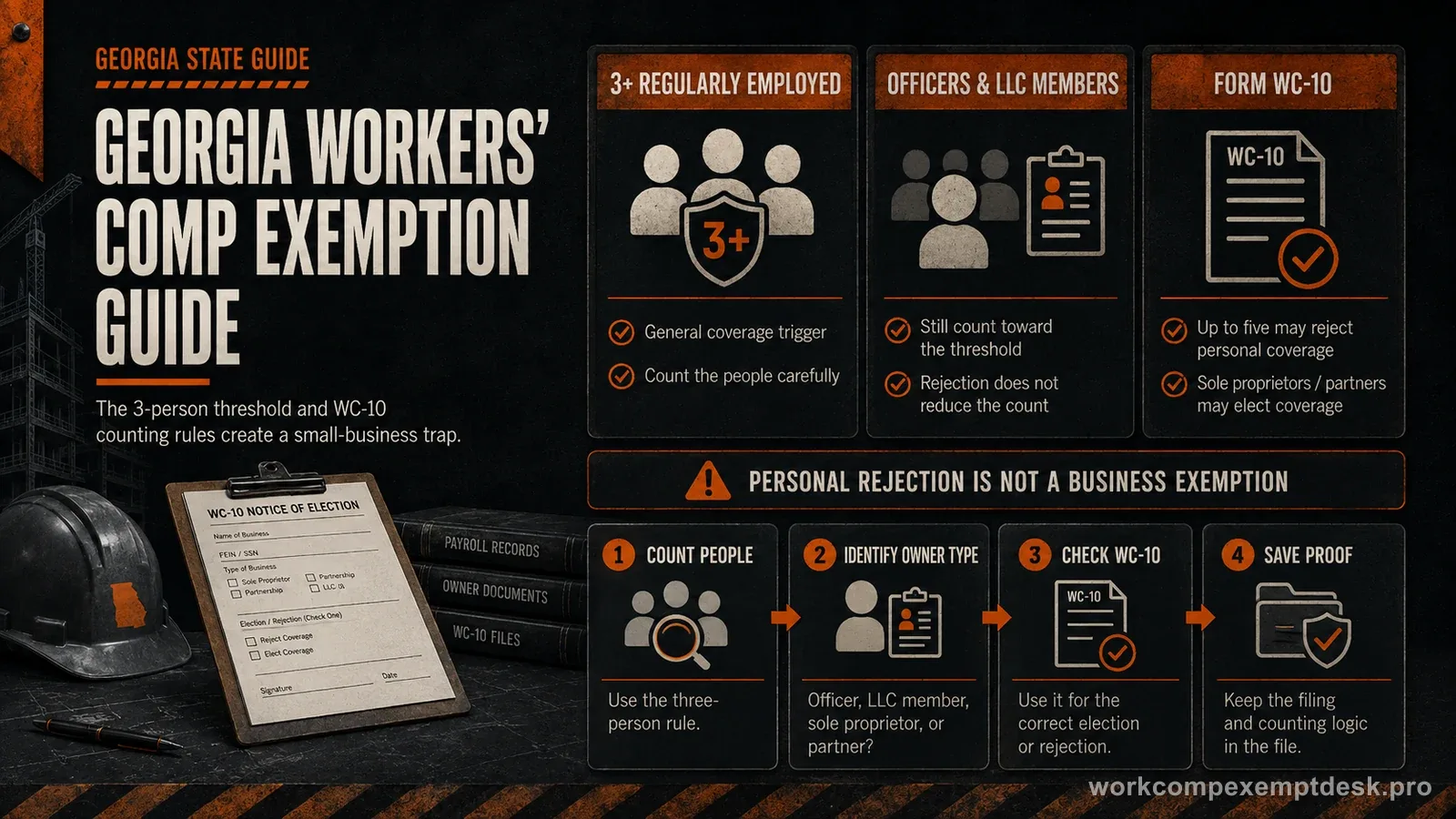
A Georgia business that regularly employs three or more people generally must carry workers’ compensation. Corporate officers and LLC members are counted toward the three-person threshold, although up to five may reject personal coverage on Form WC-10. Their rejection does not reduce the employee count. Sole proprietors and partners are not employees by default and may use WC-10 to elect coverage.
Ownership types reviewed
- Sole proprietor
- LLC member
- Partner
- Corporate officer
Georgia’s owner rules create a counting trap that matters to small corporations and LLCs. The general insurance trigger is three or more regularly employed people, and corporate officers and LLC members count toward that threshold even when up to five of them reject personal coverage. Sole proprietors and partners start from the opposite direction: Georgia treats them as employers rather than employees unless they elect to be included.
A Georgia business that regularly employs three or more people generally must carry workers’ compensation. Corporate officers and LLC members are counted toward the three-person threshold, although up to five may reject personal coverage on Form WC-10. Their rejection does not reduce the employee count. Sole proprietors and partners are not employees by default and may use WC-10 to elect coverage.
Owner treatment at a glance
Sole proprietorTreated as an employer rather than an employee by default; may elect personal coverage by notifying the insurer using WC-10.
LLC memberConsidered an employee and counted toward the three-person threshold. Up to five LLC members may reject personal coverage on WC-10; rejection does not reduce the threshold count.
PartnerTreated as an employer rather than an employee by default; may elect personal coverage by notifying the insurer using WC-10.
Corporate officerConsidered an employee and counted toward the three-person threshold. Up to five officers may reject personal coverage on WC-10; rejection does not reduce the threshold count.
Georgia’s three-person trigger includes officers and LLC members
The State Board of Workers’ Compensation says a business that regularly employs three or more people must provide workers’ compensation benefits. Regular part-time employees count, and the Board specifically says corporate officers and LLC members are included in the employee count for incorporated businesses and LLCs.
That creates a result that surprises small owner-operated companies. A corporation with three owner-officers and no outside payroll can reach the statutory count before any owner decides whether to keep personal workers’ compensation coverage. The same counting principle applies to LLC members.
The threshold analysis therefore comes first. Count the regular workers and the owner categories the Board tells you to count, then decide whether a particular officer or member will remain covered personally.
Up to five officers or LLC members can reject personal coverage without shrinking the count
Georgia permits as many as five corporate officers or LLC members to reject coverage for themselves. Each rejecting person uses Form WC-10, Notice of Election or Rejection of Workers’ Compensation Coverage, and the Board’s FAQ directs insured businesses to file the form with the insurance carrier.
The critical rule is what the rejection does not do. The Board expressly says officer exemptions do not reduce the number of employees for the three-or-more test. A three-officer corporation cannot file three WC-10s and then argue that the company has zero people for purposes of deciding whether a policy is required.
For a closely held business, keep two counts in the file: the statutory head count used to determine whether the company must secure coverage, and the list of owners actually covered under the policy after any WC-10 elections. Those numbers can legitimately be different.
Sole proprietors and partners use WC-10 in the opposite direction
Georgia treats a sole proprietor or partner as an employer rather than an employee. That means the owner is not automatically included in workers’ compensation coverage simply because the business buys a policy for employees. The owner may elect to be covered by notifying the insurer in writing; the Board’s employer material identifies WC-10 as the election form.
This is the reverse of the corporation/LLC workflow. An officer or LLC member uses WC-10 to reject default personal coverage, while a sole proprietor or partner uses it to elect into coverage. The same form name should not obscure the different legal starting points.
If the entity changes—such as a sole proprietorship converting to an LLC—the old owner election should be reviewed. The person may move from an owner category that starts outside employee status to one that is counted as an employee unless a new rejection is properly documented.
WC-10 is an insurance election, not a universal contractor waiver certificate
Georgia’s WC-10 is useful because it tells the insurer or Board how a named owner is treated for workers’ compensation coverage. It should not be marketed as a blanket certificate proving that the business has no workers’ compensation obligations. The company may still be required to maintain a policy because the owner remains in the statutory count or because other employees are present.
For an owner-only corporation or LLC with three to five officers or members and no other employees, Board materials explain that WC-10 forms can be filed for each owner as part of compliance. Even then, the record is about those individuals’ elections; it does not convert every future worker or subcontractor into an exempt person.
When a customer or general contractor asks for proof, identify whether the request is for the company’s policy, a named owner’s rejection, or subcontractor coverage. Handing over WC-10 as if it answered all three questions is the documentation mistake to avoid.
A valid owner rejection does not remove contractor liability for an uninsured subcontractor’s employees
The State Board warns that a contractor subject to Georgia’s workers’ compensation law may be liable for the employees of a subcontractor that failed to obtain required coverage. Insurers can also treat payments to an uninsured subcontractor as an exposure during premium audit.
This makes subcontractor verification a separate operational task. Before work begins, collect current coverage evidence from the subcontractor and confirm that the document covers the entity and period involved. If the subcontractor is owner-only, do not assume an owner WC-10 answers whether the subcontractor has employees who should be insured.
For construction-oriented businesses, the compliance file should therefore have three layers: company coverage, owner elections, and subcontractor proof. The owner election is important, but it is not the layer that protects the general contractor from an uninsured subcontractor workforce.
A third regular person or an entity conversion can change the Georgia result immediately
Because Georgia uses a three-person trigger, hiring or regularly using the person who brings the count to three is a major compliance event. The business should count regular part-time workers and owner-officers or LLC members as the Board instructs rather than waiting until it has three W-2 employees who are not owners.
Entity changes also matter. A sole proprietor who incorporates may become a corporate officer who is counted and covered by default unless a valid rejection is filed. An LLC that adds members can reach the threshold even when all of those members intend to reject personal coverage.
Build a simple review into payroll setup, ownership changes, and policy renewal: count first, determine entity-specific owner treatment second, and verify the company policy and WC-10 records third. That sequence prevents an owner exemption from being incorrectly used to reduce the statutory head count.
What failing to secure coverage actually costs in Georgia
Georgia backs its coverage requirement with a civil penalty the Board can assess per occurrence, a separate misdemeanor charge, and a built-in bump to the injured worker's benefit if the employer simply refused to comply.
The Board may assess a civil penalty of $500 to $5,000 per occurrence for an employer's failure to provide required coverage. An employer that refuses or willfully neglects to secure coverage is guilty of a misdemeanor, punishable by a fine of $1,000 to $10,000, up to 12 months imprisonment, or both.
On top of those penalties, the Board can award attorney's fees and increase the compensation payable to an injured employee by 10% when the employer refused or willfully neglected to carry coverage, and it can issue a stop-work order. The employer also loses the liability protection the Act normally provides.
- Civil penalty: $500–$5,000 per occurrence
- Willful refusal/neglect: misdemeanor, fine $1,000–$10,000 and/or up to 12 months
- Board can add a 10% benefit increase for the injured worker plus attorney's fees, and issue a stop-work order
Georgia owner checklist
- Count regular workers, including part-time workers, corporate officers, and LLC members where the Board requires them to be counted.
- Do not subtract an officer or LLC member from the three-person threshold merely because that person filed WC-10.
- Use WC-10 as a rejection for qualifying officers/members or as an election into coverage for sole proprietors/partners, depending on entity type.
- Keep company policy proof separate from named-owner WC-10 records.
- Verify subcontractor coverage before work starts; an owner election does not insure a subcontractor’s employees.
- Re-check after the third regular person is added, an entity changes form, or ownership changes.
Form, fee, and timing summary
Cross-checked against Georgia State Board of Workers’ Compensation and verified 2026-09-02. This restates the state forms reference; the state agency remains the authority.
Coverage ruleA business that regularly employs three or more persons generally must carry workers' compensation. Regular part-time workers count. Corporate officers and LLC members are included in the employee count.
Construction ruleThe cited Board guidance does not set a separate construction head-count threshold. A contractor subject to the Act can be liable for employees of an uninsured subcontractor, and contractual proof requirements can apply independently of an owner's personal election.
DocumentWC-10 — Notice of Election or Rejection of Workers’ Compensation Coverage
Issuing bodyGeorgia State Board of Workers’ Compensation
Filing methodFile with the current insurer; when no insurer applies in the stated owner-only scenario, file with the Board.
FeeNo separate filing fee verified
NoteCorporate officers/LLC members still count toward Georgia’s employee threshold even when they reject personal coverage. The form is not a waiver of the employer’s coverage duty.
EffectiveEffective on filing with the insurer, or with the Board when the no-insurer filing route applies.
RenewalNo fixed annual renewal; remains until revoked/superseded by a later WC-10 or relevant policy/status change.
Watch out forExcluded officers/LLC members still count toward Georgia’s employee threshold.
Full WC-10 filing guide Open the official source Compare renewal rules across states Run the eligibility screener
Responsible agency
Georgia State Board of Workers' Compensation
Source library for this state
These are the state-agency, statutory, or state-board materials used for this guide. The page was last source-checked on 2026-08-25.
Georgia workers' comp exemption FAQ
- Does a sole proprietor need workers' comp coverage in Georgia?
- Treated as an employer rather than an employee by default; may elect personal coverage by notifying the insurer using WC-10.
- Can an LLC member get a workers' comp exemption in Georgia?
- Considered an employee and counted toward the three-person threshold. Up to five LLC members may reject personal coverage on WC-10; rejection does not reduce the threshold count.
- How does a corporate officer opt out of workers' comp in Georgia?
- Considered an employee and counted toward the three-person threshold. Up to five officers may reject personal coverage on WC-10; rejection does not reduce the threshold count.
- Are partners covered by workers' comp in Georgia?
- Treated as an employer rather than an employee by default; may elect personal coverage by notifying the insurer using WC-10.
- What form is used for a Georgia workers' comp owner exemption?
- WC-10 — Notice of Election or Rejection of Workers' Compensation Coverage. WC-10 is not a waiver certificate and the cited current form does not set a fixed recurring renewal cycle for the owner election. Keep the election aligned with the current policy, owner role, and workforce and re-check after entity or ownership changes.
Answers restate the sourced fields above. Open the official source library for the underlying agency and statute pages.