Ohio
Workers' Comp Exemption
Verified against Ohio Bureau of Workers' Compensation on 2026-08-25
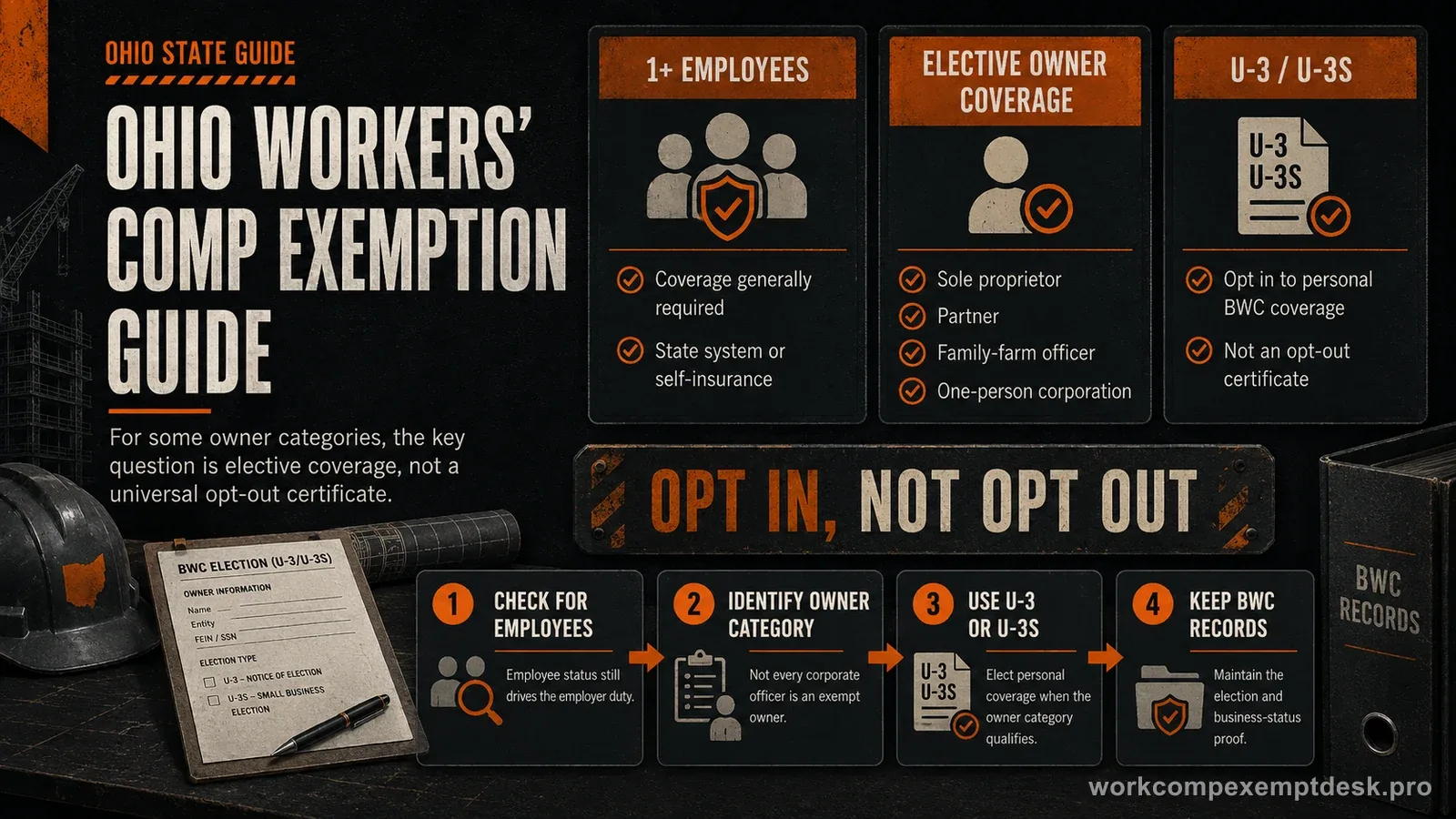
Ohio employers with one or more employees generally must maintain workers’ compensation coverage through the state system or approved self-insurance. Several owner categories have elective personal coverage, including sole proprietors, partners, LLCs acting as sole proprietorships or partnerships, family-farm corporate officers, and an individual incorporated as a corporation with no employees. Current BWC Forms U-3 and U-3S handle those elections; ordinary corporate officers are generally payroll-reportable rather than automatically exempt owners.
Entity types analyzed
- Sole proprietor
- LLC member
- Partner
- Corporate officer
Ohio reverses the usual 'owner exemption' question for several owner types. The state’s workers’ compensation system generally applies when an employer has one or more employees, but sole proprietors, partners, certain LLC owners, family-farm corporate officers, and an individual incorporated as a corporation with no employees can fall into elective-coverage categories. For those owners, the key form is an application to opt into personal BWC coverage—not a certificate to opt out.
Ohio employers with one or more employees generally must maintain workers’ compensation coverage through the state system or approved self-insurance. Several owner categories have elective personal coverage, including sole proprietors, partners, LLCs acting as sole proprietorships or partnerships, family-farm corporate officers, and an individual incorporated as a corporation with no employees. Current BWC Forms U-3 and U-3S handle those elections; ordinary corporate officers are generally payroll-reportable rather than automatically exempt owners.
Owner treatment, at a glance
Sole proprietorPersonal workers' compensation is elective. A qualifying sole proprietor may elect coverage using U-3 when opening the policy or U-3S later.
LLC memberBWC's current elective-coverage list includes an LLC acting as a sole proprietor and an LLC acting as a partnership. Match the LLC to the listed entity treatment before assuming a member is elective.
PartnerPersonal workers' compensation is elective for partners/limited partners; qualifying owners may elect coverage using U-3 or U-3S.
Corporate officerOrdinary executive corporate officers are generally payroll-reportable. BWC separately lists family-farm corporate officers and an individual incorporated as a corporation with no employees (I-Corp) as elective-coverage categories.
In Ohio, many owners ask whether to elect in—not how to get an exemption certificate
Ohio Revised Code defines an employer broadly enough to include a private business with one or more employees, and Ohio Bureau of Workers’ Compensation materials build coverage around the state fund system. For an owner-only business, however, several owner categories are excluded from the ordinary employee definition unless they elect workers’ compensation protection for themselves.
That means the familiar search for a 'workers’ comp exemption form' can point in the wrong direction. A sole proprietor who has no employees does not need a certificate from BWC proving that the proprietor opted out; the important decision is whether the proprietor wants to elect personal coverage.
Once the business hires an employee, the employer’s obligation to maintain coverage for that employee is a separate question. The owner can remain outside personal coverage while the company carries an active BWC policy for its workforce.
BWC’s current forms define a specific list of elective-coverage owners
The April 2026 U-3 application lists the owner categories that may elect personal coverage: a sole proprietor; a partnership or limited partnership; an LLC acting as a sole proprietor; an LLC acting as a partnership; family-farm corporate officers; an ordained or associate minister; and an individual incorporated as a corporation with no employees, often referred to as an I-Corp in BWC material.
The list matters because ordinary corporation officers are not simply interchangeable with a sole proprietor or I-Corp. Ohio Administrative Code says actual remuneration of executive corporate officers is included in the corporation’s payroll reporting, while the rule separately defines the elective-coverage categories.
For an LLC, tax/entity treatment also matters to the BWC form. Do not assume every member of every multi-member LLC has the same elective status without matching the entity to the categories BWC actually lists.
U-3 opens the policy; U-3S adds or cancels elective owner coverage
A new Ohio employer uses Form U-3 to apply for workers’ compensation coverage, and the current form includes the elective-coverage decision for qualifying owners. If the need for owner coverage arises later, the U-3 instructions direct the employer to the Application for or Request to Cancel Elective Coverage, Form U-3S.
The current U-3S is therefore not an owner exemption certificate. It is the document used to add elective coverage for qualifying owners or ministers, or to request cancellation of that elective coverage. The filing should identify the policy and the individual whose status is changing.
Keep the BWC confirmation with the policy file because an owner’s personal status can differ from the company’s status. A company can have an active Ohio policy for employees while a qualifying owner is not covered, or can choose to add that owner through the elective process.
Elective coverage is prospective, so timing matters before an owner injury
Ohio’s elective-coverage framework is prospective. The Revised Code says an excluded owner does not receive benefits until BWC receives the written election, and BWC’s current forms warn owners that if they choose not to cover themselves, BWC will not provide workers’ compensation for an owner work injury.
The practical record should show when BWC received and accepted the election and the payroll basis used for elective coverage. Do not treat a signed but unsubmitted form as if it had already changed the owner’s benefits, and do not rely on an injury to create retroactive owner coverage that was never elected.
Likewise, when coverage is cancelled, preserve the effective date and BWC confirmation. Other disability or health insurance can have work-injury exclusions, so the business should know exactly which system was expected to respond on the date of an accident.
An ordinary corporate officer is not the same as an I-Corp or family-farm officer
The label 'corporate officer' is especially risky in Ohio because it covers different fact patterns. The administrative rule generally includes remuneration of executive officers such as a president, vice president, secretary, or treasurer in the corporate payroll. By contrast, BWC separately lists a family-farm corporate officer and an individual incorporated as a corporation with no employees among elective-coverage persons.
A closely held corporation should therefore identify which category it actually has. Being the only shareholder does not automatically make every corporation an elective I-Corp if the business has employees or does not fit BWC’s stated category. The policy and payroll records should use the entity status BWC recognizes rather than a generic owner label.
If the business changes from owner-only to having employees, or reorganizes from a sole proprietorship/LLC into a corporation, re-check owner treatment during the same process that updates the BWC policy.
The first employee creates a company obligation even when owner coverage stays elective
An owner-only business can spend years focused only on whether the owner wants elective coverage. The first employee changes the file: Ohio’s employer definition reaches a private business with one or more employees, so the company must ensure that its BWC coverage is active for the workforce.
At that point, keep the employee policy status and owner election as separate records. If the owner remains outside elective coverage, the absence of owner benefits does not mean the employee is uninsured. If the owner elects in, add the U-3/U-3S confirmation without changing the reason the employee policy exists.
This two-line record also makes later audits easier. It explains why the policy began, which owners were voluntarily added, and when any owner election was cancelled. That is a more accurate Ohio model than calling the owner 'exempt' and assuming the same label answers the company’s coverage duty.
What lapsed coverage actually costs in Ohio
Ohio runs workers' compensation through a state-fund premium system, so its penalties are built around unpaid premium and the risk period it created, plus a separate criminal charge for continuing to operate uninsured.
A late payroll report draws a penalty of 1% of the premium due (minimum $3, maximum $15); a late premium payment adds a flat $30 fee plus up to 15% of the premium due depending on how late it is. The Bureau of Workers' Compensation gives an employer 20 days after notice to pay an assessed premium or penalty before making its own assessment of the amount owed.
If coverage lapses and the employer keeps operating, it becomes personally liable for claim costs, interest, and penalties on any injury during the lapse, and the BWC can pursue civil and criminal action — operating while non-compliant has been charged as a second-degree misdemeanor in reported enforcement cases, with restitution ordered on top of the fine.
- Late payroll report: 1% of premium due ($3 minimum, $15 maximum)
- Late premium payment: $30 flat fee plus up to 15% of the premium due
- Operating with lapsed coverage: personal liability for claim costs during the lapse, plus possible criminal charges (reported cases: misdemeanor plus full restitution)
Ohio owner checklist
- Separate the company’s one-or-more-employee coverage duty from the owner’s elective personal coverage.
- Match the owner to BWC’s listed elective categories instead of assuming every LLC member or corporate officer qualifies.
- Use U-3 when opening coverage and U-3S when adding or cancelling elective owner coverage later.
- Keep BWC receipt/confirmation because owner coverage is prospective rather than created by an unsigned or unfiled form.
- Treat ordinary corporate officers differently from family-farm officers and qualifying I-Corp owners.
- Re-check the file at the first hire and after any entity reorganization.
Form, fee, and timing at a glance
Cross-checked against Ohio Bureau of Workers’ Compensation and verified 2026-09-10. This restates the state forms reference; the state agency remains the authority.
Coverage ruleOhio's employer definition generally reaches a private business with one or more employees. Several owner categories are outside ordinary employee treatment unless they elect personal BWC coverage.
Construction ruleThe cited owner-coverage sources do not create a separate construction head-count threshold. The company must maintain BWC coverage for employees; owner elective coverage is analyzed separately from the workforce obligation.
DocumentU-3 / U-3S — Application for Ohio Workers’ Compensation Coverage / Elective Coverage Change
Issuing bodyOhio Bureau of Workers’ Compensation
Filing methodUse U-3 when opening coverage and U-3S to add or cancel elective owner coverage after the policy is established.
Fee$120 non-refundable initial U-3 policy application fee; no separate U-3S filing fee verified
NoteOhio’s listed owners are generally asking to elect personal coverage, not to obtain an exemption certificate. Premium applies when elective coverage is added.
EffectiveFor a later U-3S election, elective coverage is added on the date BWC receives the completed application and applicable premiums are charged; initial U-3 coverage begins when the completed application and $120 fee are successfully submitted/received.
RenewalElective coverage renews each July and continues until BWC receives a written cancellation request or coverage otherwise lapses/changes.
Watch out forThe $120 charge is the initial U-3 policy application fee, not an exemption fee. U-3S adds/cancels elective owner coverage.
Full U-3 / U-3S filing guide Open the official source Open the state filing form Compare renewal rules across states Run the eligibility screener
Agency in charge
Ohio Bureau of Workers' Compensation
Official source library
These are the state-agency, statutory, or state-board materials used for this guide. The page was last source-checked on 2026-08-25.
Ohio workers' comp exemption FAQ
- Does a sole proprietor need workers' comp coverage in Ohio?
- Personal workers' compensation is elective. A qualifying sole proprietor may elect coverage using U-3 when opening the policy or U-3S later.
- Can an LLC member get a workers' comp exemption in Ohio?
- BWC's current elective-coverage list includes an LLC acting as a sole proprietor and an LLC acting as a partnership. Match the LLC to the listed entity treatment before assuming a member is elective.
- How does a corporate officer opt out of workers' comp in Ohio?
- Ordinary executive corporate officers are generally payroll-reportable. BWC separately lists family-farm corporate officers and an individual incorporated as a corporation with no employees (I-Corp) as elective-coverage categories.
- Are partners covered by workers' comp in Ohio?
- Personal workers' compensation is elective for partners/limited partners; qualifying owners may elect coverage using U-3 or U-3S.
- What form is used for a Ohio workers' comp owner exemption?
- BWC U-3 — Application for Ohio Workers' Compensation Coverage; U-3S — Application for or Request to Cancel Elective Coverage. Elective owner coverage should remain aligned with BWC records until cancelled; the current U-3S handles additions/cancellations. Re-check owner status when the entity changes or the business hires employees.
Answers restate the sourced fields above. Open the official source library for the underlying agency and statute pages.