Texas
Workers' Comp Exemption
Verified against Texas Department of Insurance, Division of Workers' Compensation on 2026-08-25
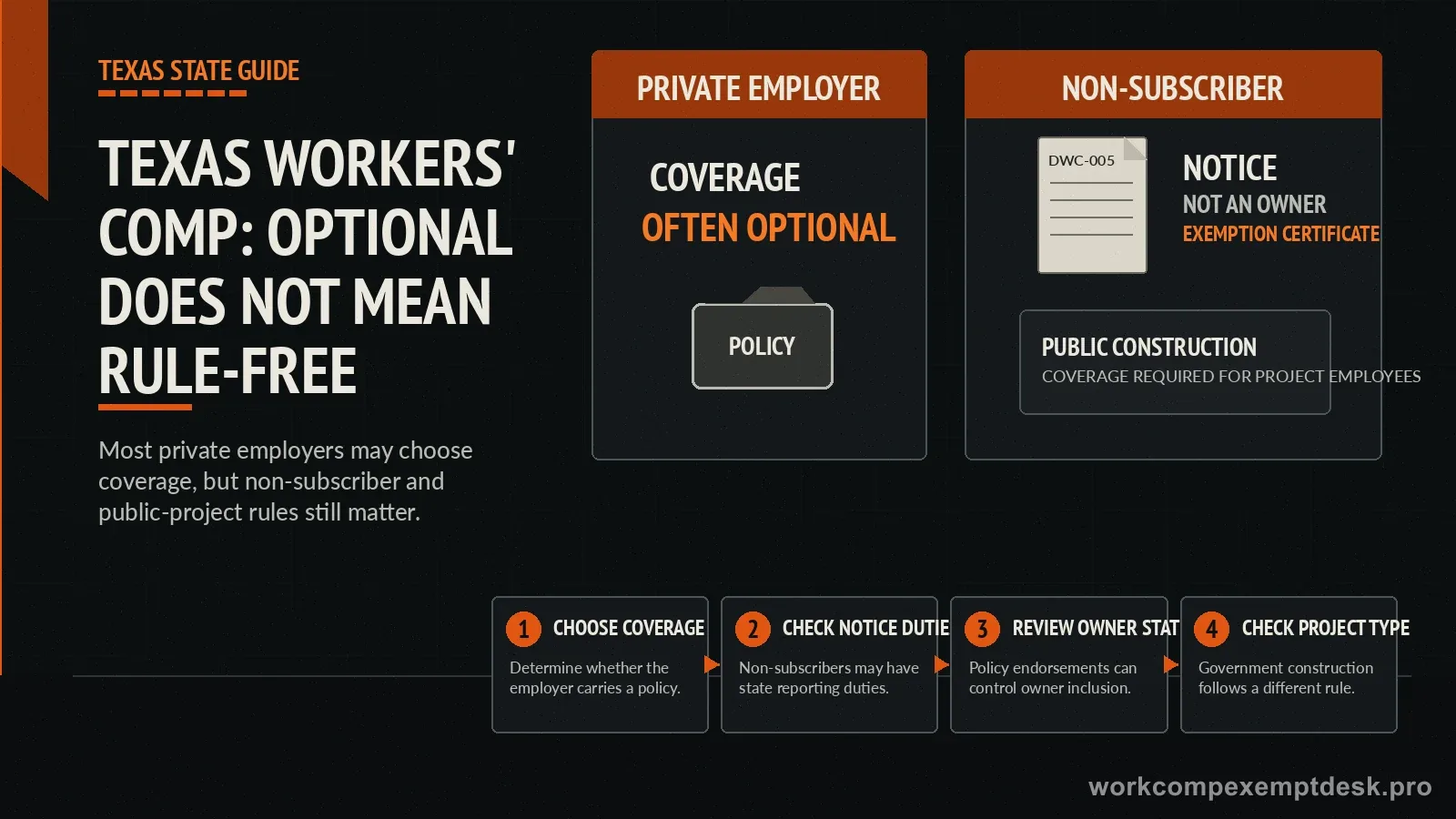
For most private Texas employers, workers’ compensation is optional. A business without coverage is a non-subscriber and may have DWC reporting and employee-notice duties. If a business buys a policy, certain owners can be excluded through the policy’s owner/officer endorsement; DWC Form-005 is not an owner-exemption certificate.
Entity types covered
- Sole proprietor
- LLC member
- Partner
- Corporate officer
Texas is different from most workers’ compensation exemption states because the central question is usually not “Which exemption certificate do I file?” Most private employers can choose whether to carry Texas workers’ compensation coverage at all. Owner exclusions, non-subscriber reporting, and public-project construction rules are separate issues that should not be collapsed into one form.
For most private Texas employers, workers’ compensation is optional. A business without coverage is a non-subscriber and may have DWC reporting and employee-notice duties. If a business buys a policy, certain owners can be excluded through the policy’s owner/officer endorsement; DWC Form-005 is not an owner-exemption certificate.
How owners are treated, at a glance
Sole proprietorIf the business elects to carry workers' compensation, a sole proprietor is covered as an employee unless specifically excluded through a policy endorsement under Texas Labor Code §406.097.
LLC memberTDI's current Basic Manual has a specific LLC rule. In a member-managed LLC, members with at least 25% equity may be excluded; members below 25% may be excluded at the carrier's option. LLC managers use the same 25% framework. A member who is not a manager but works for the LLC is an employee and cannot be excluded under that LLC rule.
PartnerIf the business elects to carry workers' compensation, a partner is covered as an employee unless specifically excluded through a policy endorsement under Texas Labor Code §406.097. TDI guidance treats both general and limited partners as partners for this purpose.
Corporate officerIf the business elects to carry workers' compensation, a corporate executive officer is covered as an employee unless specifically excluded through a policy endorsement under Texas Labor Code §406.097.
Texas does not start with an owner-exemption certificate
The Texas Division of Workers’ Compensation states that private employers may choose to carry workers’ compensation insurance in most cases. That choice makes the basic Texas analysis different from Florida or California, where the first employee can create a mandatory coverage problem under the state’s general rule.
A Texas business that buys approved workers’ compensation coverage is a subscriber. A private employer that chooses not to provide Texas workers’ compensation coverage is a non-subscriber. The decision whether the company subscribes is separate from the question whether a particular owner is included or excluded from a policy the company already has.
That separation is the key to reading Texas forms correctly. The state’s DWC Form-005 reports non-subscriber status. It does not create a personal exemption for a sole proprietor, partner, officer, or LLC member.
Non-subscriber status creates its own reporting workflow
When an employer has no Texas workers’ compensation coverage, the Division requires notices to employees and, for a non-subscriber with covered employees, notices to DWC. The current Employer E-File page says the employer must post a no-coverage notice in the workplace and give written notice of no coverage to new employees.
The state notice is not a one-time filing. DWC says the no-coverage notice should be filed between February 1 and April 30 each year, after hiring the first employee, and after terminating a Texas workers’ compensation policy. The DWC-005 instructions give the event deadlines as within 30 days after hiring the first employee and within 10 days after terminating coverage.
There is a second reporting stream for injuries, illnesses, and deaths. DWC’s current non-subscriber page says employers with five or more employees must report covered events involving more than one day of lost time, with the deadline tied to the death, knowledge of the work-related illness, or the start of lost time. These reporting duties exist because choosing not to subscribe does not mean the business disappears from the workers’ compensation regulatory system.
Texas owner exclusions depend on entity type, ownership, and the policy endorsement
When a Texas business chooses to buy workers’ compensation, owner treatment becomes a policy question. Sole proprietors and partners can be excluded under the owner-exclusion rules, and corporate executive officers can be excluded subject to the Basic Manual’s ownership rules. The exclusion must be reflected in the policy rather than assumed from a business filing or a title on the Secretary of State record.
The current Texas Basic Manual also contains a specific rule for limited liability companies, so an LLC should not be analyzed by analogy to a corporation. In a member-managed LLC, a member with at least 25 percent equity ownership is treated like a corporate executive officer for coverage purposes and may be excluded. A member with less than 25 percent may be excluded at the carrier’s option. Managers follow the same 25 percent framework, while an LLC member who is not a manager but works for the LLC is treated as an employee and cannot be excluded under that LLC rule.
Those distinctions make the endorsement and the ownership/management facts part of the permanent compliance file. A company should be able to show the person’s ownership percentage, whether the LLC is member-managed, whether the person is a manager, and what the carrier actually endorsed. 'LLC owner' by itself is not enough to determine whether the person is covered or excluded.
Public construction is the major exception to the private-employer choice
Texas does not impose a general private-sector construction employee-count threshold like Florida. But contractors and subcontractors working on building or construction projects for governmental entities are a major exception: workers’ compensation coverage must be provided for employees working on those public projects.
The state’s workers’ compensation rules define the certificates and coverage agreements used to prove project coverage, and the Basic Manual preserves an owner-officer exclusion path for a corporate executive officer with at least 25 percent equity ownership when the named insured is working under a governmental construction contract. The owner exclusion therefore does not erase the project-level duty to provide coverage for the employees who remain covered.
A private contractor should distinguish three documents that are easy to confuse: the workers’ compensation policy or approved coverage arrangement for the public job, any owner/officer exclusion endorsement attached to that policy, and DWC-005 if the employer is a non-subscriber in circumstances where that filing applies.
Choosing no coverage changes the employer’s liability position
Texas allows the non-subscriber choice, but it is not the same thing as having the protections of a workers’ compensation policy without paying for one. TDI explains that an employer without workers’ compensation loses the legal protection against most employee injury lawsuits.
The Texas Workers’ Compensation Act also limits defenses in an action by an employee who is not covered by authorized workers’ compensation insurance. The employer cannot rely on contributory negligence, assumption of the risk, or the negligence of a fellow employee as defenses in the way those concepts might otherwise be raised.
For a small business owner, this is the practical reason to keep the “should the company subscribe?” decision separate from the “can the owner be excluded from a policy?” decision. Excluding an owner from a policy is a coverage design choice inside the workers’ compensation system; operating as a non-subscriber changes the company’s position toward employee injury claims more broadly.
Build the Texas file around four decisions—not one exemption form
First document whether the employer is in a setting where coverage is mandatory, such as covered governmental construction work, or whether it is a private employer that may choose subscriber or non-subscriber status. This is the company-level decision. It should be resolved before anyone starts asking which owner form to sign.
Second, if the employer is a non-subscriber, preserve the DWC-005 filing dates and employee notices that apply to that status. If it is a subscriber, move instead to the policy roster: identify each sole proprietor, partner, executive officer, or LLC owner/manager whose personal coverage is being questioned, and match that person to the current Basic Manual rule and the actual endorsement. For an LLC, keep the ownership percentage and management role with the endorsement because those facts determine which exclusion rule applies.
Third, keep project-specific proof separate from both of those records. A governmental construction contract can require workers’ compensation for project employees even though a private employer could otherwise elect not to subscribe. Fourth, revisit the file after a first hire, policy cancellation, ownership change, change in LLC management, or new public project. Those events change different parts of the Texas analysis, so one stale 'exemption' document cannot safely answer all of them.
What skipping the notice requirement actually costs a Texas non-subscriber
Texas is the one state on this site where carrying workers' compensation is optional, so the enforceable failure isn't 'no insurance' — it's failing to tell the state and your own employees that you don't have it.
A non-subscribing employer must file the required notice with the Division of Workers' Compensation within 30 days of becoming a non-subscriber, post a workplace notice of no coverage in English, Spanish, and any other language as needed, and give new hires written notice of no coverage.
Skipping the employee-notice requirement can draw a fine of up to $500, assessed per employee not properly notified. Separately, failing to file the required DWC notice or post the workplace notice can bring an administrative penalty of up to $500 for each day of non-compliance.
- Missed employee notice: fine up to $500 per employee not notified
- Missed DWC filing or workplace posting: administrative penalty up to $500 per day of non-compliance
- Notice to DWC (Form DWC-005) is due within 30 days of becoming a non-subscriber
Texas owner checklist
- Decide first whether the business is a subscriber or non-subscriber; do not start with DWC-005 as an owner form.
- If non-subscriber reporting applies, calendar the annual filing window and event-based deadlines.
- Give workers the required no-coverage notices when the business does not provide Texas workers’ compensation.
- If the business has a policy, match each owner to the current policy rule; for an LLC, document ownership percentage, management role, and the carrier endorsement.
- For corporate officers, check the 25% equity rule and carrier discretion for officers below that level.
- Treat public building/construction contracts as a separate coverage analysis from ordinary private-sector work.
Form, fee, and timing, at a glance
Cross-checked against Texas Department of Insurance, Division of Workers’ Compensation / workers’ compensation insurer and verified 2026-09-02. This restates the state forms reference; the state agency remains the authority.
Coverage ruleMost private Texas employers may choose whether to carry workers' compensation insurance regardless of employee count. An employer that does not provide coverage is a non-subscriber and, when it has one or more employees who are not exempt from coverage rules, has state notice obligations.
Construction ruleThere is no general private-sector construction employee-count threshold because Texas coverage is optional for most private employers. A major exception applies to building or construction work for governmental entities: contractors and subcontractors must provide workers' compensation coverage for each employee working on the public project.
DocumentNo universal owner-exemption filing; the rule is statutory or policy-based
Issuing bodyTexas Department of Insurance, Division of Workers’ Compensation / workers’ compensation insurer
Filing methodNo general owner-exemption certificate. Most private employers may choose whether to carry workers’ compensation; owner/officer exclusions inside an insured policy are handled by the policy/endorsement.
FeeNo separate filing fee verified
NoteDWC Form-005 is a non-subscriber notice, not an owner exemption certificate. Public-project construction is a separate statutory exception to the otherwise optional private-employer framework.
EffectivePolicy exclusions take effect under the applicable endorsement; non-subscriber reporting follows its own filing rules.
RenewalTied to the policy/endorsement or non-subscriber reporting status; no owner-certificate renewal cycle.
Watch out forTexas is not a normal owner-exemption-certificate state; private employer non-subscription and insured-policy owner exclusions are different processes.
Open the official source Open the state filing form Compare renewal rules across states Run the eligibility screener
Which agency handles this
Texas Department of Insurance, Division of Workers' Compensation
Official sources for this page
These are the state-agency, statutory, or state-board materials used for this guide. The page was last source-checked on 2026-08-25.
- Texas DWC — Employer Resources
- Texas DWC — Employer E-File / Non-subscriber Reporting
- Texas DWC — DWC Form-005 Non-subscriber Notice
- Texas Workers' Compensation Act — §§406.096 and 406.097
- Texas DWC — Workers' Compensation Coverage Verification
- Texas DWC — Workers' Compensation Insurance Guide
- Texas Basic Manual — Owner Exclusion Rules
- Texas Basic Manual — LLC Member / Manager Coverage Rule (effective Nov. 1, 2021)
- Texas — Partners, Officers and Others Exclusion Endorsement
- Texas DWC — Workers' Compensation Rules
- Texas DWC — Workers' Compensation Act Index
Texas workers' comp exemption FAQ
- Does a sole proprietor need workers' comp coverage in Texas?
- If the business elects to carry workers' compensation, a sole proprietor is covered as an employee unless specifically excluded through a policy endorsement under Texas Labor Code §406.097.
- Can an LLC member get a workers' comp exemption in Texas?
- TDI's current Basic Manual has a specific LLC rule. In a member-managed LLC, members with at least 25% equity may be excluded; members below 25% may be excluded at the carrier's option. LLC managers use the same 25% framework. A member who is not a manager but works for the LLC is an employee and cannot be excluded under that LLC rule.
- How does a corporate officer opt out of workers' comp in Texas?
- If the business elects to carry workers' compensation, a corporate executive officer is covered as an employee unless specifically excluded through a policy endorsement under Texas Labor Code §406.097.
- Are partners covered by workers' comp in Texas?
- If the business elects to carry workers' compensation, a partner is covered as an employee unless specifically excluded through a policy endorsement under Texas Labor Code §406.097. TDI guidance treats both general and limited partners as partners for this purpose.
- What form is used for a Texas workers' comp owner exemption?
- DWC Form-005 — Non-subscriber Notice to Division of Workers' Compensation (this is a no-coverage notice, not an owner-exemption certificate). A non-subscriber with one or more non-exempt employees files the notice annually between February 1 and April 30, within 30 days after hiring its first employee, and within 10 days after terminating workers' compensation coverage.
Answers restate the sourced fields above. Open the official source library for the underlying agency and statute pages.