Pennsylvania
Workers' Comp Exemption
Verified against Pennsylvania Department of Labor & Industry, Bureau of Workers' Compensation on 2026-08-25
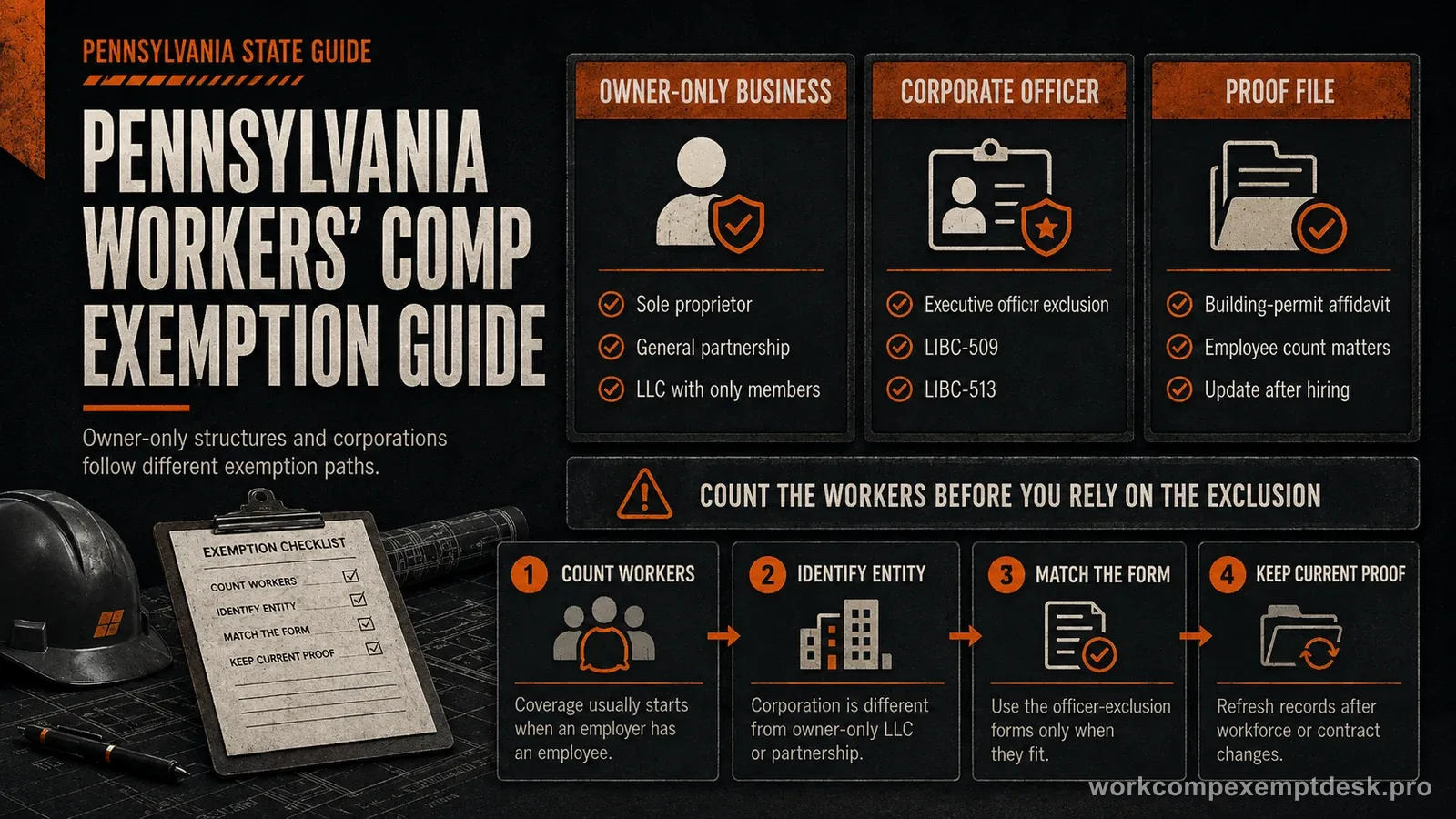
Pennsylvania generally requires workers’ compensation when an employer has at least one employee unless every worker falls within an exclusion. Sole proprietors and general partners with no other employees, and LLCs whose only workers are members, are listed as excluded situations. Qualifying corporate executive officers use LIBC-509 together with LIBC-513; where those forms are filed depends on whether the corporation already has a policy for other employees.
Entity types analyzed
- Sole proprietor
- LLC member
- Partner
- Corporate officer
Pennsylvania’s workers’ compensation rules separate owner-only businesses from corporations in a way that matters for both insurance and paperwork. A sole proprietor or general partnership with no other employees, and an LLC whose only workers are its members, can sit outside the ordinary coverage requirement. A corporation does not get the same shortcut: an executive officer who wants to be excluded must satisfy the corporate eligibility rules and use the Commonwealth’s officer-exclusion forms.
Pennsylvania generally requires workers’ compensation when an employer has at least one employee unless every worker falls within an exclusion. Sole proprietors and general partners with no other employees, and LLCs whose only workers are members, are listed as excluded situations. Qualifying corporate executive officers use LIBC-509 together with LIBC-513; where those forms are filed depends on whether the corporation already has a policy for other employees.
How owners are treated, at a glance
Sole proprietorA sole proprietor with no other employees is listed as excluded from the mandatory coverage requirement; owner coverage may be elected voluntarily.
LLC memberAn LLC whose only workers are members is listed as excluded from the mandatory coverage requirement. Adding a non-member employee changes the analysis.
PartnerGeneral partners with no other employees are listed as excluded from mandatory coverage; owner coverage may be elected voluntarily.
Corporate officerA qualifying executive officer uses LIBC-509 with LIBC-513. Nonprofit unpaid voluntary officers, qualifying S-corporation officers with ownership interest, and qualifying C-corporation officers with at least 5% interest have specified exclusion paths.
Pennsylvania can require coverage with a single employee
The Department of Labor & Industry’s employer guidance says an employer must insure workers’ compensation liability unless all employees fall within a listed exclusion. That means a single part-time or family employee can be enough to move an owner-only business into the insured-employer category; the state specifically warns that limited hours or family relationship do not by themselves remove the duty.
The owner analysis therefore comes after the workforce inventory. A no-employee sole proprietor can be outside the coverage requirement, while the same sole proprietorship with a hired helper may need a policy for that helper. The owner’s own treatment does not erase the employee’s status.
This is also why 'zero employees' should be documented as a fact rather than used as a permanent business label. Once the business hires, the old exclusion may no longer describe the operation.
Owner-only sole proprietorships, partnerships, and LLCs are handled differently from corporations
Pennsylvania’s LIBC-200 employer information lists a sole proprietor or general partners with no other employees among the situations excluded from the mandatory coverage rule. It separately lists LLCs where the only employees are members of the LLC. The current Employer’s Certificate of Insurance, LIBC-661, reinforces that distinction by using 'zero employees' examples that include sole proprietors, LLC members, and general partners—but not corporations.
Those rules do not mean an owner can never elect coverage. State Workers’ Insurance Fund materials include voluntary-election paths for owners who want to be covered. The important point for an exemption-focused file is that these owners generally do not need the corporate officer-exclusion forms merely because they personally are not on a workers’ compensation policy.
A business should record whether it truly has no non-owner employees and which entity type it is using. An LLC whose only workers are members fits a different published exclusion than an LLC that hires a non-member employee.
Corporate officer exclusion requires eligibility plus LIBC-509 and LIBC-513
The corporate path is more formal. The Bureau of Workers’ Compensation says a qualifying executive officer must be supported by an Application for Executive Officer Exception, LIBC-509, filed together with the appropriate Executive Officer’s Declaration, LIBC-513. SWIF describes the pair as the officer’s notice of rejection from workers’ compensation coverage.
Eligibility depends on the corporation. Pennsylvania says a nonprofit may seek exclusion for an executive officer serving voluntarily and without remuneration; an S corporation may seek exclusion for an executive officer with the required ownership interest; and a C corporation may seek exclusion for an executive officer with at least a five percent interest.
That means the forms should not be treated as self-certifying. Keep the corporate tax/entity status, ownership evidence, officer role, and signed declarations with the filing so the file explains why the officer qualified—not merely that a PDF was submitted.
Where the officer forms go depends on whether other employees are insured
Pennsylvania’s compliance page gives two filing destinations. If the corporation has a workers’ compensation policy covering other employees, the officer-exclusion forms are filed with the insurance carrier. If the employer has no other employees, the forms go to the Bureau of Workers’ Compensation Compliance Section.
That distinction prevents a common small-business error: sending every officer form to the state while ignoring the policy that actually covers the workforce. When employees remain insured, the carrier must know who is being excluded from that policy. When there are no other employees, the Bureau needs the exclusion record to understand why the corporation reports no covered workforce.
For SWIF policies, current underwriting guidance also says officer coverage choices cannot be changed during the policy term. A business should therefore verify the effective policy period and carrier-specific processing before assuming an exclusion can be toggled midterm.
Construction adds both building-permit proof and a stricter misclassification test
Pennsylvania municipalities must address workers’ compensation before issuing a building permit to a contractor. State guidance says the contractor must present proof of workers’ compensation insurance or an affidavit that it employs no other individuals and is not required to carry the insurance. If an exempt permit holder later hires people for that permitted work without required coverage, the statute provides for a stop-work response.
Construction businesses also have to separate true independent contractors from employees. Under the Construction Workplace Misclassification Act, the Department says an individual must have a written contract, be free from control or direction, and be customarily engaged in an independently established trade or business, with additional factors used to establish that independent business.
An owner-only contractor can therefore have a valid no-employee affidavit and still create a coverage problem by adding labor that does not satisfy the construction classification test. The permit file, subcontractor file, and owner-exclusion file should be kept distinct.
The first hire and a corporate reorganization are the two biggest Pennsylvania reset points
For an owner-only sole proprietorship, partnership, or member-only LLC, the first non-owner worker changes the mandatory-coverage analysis. The business should not wait for a building permit renewal or an annual insurance audit to notice that the facts supporting the exclusion are gone.
For a corporation, changes in tax status, officer position, compensation, or ownership percentage can affect whether an executive officer remains eligible for exclusion. Keep those facts with LIBC-509 and LIBC-513 and re-check them at policy renewal rather than treating the original filing as permanent proof.
A Pennsylvania compliance record is strongest when it shows both the legal reason for the owner’s treatment and the workforce facts on the relevant date. That makes it possible to answer an insurer, municipality, or auditor without stretching a corporate form to cover an LLC, or stretching a zero-employee affidavit beyond the period when the business actually had zero employees.
What failing to insure actually costs in Pennsylvania
Pennsylvania pursues an uninsured employer on two tracks at once — reimbursing whatever the state fund paid an injured worker, and prosecuting the employer criminally for the gap itself.
An unintentional violation is a misdemeanor, punishable by up to 1 year in jail and a fine of up to $2,500. An intentional violation is a felony, punishable by up to 7 years in prison and a fine of up to $15,000 — and a continuing violation can be charged as multiple counts of either offense.
If a worker is hurt while the employer is uninsured, the Uninsured Employers Guaranty Fund can pay the claim, and the employer must then reimburse the Fund for the benefits paid, plus interest, penalties, and fees under the Act.
- Unintentional violation: misdemeanor, up to 1 year and a fine up to $2,500
- Intentional violation: felony, up to 7 years and a fine up to $15,000
- A continuing violation can be charged as multiple separate counts
- If a claim is paid by the Uninsured Employers Guaranty Fund, the employer must reimburse it plus interest, penalties, and fees
Pennsylvania owner checklist
- Confirm whether the business has even one non-excluded employee; part-time and family status do not automatically avoid coverage.
- For a sole proprietor, general partnership, or member-only LLC, document the no-other-employee fact instead of filing corporate officer forms.
- For a corporation, verify the officer’s entity-specific ownership/compensation eligibility before using LIBC-509 and LIBC-513.
- File officer forms with the carrier when other employees are insured, or with the Bureau Compliance Section when there are no other employees.
- For construction, keep building-permit proof/affidavit and Act 72 worker-classification records separate from owner paperwork.
- Re-check after the first hire, ownership change, officer change, or policy renewal.
Form, fee, and timing at a glance
Cross-checked against Pennsylvania Department of Labor & Industry / insurer and verified 2026-10-10. This restates the state forms reference; the state agency remains the authority.
Coverage ruleWorkers' compensation is generally mandatory when an employer has at least one employee unless all workers fall within an exclusion. State guidance lists sole proprietors/general partners with no other employees and LLCs whose only workers are members among excluded situations.
Construction ruleNo separate construction head-count threshold is stated in the cited employer guidance. Contractors seeking building permits must provide workers' compensation proof or a qualifying no-employee affidavit, and construction worker classification is subject to the Construction Workplace Misclassification Act.
DocumentLIBC-509 + LIBC-513 — Executive Officer Exclusion Application and Declaration
Issuing bodyPennsylvania Department of Labor & Industry / insurer
Filing methodSubmit LIBC-509 with an LIBC-513 declaration for each eligible officer, electronically or by paper. File with the carrier when the corporation insures other employees; if it has no other employees, file with DLI’s Bureau of Workers’ Compensation Compliance Section.
FeeNo separate filing fee verified
NoteFor-profit S-corporations may request exclusion for officers with any ownership interest; C-corporation officers need at least 5%. Paper filings include a declaration for every officer with an ownership interest, and the declared ownership shares must total 100%. These forms are for corporate officers, not sole proprietors, partners, or LLC members.
EffectiveOn acceptance/endorsement of the qualifying executive-officer exclusion under the applicable carrier/DLI workflow.
RenewalTied to the exclusion/policy and officer/ownership facts; refile when the relevant policy or eligibility changes.
Watch out forSole proprietors/general partners/member-only LLCs use different owner exclusions; LIBC-509/513 are corporate-officer forms.
Full LIBC-509 + LIBC-513 filing guide Open the official source Compare renewal rules across states Run the eligibility screener
Which agency handles this
Pennsylvania Department of Labor & Industry, Bureau of Workers' Compensation
Official sources for this page
These are the state-agency, statutory, or state-board materials used for this guide. The page was last source-checked on 2026-08-25.
Pennsylvania workers' comp exemption FAQ
- Does a sole proprietor need workers' comp coverage in Pennsylvania?
- A sole proprietor with no other employees is listed as excluded from the mandatory coverage requirement; owner coverage may be elected voluntarily.
- Can an LLC member get a workers' comp exemption in Pennsylvania?
- An LLC whose only workers are members is listed as excluded from the mandatory coverage requirement. Adding a non-member employee changes the analysis.
- How does a corporate officer opt out of workers' comp in Pennsylvania?
- A qualifying executive officer uses LIBC-509 with LIBC-513. Nonprofit unpaid voluntary officers, qualifying S-corporation officers with ownership interest, and qualifying C-corporation officers with at least 5% interest have specified exclusion paths.
- Are partners covered by workers' comp in Pennsylvania?
- General partners with no other employees are listed as excluded from mandatory coverage; owner coverage may be elected voluntarily.
- What form is used for a Pennsylvania workers' comp owner exemption?
- LIBC-509 Application for Executive Officer Exception + LIBC-513 Executive Officer's Declaration (corporations only). The cited Bureau guidance does not state a single statewide fixed expiration for executive-officer exclusions. If other employees are insured, the forms are filed with the carrier; SWIF guidance says the officer coverage choice cannot be changed during the policy term.
Answers restate the sourced fields above. Open the official source library for the underlying agency and statute pages.