New York
Workers' Comp Exemption
Verified against New York State Workers' Compensation Board on 2026-08-25
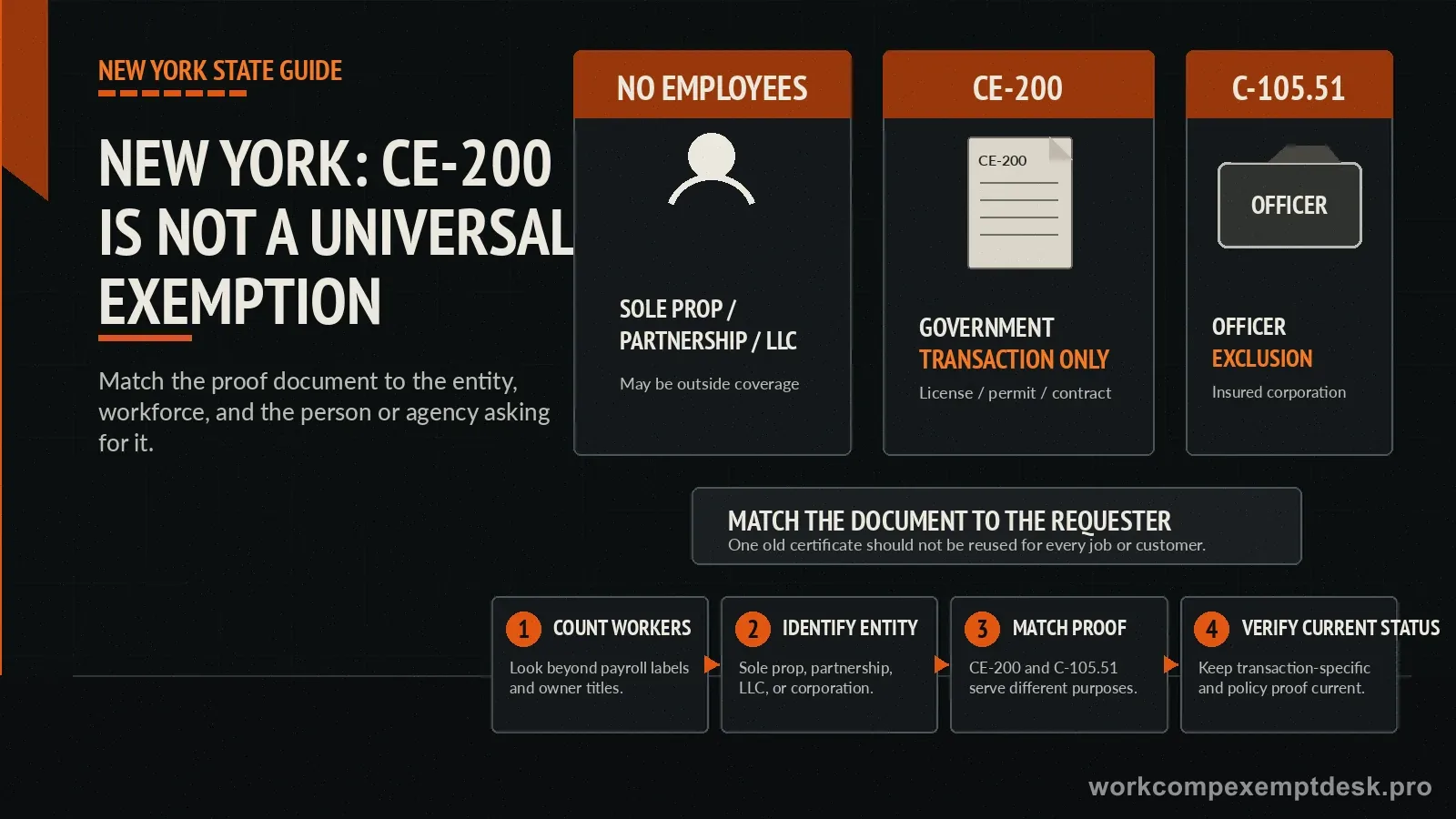
A sole proprietor, partnership, LLC, or LLP with no employees generally does not need workers’ compensation solely for the owner, partners, or members. A one- or two-person corporation can also fall outside the requirement if the owners hold all stock and offices and there are no other workers. CE-200 is only for a specific government license, permit, or contract; C-105.51 is the separate officer-exclusion form for a qualifying corporation that otherwise has workers’ compensation coverage.
Entity types analyzed
- Sole proprietor
- LLC member
- Partner
- Corporate officer
New York’s small-business rules are built around whether the business actually has employees and what legal entity owns the business. A no-employee sole proprietor, partnership, or LLC can be outside the coverage requirement without a broad “owner exemption certificate.” CE-200 is narrower: it is evidence for a specific government license, permit, or contract, not a universal certificate for customers or insurers.
A sole proprietor, partnership, LLC, or LLP with no employees generally does not need workers’ compensation solely for the owner, partners, or members. A one- or two-person corporation can also fall outside the requirement if the owners hold all stock and offices and there are no other workers. CE-200 is only for a specific government license, permit, or contract; C-105.51 is the separate officer-exclusion form for a qualifying corporation that otherwise has workers’ compensation coverage.
How owners are treated, at a glance
Sole proprietorA sole proprietor with no employees is not required to carry workers' compensation for themself, but may voluntarily include themself on a policy. Once the business has employees, coverage is required for those employees.
LLC memberAn LLC with no employees is not required to carry workers' compensation solely for its members. Members are not considered employees for obtaining workers' compensation coverage, but may voluntarily cover themselves.
PartnerA partnership with no employees is not required to carry workers' compensation solely for its partners. Partners are not considered employees for obtaining workers' compensation coverage, but may voluntarily cover themselves.
Corporate officerA one- or two-person corporation can be outside the coverage requirement when those one or two individuals own all stock, hold all corporate offices, and there are no other employees or workers described by the Board. If a corporation is otherwise required to carry coverage, Form C-105.51 is used to exclude a qualifying sole shareholder-officer or one or both qualifying executive officers-shareholders from an existing policy.
New York begins with the no-employee rule, not a universal exemption form
The Workers’ Compensation Board says a sole proprietor with no employees does not need workers’ compensation coverage solely for themself. Partnerships, LLCs, and LLPs with no employees are treated similarly: partners and members are not considered employees for the purpose of obtaining workers’ compensation coverage, although they may voluntarily include themselves on a policy.
Once those businesses have employees, the result changes. The Board’s for-profit coverage guidance includes part-time, temporary, seasonal, casual/day labor, leased, borrowed, family, and even certain unpaid workers in the categories that can create a coverage duty. The business should therefore count the people actually providing services rather than looking only at W-2 payroll.
This is why a New York owner with no employees may be legally outside the coverage requirement without possessing CE-200. The certificate is only needed in the specific government-facing situations described by the Board.
One- and two-person corporations have a special ownership test
A corporation is not treated exactly like a sole proprietorship or LLC. The Board says workers’ compensation coverage is not required for a one- or two-person owned corporation when those individuals own all of the stock, hold all corporate offices, and there are no other employees or workers of the kinds listed in the Board’s guidance. In a two-person corporation, each person must hold an office and own at least one share, and together they must own all shares.
The exception is narrow. The Board states that coverage is required if the corporation has more than two corporate officers or more than two shareholders, or if the one or two officers do not own all of the stock. The presence of other workers also breaks the no-employee fact pattern.
A corporation that is otherwise required to maintain workers’ compensation can still have a separate officer-exclusion issue. Form C-105.51 is designed for a sole shareholder-officer or one or both executive officer-shareholders of a qualifying one- or two-person corporation that has a policy and wants those officers excluded from that coverage.
The CE-200 form: what the Certificate of Attestation of Exemption proves and when you need it
The Certificate of Attestation of Exemption, CE-200, can be used to tell a New York government entity that a business seeking a license, permit, or contract is not required to carry workers’ compensation and/or disability and Paid Family Leave coverage. The Board expressly limits the certificate to that government transaction.
CE-200 cannot be used to answer a Board non-compliance or penalty matter, and it cannot be used as proof to another private business or that business’s insurance carrier that workers’ compensation is not required. The Board’s application page limits the certificate to entities operating in New York with no employees and certain out-of-state entities whose contract or licensed work is entirely outside New York.
The certificate is also transaction-specific. It is valid only for the license, permit, or contract identified on it, and a separate CE-200 is required for each building permit. A contractor who keeps one old CE-200 in a general compliance folder and hands it to every customer is using the document for a purpose the Board specifically says it does not serve.
There is no CE-200 PDF to download and mail in. The Board issues it only through its own online request service, at wcb.ny.gov, where an eligible applicant answers the exemption questions and prints the completed certificate immediately on approval — a paper or third-party fillable-PDF version is not a valid substitute.
C-105.51 is the corporate-officer exclusion—not CE-200
When a corporation is required to have workers’ compensation coverage but qualifies to exclude its sole shareholder-officer or one or both of two executive officer-shareholders, the relevant Board form is C-105.51. The form is filed with the insurer; Board-approved self-insured employers use the Board’s self-insurance filing path.
The form itself states the ownership conditions. A one-person corporation uses it for the sole executive officer who owns all issued and outstanding stock and holds all offices. A two-person corporation may exclude one or both executive officers if the two officers own all stock between them and each owns at least one share.
The election continues until the corporation revokes it. The Board’s forms table identifies C-105.55 as the revocation form. This is a policy election inside an insured corporation, not a substitute for CE-200 and not a general declaration that the corporation never needs workers’ compensation.
Construction owners must watch the employee-versus-contractor presumption
New York’s Construction Industry Fair Play Act creates a separate risk for small contractors who use people labeled as independent contractors. The Board explains that a person performing services for a construction contractor is presumed to be the contractor’s employee unless the statutory independent-contractor test or separate-business-entity test is satisfied.
For an individual worker, the contractor must be able to establish all three parts of the test: freedom from control and direction, work outside the contractor’s usual course of business, and an independently established trade or business similar to the service being performed. A separate business entity faces a longer twelve-factor test.
The Board also notes that general contractors commonly require subcontractors to prove their own workers’ compensation coverage, even when a sole proprietor, partnership, or small corporation might otherwise be outside the statutory requirement. The contract requirement and the statutory coverage requirement are therefore related but not identical questions.
What failing to secure coverage actually costs under §52
Workers’ Compensation Law §52 sets separate criminal and administrative consequences for an employer that is required to carry coverage and does not — this is distinct from the owner-exemption question above, and it is why getting the entity/employee analysis right matters beyond paperwork.
Criminally, failing to secure coverage for five or fewer employees within a 12-month period is a misdemeanor, punishable by a fine of $1,000 to $5,000. Failing to secure coverage for more than five employees in that period is a class E felony, punishable by a fine of $5,000 to $50,000, on top of any other penalty the law provides.
Separately, the Board can assess an administrative penalty of up to $2,000 for each 10-day period an employer goes without coverage, or up to twice the cost of compensation for the payroll during that period — whichever the Board applies — in addition to the criminal penalties above. It is an affirmative defense to criminal prosecution that the employer took reasonable steps to secure compensation.
- Misdemeanor (≤5 employees/12 months): fine $1,000–$5,000
- Class E felony (>5 employees/12 months): fine $5,000–$50,000
- Administrative penalty: up to $2,000 per 10-day period without coverage, or up to 2× payroll compensation cost for that period
- Reasonable steps taken to secure compensation can be raised as an affirmative defense to criminal prosecution
Match the proof document to the requester and the business’s actual coverage status
For a New York state or municipal permit, license, or contract, the Workers’ Compensation Board identifies several acceptable proof paths. A privately insured business generally has its carrier or licensed agent send Form C-105.2; an employer insured through the New York State Insurance Fund uses U-26.3; approved self-insured employers use SI-12, and group self-insured employers use SIG-105.2. CE-200 belongs only in the final branch—when the business is legally exempt from the coverage requirement for that government transaction.
That list prevents a common documentation mistake. An ACORD certificate is not accepted as proof under Workers’ Compensation Law §57, and CE-200 cannot be used to prove a general exemption to another private business or that business’s insurer. A contractor therefore needs to ask who is requesting the proof and why before handing over a document from the compliance folder.
Re-run the underlying coverage test before each new government transaction if the facts have changed. Adding a worker, changing corporate ownership or offices, taking on construction labor that fails the Fair Play Act test, or beginning New York work can alter which proof path is correct. The document should follow the current coverage status; it should not be used to manufacture that status after the fact.
New York owner checklist
- Confirm whether the business truly has no employees under New York’s broad for-profit worker rules.
- For a one- or two-person corporation, verify that the owners hold all stock and all offices and that no other workers are present.
- Use CE-200 only for the specific government license, permit, or contract identified on the certificate.
- Do not use CE-200 as proof to a private customer or insurer that the business is generally exempt.
- If an insured corporation wants to exclude qualifying owner-officers, use the C-105.51 policy-election path instead.
- For government proof, use the form that matches current status—C-105.2/U-26.3, self-insurance proof, or CE-200—and do not substitute an ACORD certificate.
Form, fee, and timing at a glance
Cross-checked against New York State Workers’ Compensation Board and verified 2026-09-08. This restates the state forms reference; the state agency remains the authority.
Coverage ruleFor-profit businesses generally must carry workers' compensation for employees, including part-time, temporary, seasonal, casual, borrowed, leased, unpaid, and family workers. A sole proprietor, partnership, LLC, or LLP with no employees is not required to carry coverage solely for the owner, partners, or members.
Construction ruleThe Board's general coverage rules do not create a separate employee-count threshold for construction businesses: once a for-profit business has workers who qualify as employees, coverage is required. Construction businesses should also account for New York's stricter employee-versus-independent-contractor rules when classifying labor.
DocumentCE-200 — Certificate of Attestation of Exemption
Issuing bodyNew York State Workers’ Compensation Board
Filing methodRequest the CE-200 online through New York Business Express (businessexpress.ny.gov) or the WCB online exemption service, for a specific government license, permit, or contract.
FeeNo separate filing fee verified
NoteCE-200 is transaction-specific proof for government licensing/permit/contract purposes. It is not a private-business owner exemption certificate and is separate from C-105.51 officer exclusions inside insured policies.
EffectiveOn issuance for the specific government transaction identified on the certificate.
RenewalNo periodic renewal; a new CE-200 is required for each separate license, permit, or contract when the exemption conditions are met.
Watch out forCE-200 is not private proof of exemption for a GC/client; it is limited to the specific government transaction.
Full CE-200 filing guide Open the official source Compare renewal rules across states Run the eligibility screener
Which agency handles this
New York State Workers' Compensation Board
Official sources for this page
These are the state-agency, statutory, or state-board materials used for this guide. The page was last source-checked on 2026-08-25.
- NYS WCB — Workers' Compensation Coverage Requirements
- NYS WCB — CE-200 Certificate of Attestation of Exemption
- NYS WCB — Government Permits, Licenses and Contracts
- NYS WCB — C-105.2 Certificate of Coverage
- NYS WCB — Identifying an Independent Contractor / Construction Industry Fair Play Act
- NYS WCB — Self-Insured Employer Forms / C-105.51
- NYS WCB — C-105.51 Officer Exclusion Form
New York workers' comp exemption FAQ
- Does a sole proprietor need workers' comp coverage in New York?
- A sole proprietor with no employees is not required to carry workers' compensation for themself, but may voluntarily include themself on a policy. Once the business has employees, coverage is required for those employees.
- Can an LLC member get a workers' comp exemption in New York?
- An LLC with no employees is not required to carry workers' compensation solely for its members. Members are not considered employees for obtaining workers' compensation coverage, but may voluntarily cover themselves.
- How does a corporate officer opt out of workers' comp in New York?
- A one- or two-person corporation can be outside the coverage requirement when those one or two individuals own all stock, hold all corporate offices, and there are no other employees or workers described by the Board. If a corporation is otherwise required to carry coverage, Form C-105.51 is used to exclude a qualifying sole shareholder-officer or one or both qualifying executive officers-shareholders from an existing policy.
- Are partners covered by workers' comp in New York?
- A partnership with no employees is not required to carry workers' compensation solely for its partners. Partners are not considered employees for obtaining workers' compensation coverage, but may voluntarily cover themselves.
- What form is used for a New York workers' comp owner exemption?
- CE-200 — Certificate of Attestation of Exemption for a government license, permit, or contract; C-105.51 applies to certain corporate-officer exclusions from an existing workers' compensation policy. CE-200 is not a general multi-year exemption certificate. It is valid only for the specific government license, permit, or contract for which it is issued; a separate CE-200 is required for each building permit.
Answers restate the sourced fields above. Open the official source library for the underlying agency and statute pages.