Workers' Comp Exemptions and Thresholds in Agriculture
Built from official state-agency sources · desk review 2026-08-26
Farm and seasonal-labor rules can use different thresholds and definitions from the general business rule in the same state.
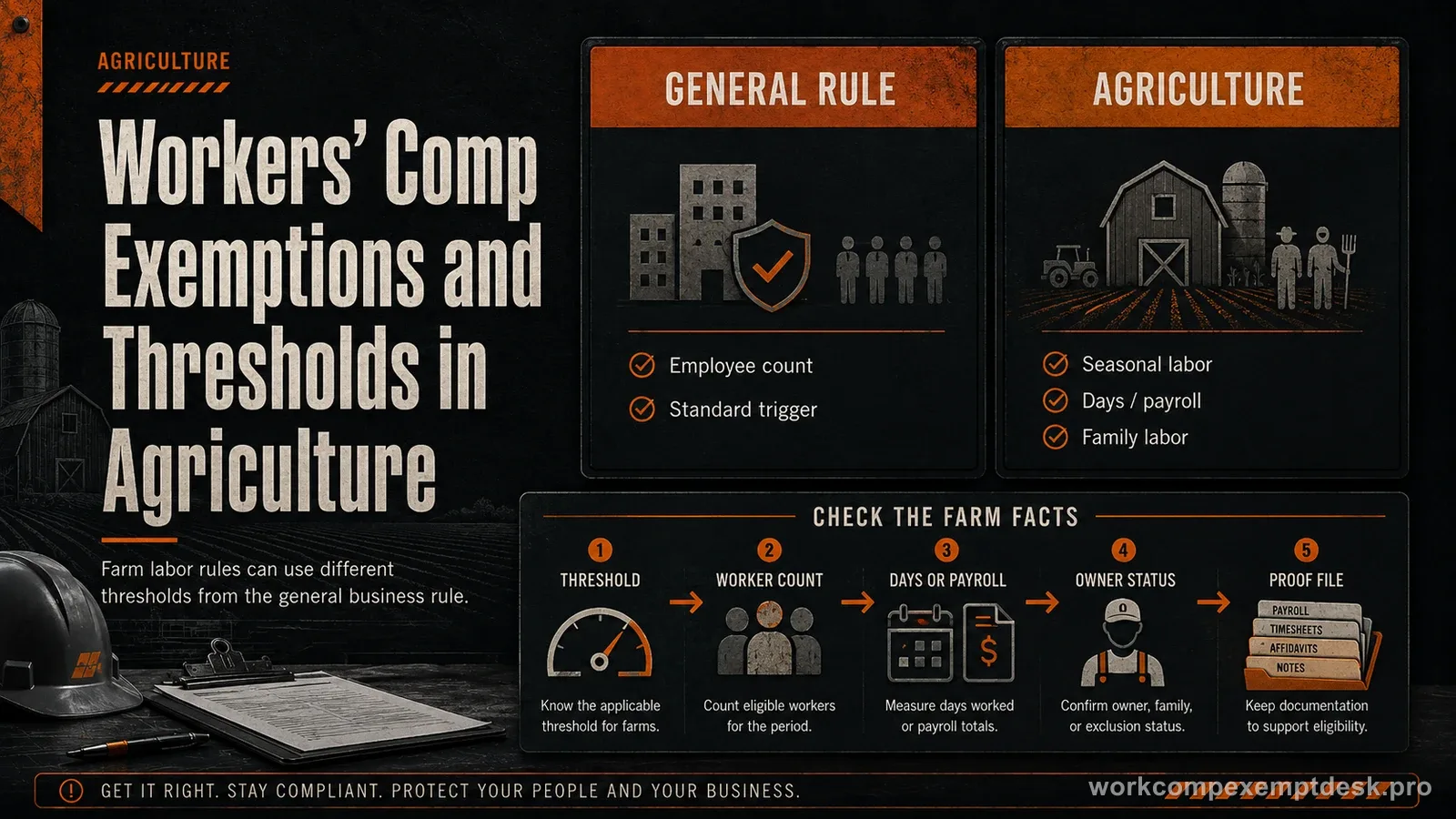
Agriculture can have its own workers' compensation thresholds, seasonal-worker definitions, family-labor rules, and labor-agent requirements. Do not apply the state's ordinary business employee threshold to a farm without checking the agricultural rule.
What to verify before relying on an exemption
- Find the state's agricultural coverage threshold rather than using the general threshold
- Separate regular employees from seasonal or temporary agricultural labor
- Check family-member and low-wage agricultural exclusions if the state provides them
- Verify who employs workers supplied through a labor agent or crew leader
- Recount the workforce when the season, payroll, or labor arrangement changes
Agricultural businesses are especially easy to misread because the workforce can change by season. A farm may have a few year-round employees, a large short-term harvest crew, family members, contractors, or workers supplied by a labor agent. State workers' compensation statutes may count those groups differently from the ordinary business rule. The owner-exemption question therefore comes after the agricultural workforce is mapped accurately.
Agriculture can use a completely different threshold from the rest of the state
Florida is a clear example. Non-construction employers generally use a four-employee threshold, but agricultural employers use a separate rule: six regular employees and/or twelve seasonal workers who satisfy the state's duration conditions. A farm owner who looks only at the ordinary business threshold can therefore buy coverage too late or assume coverage is required when the agricultural rule says otherwise.
The first step is to locate the state's agricultural section and copy the definitions exactly. Terms such as regular employee, seasonal worker, agricultural labor, and days worked can determine whether the threshold has been crossed.
SOURCE CONTEXT: Florida DFS publishes a separate agricultural threshold and seasonal-work duration test.
Seasonal head count is not always enough—you may need days or payroll
Agricultural rules can use time or wage limits rather than a simple number of people. Florida's seasonal rule includes duration conditions. Pennsylvania lists agricultural laborers earning under a specified per-person annual amount among excluded categories, subject to additional conditions. These are very different counting systems.
A farm should therefore maintain the data needed to apply its own state's test. That may mean days worked during a season, total calendar-year days, wages per worker, or whether a family-labor condition applies. A year-end employee count may be useless if the statute measures the threshold differently.
SOURCE CONTEXT: Pennsylvania's employer guidance includes a wage-based agricultural exclusion; Florida uses employee and seasonal-duration thresholds.
The owner question still has to be separated from farm-worker coverage
A farm can have an owner who is outside personal employee treatment while still owing workers' compensation for agricultural employees once the state threshold is reached. The owner's personal election does not convert harvest workers or farmhands into exempt labor.
Conversely, an owner may voluntarily elect personal coverage even when not required to do so. The research file should record the owner's status and the agricultural workforce status separately so the decision to cover the owner is not confused with the legal duty to cover employees.
Labor agents and crew arrangements need their own proof trail
Farms frequently obtain seasonal workers through labor agents or crew leaders. Texas workers' compensation rules require a labor agent providing migrant and seasonal farm or ranch workers to give written notice about whether the agent has workers' compensation coverage and, when coverage exists, to provide evidence at the time of each contract. The notice must be repeated for each contract.
That example shows why a farm should not assume that supplied workers are automatically insured by the intermediary. The contract should identify who is the employer, who carries coverage, and what proof must be renewed for each engagement.
SOURCE CONTEXT: Texas Rule §112.301 imposes contract-by-contract notice and evidence duties on labor agents serving farm and ranch operations.
Family labor and low-dollar exceptions should be read narrowly
Some states carve out certain family or low-wage agricultural labor. Those provisions can be fact-intensive and should not be converted into a general “family members are exempt” rule. Pennsylvania's published exclusion, for example, combines an annual earnings limit with an additional family condition.
When a farm relies on such an exclusion, preserve payroll records and the relationship facts that make the exclusion applicable. If wages increase, duties change, or the worker no longer fits the family condition, the coverage analysis may change during the same year.
Use a seasonal reset instead of a one-time annual exemption review
Before each planting, harvest, or other labor-intensive period, update the regular-worker count, expected seasonal head count, days of work, labor-agent contracts, and payroll assumptions required by the state rule. Then check whether the owner status or company policy needs to change before workers arrive.
This seasonal reset is more useful than checking the rule only at formation. Agriculture can move from below a threshold to above it quickly, and the workers may already be on site before the owner realizes the legal count has changed. A short pre-season review closes that timing gap.
Frequently asked questions
- Do farms have different workers' comp thresholds?
- Yes, in many states. Agricultural employment can use a separate employee count, payroll figure, or seasonal-worker definition that differs from the general business rule in the same state.
- Are seasonal farm workers counted toward the coverage threshold?
- That varies by state. Some count seasonal and part-time agricultural labor differently from year-round employees, which can change whether coverage is required.
- Does an owner exemption help a farm with hired labor?
- An owner election only changes the owner's status. Hired agricultural workers are analyzed under the state's farm-labor coverage rule.
Agency and statutory pages used for this guide
These links back the state-specific examples above. Recheck the destination state's current rule before filing or changing coverage.