Workers' Comp Exemption Issues for Trucking and Transportation
Built from official state-agency sources · desk review 2026-08-26
Owner-operators, leased drivers, motor carriers, and multi-state routes create classification and jurisdiction questions that a simple 1099 does not solve.
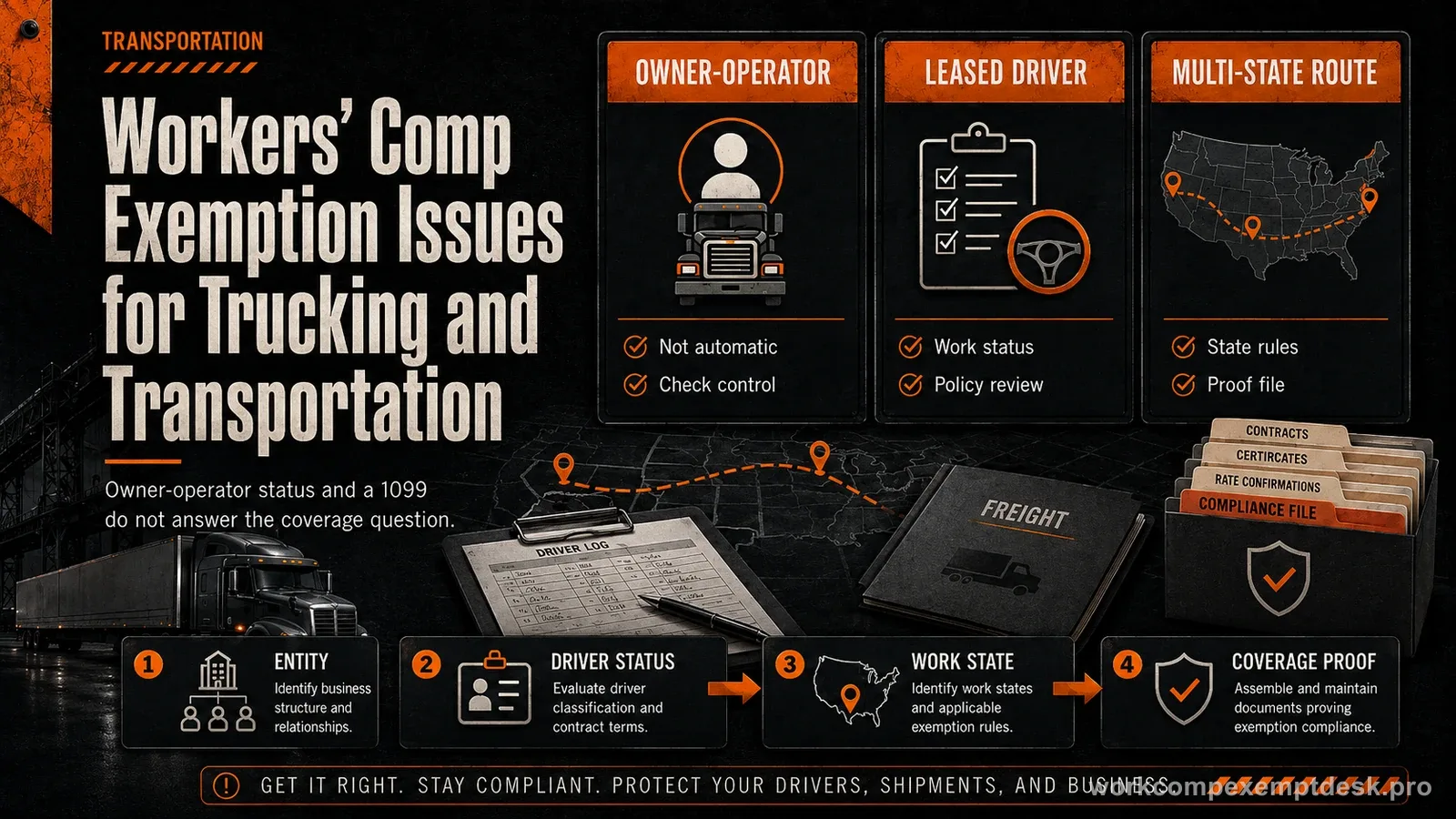
In trucking and transportation, the difficult question is often not whether an owner can opt out, but whether drivers are truly independent contractors and which state's workers' compensation law applies. A 1099, leased truck, or owner-operator agreement does not settle those questions by itself.
Facts to lock down before relying on an exemption
- Separate the owner's personal election from driver classification
- Identify where each driver actually performs work, pickups, deliveries, and loading
- Test independent-contractor status under the applicable state rule
- Check whether a transportation-specific fair-play statute applies
- Verify policy state listings before regular or project-based cross-border work
Transportation businesses combine mobile workers, owner-operators, leased equipment, multiple states, dispatch control, and contractor agreements. That makes them a poor fit for one-page “owner exemption” advice. The right analysis separates the business owner's personal status from driver classification and from the jurisdictional rules of every state where the company actually sends people to work.
Owner-operator is a business description, not a universal workers' compensation status
A driver may own a tractor, operate through an LLC, receive a 1099, and still be treated as an employee under a state's workers' compensation test. Conversely, a genuinely independent transportation business can exist where the legal criteria are satisfied. The equipment title and tax form are evidence, not the entire legal test.
For the business owner, this creates two parallel questions. First: can the owner or LLC member personally be excluded under the state owner rule? Second: how are the drivers who perform transportation services classified? Solving the first question does not answer the second.
New York presumes employment in commercial goods transportation
New York's Commercial Goods Transportation Industry Fair Play Act creates a transportation-specific presumption. A qualifying driver who transports goods in New York while operating a commercial motor vehicle is presumed to be an employee of the commercial goods transportation contractor that compensates the driver unless the statutory independent-contractor test is satisfied.
That means a carrier cannot rely on a standard owner-operator contract alone. The actual relationship must satisfy the statutory criteria. For workers' compensation purposes, New York's Board expressly incorporates this transportation framework into the coverage analysis.
SOURCE CONTEXT: New York WCB publishes the transportation-industry presumption and independent-contractor test.
California warns that a 1099 does not determine employment status
California's Labor Commissioner explains that labeling a worker an independent contractor, paying without payroll withholding, or issuing a 1099 does not determine status. For workers' compensation, the ABC test has applied since July 1, 2020 unless a statutory exception or other rule changes the applicable test.
Transportation relationships can have additional statutory complexity, including special treatment for certain motor-carrier arrangements. The compliance lesson is not to memorize one test nationally. It is to identify the applicable California rule for the actual driver relationship and then document the facts that support classification.
SOURCE CONTEXT: California DIR's independent-contractor FAQ specifically addresses workers' compensation and the limits of contract labels.
Crossing a state line can create a new coverage obligation
Transportation companies cross state borders as part of ordinary operations, but workers' compensation coverage is not governed solely by the company's home address. New York states that out-of-state employers with employees working in New York can need full statutory New York coverage, and its policy lists circumstances that trigger Item 3A coverage. Florida likewise requires out-of-state employers to evaluate Florida coverage and publishes a temporary-work reciprocity framework.
A carrier should therefore map regular delivery states, terminals, loading sites, and project-based work. The policy information page—especially the states listed for coverage—should be reviewed before assuming the home-state policy follows every driver everywhere.
Special labor arrangements and multi-state routes belong in the same operating file
Texas workers' compensation rules include specific notice requirements for labor agents who provide migrant and seasonal farm or ranch workers. The agent must tell the contracting party whether workers' compensation coverage exists and, if covered, provide evidence each time a contract is made. A prior contract's notice is not enough for a later agreement.
The point is broader than agriculture: transportation businesses often use staffing intermediaries, leasing arrangements, and contractors. Each layer can have its own proof duties. The company should identify who employs, pays, directs, and insures the worker instead of assuming the party supplying labor has handled workers' compensation automatically.
For each driver group, record employer or contractor entity, home base, states where work is performed, vehicle ownership, dispatch and control facts, payment method, policy states, and any independent-contractor analysis. Then keep the owner's own election or exclusion as a separate record.
This structure makes changes visible. A new customer route into New York, a California terminal, a new leased-driver program, or a shift from one-driver owner-operator to a small fleet can trigger a fresh review. Transportation compliance is dynamic because the place and structure of the work change even when the legal entity stays the same.
SOURCE CONTEXT: Texas Rule §112.301 shows how a labor-supply relationship can carry transaction-specific coverage notice duties.
Common questions
- Does a workers' comp exemption cover an owner-operator in trucking?
- It depends on classification and jurisdiction. Owner-operators, leased drivers, and motor-carrier arrangements raise employee-status and which-state questions that a 1099 does not settle.
- Which state's workers' comp rules apply to a multi-state route?
- More than one state can have a claim to jurisdiction based on where the driver is based, hired, or injured. Confirm the rule for each state a route touches.
- Is a motor carrier responsible for a leased driver's coverage?
- Often the carrier has obligations regardless of the lease label. Check the state's specific treatment of leased and owner-operator drivers.
Agency and statute pages behind this guide
The state-specific examples above draw on these links. Always confirm the current rule with the destination state before filing or changing coverage.