Illinois
Workers' Comp Exemption
Verified against Illinois Workers' Compensation Commission on 2026-08-25
Illinois generally requires workers’ compensation when a business has an employee, while a sole proprietor, partner, LLC member, or qualifying corporate officer can choose not to cover themself. The Illinois Workers’ Compensation Commission does not issue an owner opt-out certificate or require a state opt-out form; when a policy covers other employees, the owner’s written notice goes to the insurance carrier.
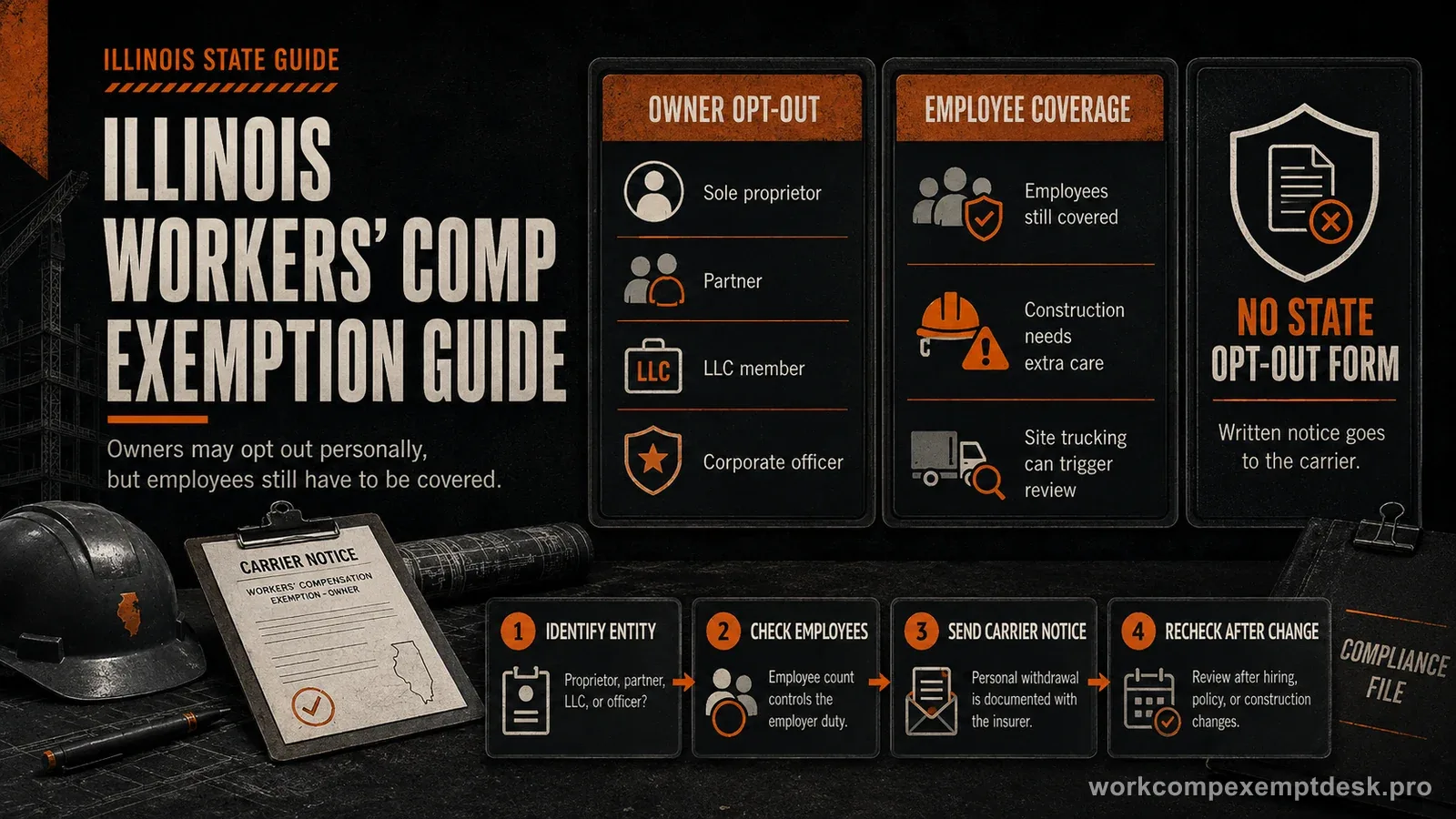
Ownership types reviewed
- Sole proprietor
- LLC member
- Partner
- Corporate officer
Illinois lets several business owners remove themselves from personal workers’ compensation coverage, but that owner decision should not be confused with the employer’s duty to insure workers. The state generally expects employers to cover people they hire, while sole proprietors, partners, qualifying corporate officers, and LLC members have owner-specific election rules. Construction and other extra-hazardous work add a classification layer that makes a simple 'I am an owner' answer unsafe.
Illinois generally requires workers’ compensation when a business has an employee, while a sole proprietor, partner, LLC member, or qualifying corporate officer can choose not to cover themself. The Illinois Workers’ Compensation Commission does not issue an owner opt-out certificate or require a state opt-out form; when a policy covers other employees, the owner’s written notice goes to the insurance carrier.
Owner treatment, at a glance
Sole proprietorMay elect not to cover themself. If the business has a policy for employees and the proprietor opts out personally, the Commission directs the owner to notify the carrier in writing.
LLC memberMay elect not to cover themself. If a policy covers other employees, preserve written carrier notice/confirmation of the member's personal opt-out.
PartnerMay elect not to cover themself. If the business has a policy for employees and the partner opts out personally, the Commission directs written notice to the carrier.
Corporate officerA bona fide president, vice president, secretary, or treasurer may withdraw individually by written notice to the carrier; the withdrawal is effective when the carrier receives the notice. Coverage can be resumed by written notice.
Illinois starts with the employer’s workforce, not an owner certificate
The Illinois Workers’ Compensation Commission describes workers’ compensation insurance as a legal obligation for employers and says Illinois law requires coverage for almost everyone who is hired and whose employment is localized in the state. For a small business, the practical starting point is therefore whether anyone is working under a contract of hire—not whether the owner has found an exemption form online.
Owner status changes the treatment of the owner, not necessarily the treatment of everyone else. A sole proprietor who chooses not to cover themself can still operate a business that has covered employees. An LLC member can make a personal election while the LLC continues to insure its workforce. The company-level coverage question and the individual owner’s coverage question should be recorded separately.
This distinction becomes especially important after the first hire. A business that previously consisted only of an owner may not need to buy a policy solely for that owner, but the arrival of an employee creates a new employer analysis. An old owner opt-out decision is not proof that the new worker is outside the Act.
Sole proprietors, partners, and LLC members have a personal opt-out rule
Section 3 of the Illinois Workers’ Compensation Act states that the Act is not construed to apply to a sole proprietor, partner, or member of an LLC who elects not to provide and pay compensation for injuries to themself. The Commission’s insurance guidance expresses the rule in practical terms: those owners may choose to come under the Act or choose not to be covered personally.
If the business already has a workers’ compensation policy for employees, the Commission tells an owner who does not want personal coverage to notify the carrier in writing. That written carrier record matters more than a homemade 'exemption certificate' because the Commission says it does not have an opt-out form and does not require individuals to use one.
The reverse decision is also possible. An owner who wants workers’ compensation protection for a work injury can purchase or elect coverage for themself. That is why the compliance file should state the election actually made instead of describing these owner categories as permanently exempt by entity type.
A corporate officer must fit Illinois’s statutory officer definition
Illinois gives corporate officers their own withdrawal rule. The current statute defines a corporate officer for this purpose as a bona fide president, vice president, secretary, or treasurer who voluntarily elects to withdraw. The election is individual, and written notice to the insurance carrier is effective when the carrier receives it.
That definition is narrower than 'shareholder' or 'owner.' A person who owns stock but does not hold one of the listed offices should not assume the corporate-officer withdrawal language applies. Conversely, a qualifying officer who later wants coverage again can provide written notice to resume coverage, with the statute again tying effectiveness to carrier receipt.
For recordkeeping, keep the corporate office evidence, the signed notice, and carrier receipt together. That produces a defensible answer to two different questions: why the person qualified to make the election, and when the election actually became effective.
Construction makes worker classification—not just owner status—the dangerous part
The Commission flags construction, trucking at construction sites, and other extra-hazardous occupations for special attention. Its guidance specifically points businesses toward Illinois’s Employee Classification Act and warns that calling someone an independent contractor does not necessarily remove a workers’ compensation obligation.
This matters for a small contractor that has valid owner opt-outs. The owner elections do not transform laborers, helpers, drivers, or subcontractor personnel into exempt owners. A construction business should separately document who owns the business, who is an employee, and why any person treated as an independent contractor satisfies the applicable classification rules.
The safest workflow is to treat the owner election as one line in the file and worker classification as another. If the business brings in labor for a project, re-check coverage even when every principal of the company has opted out personally.
There is no Illinois owner-exemption certificate to collect from the Commission
A useful Illinois-specific fact is what the state does not provide. The Commission says it has no opt-out form and does not require individuals to use an opt-out form. That makes Illinois a poor fit for a workflow copied from states that issue a government certificate of election to be exempt.
When other employees are insured, the operative record is the written notice to the carrier and the resulting policy treatment. For a corporate officer, the statute supplies an explicit receipt-based effective date. For a sole proprietor, partner, or LLC member, the business should follow the carrier’s documentation process and retain the carrier’s confirmation rather than inventing a certificate number that does not exist.
If a general contractor or customer asks for proof, give the document that answers the actual request—usually proof of the company’s workers’ compensation policy or carrier confirmation of owner treatment. Do not label an internal letter as an IWCC certificate.
Re-check the Illinois file after a hire, officer change, or move into higher-risk work
Three changes should trigger a fresh review. The first is a workforce change: hiring an employee changes the company-level insurance question even when an owner remains personally opted out. The second is an ownership or governance change: an LLC member can cease being a member, and a corporate owner can cease holding a statutory officer position.
The third is an operations change. Moving into construction, construction-site trucking, or another extra-hazardous activity can change the practical classification and insurance analysis. The Commission itself tells these businesses to pay special attention to the extra-hazardous rules and the Employee Classification Act.
A compact Illinois compliance file therefore needs the current policy, the owner’s election evidence, and a dated note showing the workforce and business activity that supported the decision. That is more useful than a static 'exempt' label because it makes the business re-test the facts that actually control coverage.
What failing to insure actually costs in Illinois
Illinois assesses noncompliance in per-day civil penalties on top of separate criminal exposure, and the amounts step up sharply on a repeat finding.
A first finding of a knowing and willful failure to carry coverage can draw a civil penalty of up to $500 for each day of noncompliance, with a minimum penalty of $10,000. If the Illinois Workers' Compensation Commission finds the employer noncompliant again, the daily penalty rises to up to $1,000 per day, with a $20,000 minimum.
Separately, a negligent failure to carry coverage is a Class A misdemeanor for each day without coverage (up to 12 months and a $2,500 fine); a knowing failure is a Class 4 felony for each day (1–3 years and up to a $25,000 fine). Corporate officers can be held personally liable for an unpaid penalty.
- First finding, knowing/willful: civil penalty up to $500/day, $10,000 minimum
- Repeat finding: civil penalty up to $1,000/day, $20,000 minimum
- Negligent failure: Class A misdemeanor per day (up to 12 months, $2,500 fine)
- Knowing failure: Class 4 felony per day (1–3 years, up to $25,000 fine)
Illinois owner checklist
- Count the people working for the business before analyzing the owner’s personal coverage.
- For a sole proprietor, partner, or LLC member opting out while employees are insured, keep written carrier notice and confirmation.
- For a corporate officer, verify the person is a bona fide president, vice president, secretary, or treasurer before using the statutory withdrawal rule.
- Do not look for an IWCC owner opt-out certificate; the Commission says it does not issue or require one.
- In construction or other extra-hazardous work, analyze employee/independent-contractor status separately from owner status.
- Re-check after the first hire, governance changes, or a change into construction or other higher-risk operations.
Form, fee, and timing summary
Cross-checked against Illinois Workers’ Compensation Commission / workers’ compensation carrier and verified 2026-09-02. This restates the state forms reference; the state agency remains the authority.
Coverage ruleIllinois generally requires employers to provide workers' compensation for employees. Owner treatment is separate: sole proprietors, partners, qualifying corporate officers, and LLC members may choose not to cover themselves personally.
Construction ruleIllinois Commission guidance flags construction, construction-site trucking, and other extra-hazardous occupations for special attention. Owner opt-outs do not eliminate the employer's duty to cover employees or resolve worker-classification issues under the Employee Classification Act.
DocumentNo universal owner-exemption filing; the rule is statutory or policy-based
Issuing bodyIllinois Workers’ Compensation Commission / workers’ compensation carrier
Filing methodNo IWCC owner opt-out form. Qualifying owner/officer opt-out is handled by written notice to the carrier.
FeeNo separate filing fee verified
NoteThe personal opt-out is separate from the employer’s duty to insure employees; construction and extra-hazardous work require separate analysis.
EffectiveFor qualifying corporate officers, effective on carrier receipt of the withdrawal notice.
RenewalNo state-form renewal cycle; tied to the written carrier election and policy/status changes.
Watch out forIWCC does not publish a universal owner opt-out form; the carrier notice controls qualifying officer withdrawal.
Open the official source Compare renewal rules across states Run the eligibility screener
Agency in charge
Illinois Workers' Compensation Commission
Official source library
These are the state-agency, statutory, or state-board materials used for this guide. The page was last source-checked on 2026-08-25.
Illinois workers' comp exemption FAQ
- Does a sole proprietor need workers' comp coverage in Illinois?
- May elect not to cover themself. If the business has a policy for employees and the proprietor opts out personally, the Commission directs the owner to notify the carrier in writing.
- Can an LLC member get a workers' comp exemption in Illinois?
- May elect not to cover themself. If a policy covers other employees, preserve written carrier notice/confirmation of the member's personal opt-out.
- How does a corporate officer opt out of workers' comp in Illinois?
- A bona fide president, vice president, secretary, or treasurer may withdraw individually by written notice to the carrier; the withdrawal is effective when the carrier receives the notice. Coverage can be resumed by written notice.
- Are partners covered by workers' comp in Illinois?
- May elect not to cover themself. If the business has a policy for employees and the partner opts out personally, the Commission directs written notice to the carrier.
- What form is used for a Illinois workers' comp owner exemption?
- No IWCC owner opt-out form; qualifying owners use written notice to the workers' compensation carrier when a policy covers other employees. The Commission does not publish a state owner-exemption certificate renewal cycle. Corporate-officer withdrawal/resumption is tied to written carrier receipt; other owner elections should be kept current with the policy and underlying ownership/workforce facts.
Answers restate the sourced fields above. Open the official source library for the underlying agency and statute pages.