Arizona
Workers' Comp Exemption
Verified against Industrial Commission of Arizona on 2026-08-25
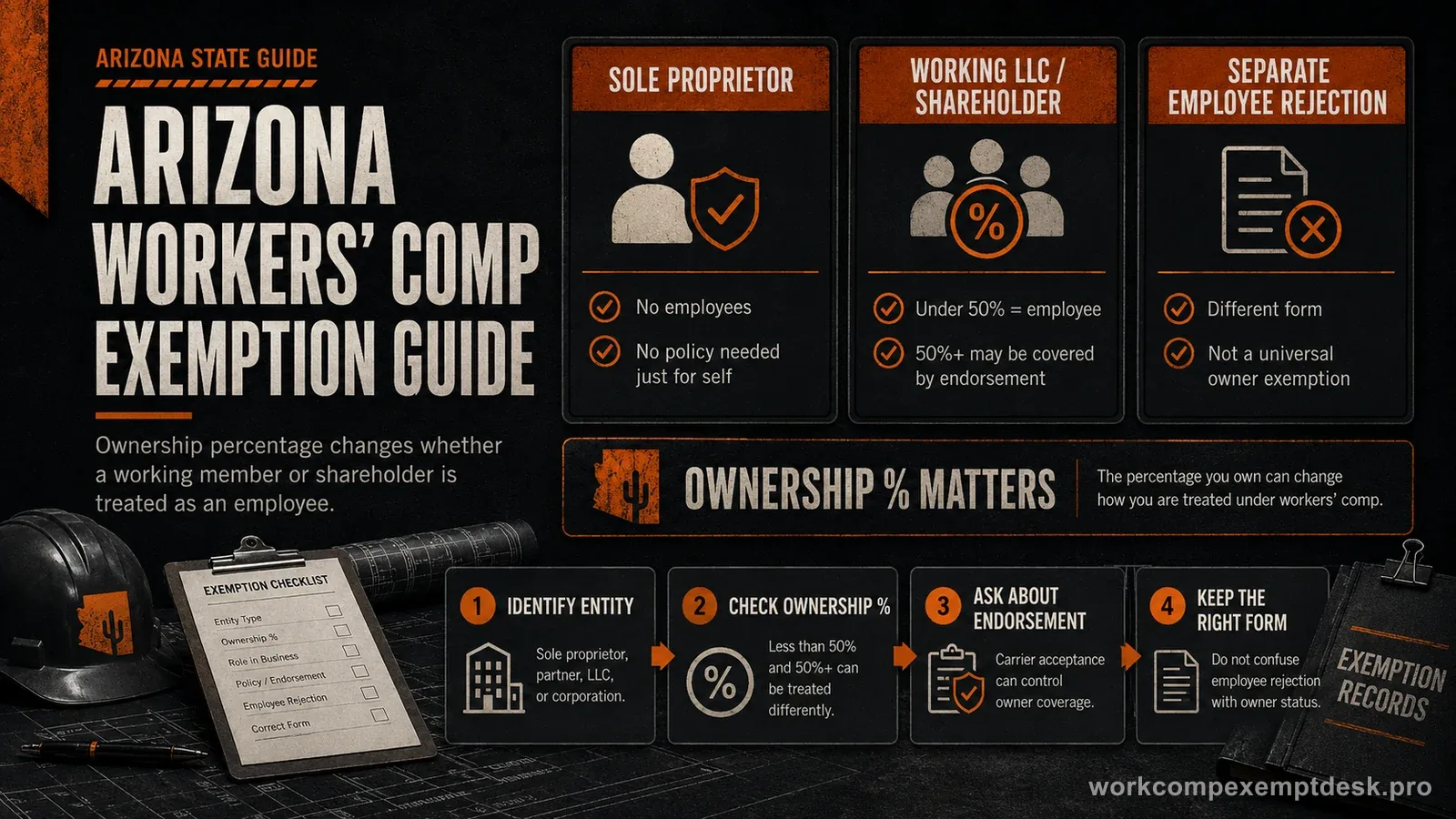
Arizona employers must secure workers’ compensation for employees. A sole proprietor with no employees does not need a policy solely for themself. A working partner or sole proprietor can elect personal coverage through carrier endorsement; a working LLC member or corporate shareholder with less than 50% ownership is an employee, while a 50%+ working member/shareholder can be covered through written carrier acceptance by endorsement. Arizona’s Employee Rejection of Terms form is a separate employee election, not a universal owner-exemption certificate.
Ownership types reviewed
- Sole proprietor
- LLC member
- Partner
- Corporate officer
Arizona’s owner rules turn on both entity type and ownership percentage. A sole proprietor with no employees is not required to insure themself, while a working LLC member or corporate shareholder who owns less than 50 percent is treated as an employee. At 50 percent or more, the working owner can be brought into workers’ compensation by a carrier endorsement. Arizona also has an employee rejection procedure, but that is a separate statutory election and should not be confused with owner status.
Arizona employers must secure workers’ compensation for employees. A sole proprietor with no employees does not need a policy solely for themself. A working partner or sole proprietor can elect personal coverage through carrier endorsement; a working LLC member or corporate shareholder with less than 50% ownership is an employee, while a 50%+ working member/shareholder can be covered through written carrier acceptance by endorsement. Arizona’s Employee Rejection of Terms form is a separate employee election, not a universal owner-exemption certificate.
Owner treatment, at a glance
Sole proprietorNo personal policy is required solely for a no-employee sole proprietor, although coverage may be elected. A narrow Sole Proprietor / Independent Contractor Statement exists for qualifying work performed for an insured employer and requires signatures from the proprietor and carrier.
LLC memberA working LLC member owning less than 50% is an employee. A working member owning 50% or more may be covered as an employee through written carrier acceptance by endorsement.
PartnerA working partner may be treated as an employee entitled to workers' compensation through written carrier acceptance by endorsement, at the carrier's discretion, under A.R.S. §23-901(6)(h).
Corporate officerTitle alone does not control the owner rule. A working shareholder below 50% is an employee; a working shareholder at 50% or more may be covered through written carrier acceptance by endorsement. Non-owner officers should be analyzed under the ordinary employee rules.
Arizona requires the employer to insure employees; owner status determines who is an employee
Arizona Revised Statutes §23-961 requires employers to secure workers’ compensation for their employees through an authorized carrier or approved self-insurance. The Industrial Commission’s employer guidance states the practical owner-only corollary: a sole proprietor with no employees is not required to maintain workers’ compensation solely on themself, but must insure employees once the business has them.
That means the threshold is not a multi-employee number such as three or four. The business should identify whether it has an employee under Arizona’s definitions. For an LLC or corporation, a working owner can be an employee based on ownership percentage, so the answer is not limited to people the company informally calls staff.
The correct first step is therefore to map every working person to the statutory category before deciding whether a carrier endorsement or other form is relevant.
The 50 percent ownership line changes the default for working LLC members and shareholders
Arizona’s employee definition includes a working LLC member who owns less than 50 percent of the membership interest. The same structure applies to a working corporate shareholder who owns less than 50 percent of the beneficial interest: that working owner is treated as an employee rather than outside coverage merely because they own part of the business.
At 50 percent or more, the default changes. A working LLC member with at least 50 percent can be treated as an employee entitled to benefits when the carrier gives written acceptance by endorsement to the member’s coverage application. Arizona uses parallel language for a working shareholder with at least 50 percent ownership.
That makes the ownership ledger and endorsement part of the insurance record. A 49 percent working member and a 51 percent working member can have different default treatment, so 'LLC owner' or 'shareholder' is not specific enough for a compliance decision.
Sole proprietors and working partners can elect coverage; the contractor statement is narrower
Arizona’s current employee definition allows a working partner to be treated as an employee through written carrier acceptance by endorsement, at the insurer’s discretion. It gives a sole proprietor a parallel personal-coverage election. The Industrial Commission also says a sole proprietor with no employees is not required to maintain workers’ compensation solely on themself; once the proprietor has employees, those employees must be covered.
Arizona also has a narrower Sole Proprietor / Independent Contractor Statement for a sole proprietor performing services for an employer that has workers’ compensation insurance. The Commission warns that the statement is only for the statutory situation permitted by A.R.S. §23-961 and is not valid until both the sole proprietor and the employer’s insurance carrier sign and date it.
That statement should not be generalized into a statewide owner-exemption certificate, and it does not replace the partner/sole-proprietor endorsement election in §23-901. It addresses a specific contractor relationship and does not excuse the proprietor from insuring any employees the proprietor has. Keep it with the contracting relationship rather than with a generic company 'exemption' file.
Employee rejection of Arizona workers’ compensation is a different election entirely
Arizona allows an employee to reject the provisions of the workers’ compensation law and retain common-law rights, but the Industrial Commission treats that as an employee election under A.R.S. §23-906—not as an owner exemption. The current Employee Rejection of Terms form must be completed in duplicate and delivered before a workplace injury, with the employer filing a copy with its carrier.
The distinction matters for a working minority owner. A working shareholder or LLC member who is an employee under the 50 percent rule does not become non-employee merely because the person has an ownership interest. If that employee separately uses the statutory rejection procedure, the business should preserve it as an employee rejection record, not rewrite the ownership analysis.
Likewise, an employer cannot require an employee to reject workers’ compensation as a condition of employment. The file should show a voluntary employee election and the carrier copy when that rare path is used.
Independent-contractor labels do not replace Arizona’s employment-status analysis
Arizona’s sole-proprietor statement is narrow precisely because contractor status has legal consequences. Section 23-961 limits when a carrier may assess premiums for a contractor alleged to be an employee and requires written findings applying the employment-status factors before the premium is assessed.
For a business hiring owner-operators or solo tradespeople, the practical lesson is not that a signed statement automatically proves independent-contractor status. The parties should preserve the contract, the owner’s business facts, any statutory statement actually applicable, and the carrier’s documentation. If the worker has employees of their own, those employees remain a separate workers’ compensation responsibility.
In construction, delivery, and field-service work, this file is often more important than an owner certificate because the dispute is usually whether the person was an employee of the hiring business—not whether the person owned a separate entity on paper.
Ownership percentages and the first employee are Arizona’s biggest reset points
A transfer of LLC membership interest or corporate stock can move a working owner across the 50 percent line. Because the default employee treatment changes at that line, update the workers’ compensation file when ownership changes rather than waiting until an injury or premium audit exposes the old percentage.
The first employee is the other major reset for a sole proprietor or owner-only entity. A proprietor who never needed a policy solely for themself must secure coverage for employees. For an LLC or corporation, also re-check whether the working owners themselves are employees under the current ownership percentages.
Keep the current ownership record, carrier endorsements, any employee rejection notice, and any sole-proprietor contractor statement as different documents serving different purposes. Arizona has several elections, but none should be treated as a universal certificate that makes the business exempt from workers’ compensation.
What failing to secure coverage actually costs in Arizona
Arizona's penalty escalates sharply on repeat offenses and strips the employer of its own legal protections during the gap, on top of a separate injunction that can shut the business down entirely.
The Industrial Commission can assess a civil penalty of $1,000 if it awards a noncompensable claim against an uninsured employer, or up to $1,000 by separate order simply for being uninsured. If the employer has already been penalized once in the previous five years, a second failure to secure coverage can draw up to $5,000, and a third or later failure up to $10,000.
Separately, the Commission can apply to court for an injunction shutting the business down until coverage is obtained. An employer who fails to comply with the coverage statutes also loses the Act's benefits and defenses during the period of noncompliance — including the exclusive-remedy protection — and can be sued directly by an injured worker under ordinary civil liability rules.
- First penalty: up to $1,000 (per noncompensable-claim award or by separate order for being uninsured)
- Second failure within 5 years: up to $5,000; third or later: up to $10,000
- Industrial Commission may seek a court injunction closing the business until coverage is secured
- Employer loses exclusive-remedy protection and other Act defenses during the uninsured period
Arizona owner checklist
- Identify every working owner’s entity type and current ownership percentage before deciding employee status.
- Treat working LLC members/shareholders below 50% as employees under the current Arizona rule; for 50%+ owners, verify any carrier endorsement electing coverage.
- For a sole proprietor or working partner, distinguish the carrier-endorsement election for personal coverage from the narrower sole-proprietor contractor statement.
- Do not confuse the Employee Rejection of Terms procedure with an owner exemption.
- Preserve contractor-classification evidence instead of relying on a 1099 label or ownership document alone.
- Re-check after ownership crosses the 50% line or the business hires its first employee.
Form, fee, and timing summary
Cross-checked against Industrial Commission of Arizona / workers’ compensation carrier and verified 2026-09-10. This restates the state forms reference; the state agency remains the authority.
Coverage ruleArizona employers must secure workers' compensation for employees. A sole proprietor with no employees is not required to maintain coverage solely for themself; LLC members and corporate shareholders can be employees based on working status and ownership percentage.
Construction ruleThe cited sources do not set a separate construction employee-count threshold. Contractor/independent-contractor classification and the narrow sole-proprietor statement under A.R.S. §23-961 can affect who is treated as an employee, but do not excuse coverage for a sole proprietor's own employees.
DocumentNo universal owner-exemption filing; the rule is statutory or policy-based
Issuing bodyIndustrial Commission of Arizona / workers’ compensation carrier
Filing methodNo universal owner-exemption certificate. A.R.S. §23-961 provides (in a subsection recodified over time) a signed sole-proprietor waiver a sole proprietor can give the hiring business/insurer in the stated context; other inclusion/exclusion is handled by carrier endorsement.
FeeNo separate filing fee verified
NoteThe ICA sole-proprietor/independent-contractor statement is a relationship/classification document, not a universal owner exemption. Under that provision, a business using a sole proprietor who has waived workers' comp rights is not liable for that sole proprietor's coverage or premiums.
EffectiveCarrier endorsement controls any elective personal coverage; the §23-961 sole-proprietor waiver applies as stated in the statute; statutory exclusions do not wait for an exemption certificate.
RenewalTied to the policy/endorsement, the signed waiver, and ownership status; no universal state-form renewal interval.
Watch out forThe sole-proprietor/independent-contractor statement is not a universal owner exemption certificate.
Open the official source Open the state filing form Compare renewal rules across states Run the eligibility screener
Agency in charge
Industrial Commission of Arizona
Official source library
These are the state-agency, statutory, or state-board materials used for this guide. The page was last source-checked on 2026-08-25.
- Arizona Revised Statutes §23-961 — Securing Compensation / Sole Proprietor Statement
- Arizona Revised Statutes §23-906 — Employee Rejection
- Industrial Commission of Arizona — Sole Proprietor / Independent Contractor Statement
- Industrial Commission of Arizona — Employee Rejection of Terms
- Arizona owner / entity workers' compensation FAQ
- Arizona Revised Statutes §23-901 — Working partners, sole proprietors, LLC members and shareholders
Arizona workers' comp exemption FAQ
- Does a sole proprietor need workers' comp coverage in Arizona?
- No personal policy is required solely for a no-employee sole proprietor, although coverage may be elected. A narrow Sole Proprietor / Independent Contractor Statement exists for qualifying work performed for an insured employer and requires signatures from the proprietor and carrier.
- Can an LLC member get a workers' comp exemption in Arizona?
- A working LLC member owning less than 50% is an employee. A working member owning 50% or more may be covered as an employee through written carrier acceptance by endorsement.
- How does a corporate officer opt out of workers' comp in Arizona?
- Title alone does not control the owner rule. A working shareholder below 50% is an employee; a working shareholder at 50% or more may be covered through written carrier acceptance by endorsement. Non-owner officers should be analyzed under the ordinary employee rules.
- Are partners covered by workers' comp in Arizona?
- A working partner may be treated as an employee entitled to workers' compensation through written carrier acceptance by endorsement, at the carrier's discretion, under A.R.S. §23-901(6)(h).
- What form is used for a Arizona workers' comp owner exemption?
- No universal owner-exemption certificate. Relevant documents include carrier endorsements for qualifying 50%+ working owners, the narrow Sole Proprietor / Independent Contractor Statement, and the separate Employee Rejection of Terms form under A.R.S. §23-906.. No fixed statewide owner-exemption certificate cycle is stated in the cited sources. Carrier endorsements and ownership percentages should be re-checked at policy renewal and after ownership changes; employee rejection remains a separate statutory election.
Answers restate the sourced fields above. Open the official source library for the underlying agency and statute pages.